

The Cockroaches of Railways | Part 10: Minister Must Urgently Review Conduct, Character & Competence Across Key Railway Bodies
The railway has stopped posting competence and expertise where it needs them most
A note made by a decorated and respected senior retired officer on the CBI trap cases of July and August 2026, prepared on your editor’s observations at his request. No individual is named. Designations only as we need to analyse the root of the rot.
1. Twenty eight days, twelve cases
We gave following table to the expert to elicit his views. Between 23 July and 19 August 2026, the CBI acted twelve times against Indian Railways establishments. Six zones and one PSU. Seven traps. ₹77 lakh recovered from one officer’s premises alone.
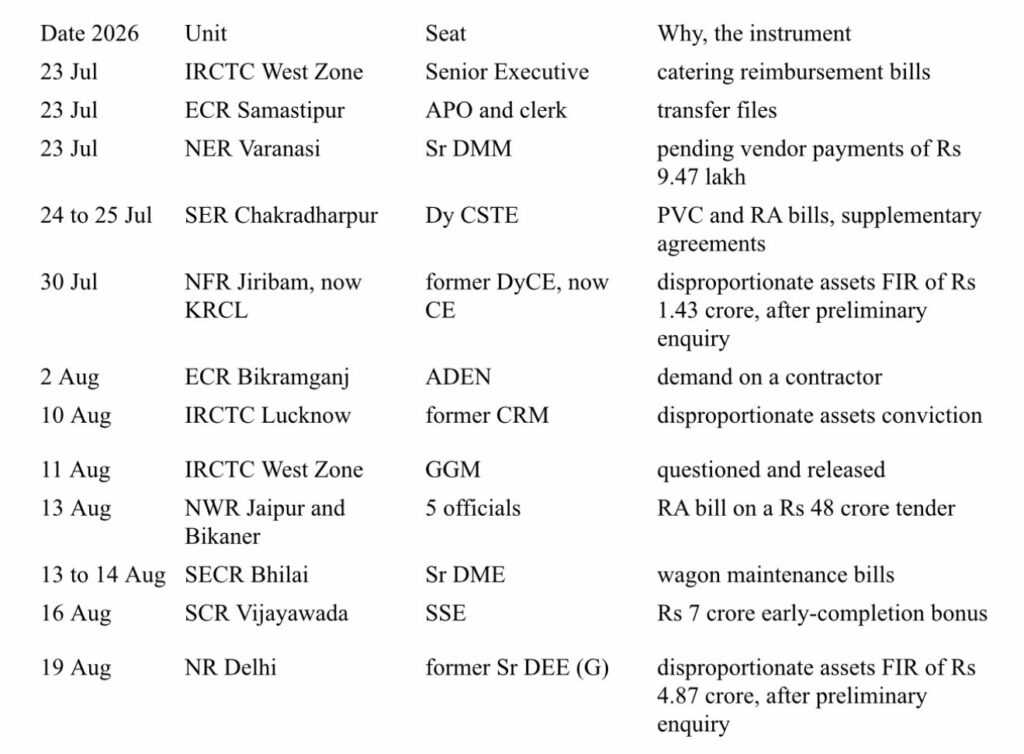
Read the fourth column. The instrument is never the #tender. It is the #payment: “the bill already passed for work already done. That is where a #vendor bleeds, and that is where a vendor complains”.
The two disproportionate assets (#DA) cases are not traps. The #CBI registered both after a preliminary enquiry. The pattern they reflect is the same: “the bill release stage”.
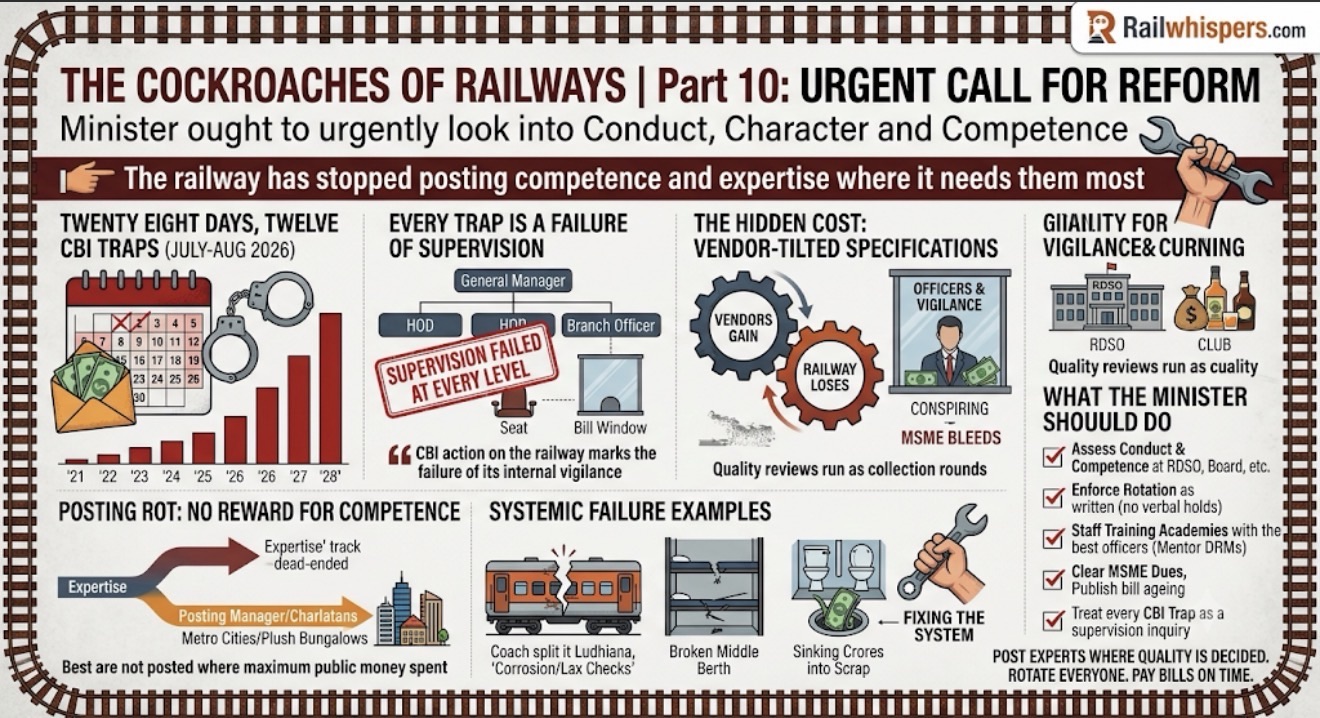
2. Every trap is a failure of supervision
A trap is an outside agency doing an inside job. Each seat in the table has a supervisor, a branch officer, a head of department and a General Manager above it. A bill does not stall for months in secret. The file sits in a register that three levels are paid to read.
Not one of the twelve actions began inside the railway. No divisional vigilance report, no zonal vigilance trap, no departmental charge sheet preceded any of them. The complainant went to the CBI because the supervisory chain was not worth complaining to. The site has held this position for years: “CBI action on the railway marks the failure of its internal vigilance”. (17 Dec 2023, “Railway Vigilance: Unveiling a Corrupt and Collapsing System”).
The conclusion is uncomfortable and unavoidable. The CBI’s trap register has become the railway’s supervision register. When the outside agency knows a seat’s price and the supervisor does not, supervision has failed at every level above that seat.
3. What the case list cannot see
The case list has a blind spot, and it matters more than the list. Every case sits at the bill window because that is the one stage with a complainant. A vendor whose money is stuck will complain. Complaints at the specification stage get managed in a more sophisticated manner, because there the vendor gains and only the railway loses. This is where incumbent vendors increase entrenchment.
So the traps undercount the costlier corruption: “the framing of specifications, the setting of eligibility criteria, the generation of demand”.
That stage is where officers and vigilance officers often conspire. This is the invited expert’s observation from long years of serving the Indian Railways. It is also where incompetence becomes an open door. An officer who does not command the subject cannot detect a vendor-tilted clause, and cannot defend a railway-tilted one. The specification then serves the vendor, not the railway (“The Cockroaches of Rail Bhawan | Part 7: Who Does the Railway Ask?” 18 August 2026).
The RDSO expose sharpens the question. Whistleblower input alleges a wagon component manufacturer financed the officers’ club revamp and the costly alcohol in the bar, near the time of #coupler approvals. The same input alleges quality reviews now run as collection rounds. If that is the conduct alleged of the principal heads of directorates, how can those chairs be trusted with lakhs of crore of investment? They cannot, unless the posting policy puts experts of proven character in them. The argument circles back to expertise.
Minister ought to urgently look in to conduct, character and competence of second in command of #RDSO (13 June 2026, “विशेष रिपोर्ट: आरडीएसओ में प्रशासनिक अराजकता और उत्पीड़न”, heads of wagon and electric locomotive directorates. “Continued failure to do so will take stink to the political leadership’s door step”.
4. The crisis is cultural, and the cause is the posting policy: “no reward for competence & expertise”
Why does the man on the seat let it rot? Because nothing in his career rewards setting it straight. That is the premise of this note. When experts are not posted at the Training Academies, RDSO, the Production Units and the Railway Board, competence carries no premium. An officer then adopts the traits that keep one posting in one location, without #rotation. The traits that keep an officer in one seat are the traits the traps now catch.
The record shows the selection working in reverse. RDSO and the Production Units shape purchase decisions of about ₹70,000 crore a year. CLW alone spends about ₹10,000 crore a year. The cadre treats it as a punishment posting. In August 2026 two Presidential transfer orders to CLW were defeated, for officers with about 24 years each in one zone. One stands verbally withheld, one was cancelled (“Compromising the Cadre: How Railway Board Orders Face Verbal Holds and Quiet Cancellations” 21 August 2026). If you cannot post your best where maximum pubic money is spent, why to spend money at all?
Hold the two facts together. The seats that decide “70,000 crore of #quality go begging—who will leave Chennai and Mumbai for Chittaranjan? A system that punishes the upright and rewards the entrenched will produce these cases endemically. No enforcement drive can outrun a posting policy. Do you know that one can retain their plush bungalow in their earlier place of posting even if they get transferred to placed like Jaipur or Hajipur! Even officers who get promoted to Level 16 and 17, the terminal posting of career, they still retain for years their bungalows and large flats in metros-where they were posted last. This is what ‘quality’ management in Indian Railways is now reduced to. Damn the #product-quality or #service-quality or #decision making-quality that poor Prime Minister pleads for.
Those who can manage, well manage. Take the case of one RDSO officer. In a bid to remain in Lucknow, he got his order for ADRM Izzatnagar cancelled and went on paid study leave. He then managed a 5-year posting at IRITM, Lucknow. A training academy was reduced to a parking lot.
Sources: “ACC Hoodwinked—सरकार किसी की भी हो, सिस्टम हमारा है और हमेशा रहेगा!” 9 February 2026, with “अंधेर नगरी के चौपट निर्णय!”, and the X thread of 4 February 2025–
We will discuss the posting rot in the training academies separately. The academies produce the future leaders, who begin by working closest to the ground. It is no wonder that it is young officers who are being trapped by the CBI. If the trainers are posting managers and known charlatans, what would the trainees learn? How can government salaries be wasted on such officers?
5. What it costs when nobody competent minds the shop
Three exhibits, all from the railway’s own record.
On 6 June 2026 a coach split in two at Ludhiana, at a standing start, with about 500 passengers behind it. The Railway Board’s own letter names heavy corrosion. It admits that the laid-down checks of headstock, sole bar and lavatory were not followed. Source: “A Coach Broke in Two—The Real Crack Is in Rail Bhavan” 8 June 2026.
On 21 August 2026 a middle berth broke and fell on the passenger below, on train 15657, coach no. S1. The zone repaired the seat at the next station and regretted the inconvenience. Source: the @truth_on_track post — https://x.com/truth_on_track/status/2090722095311573344 – of 21 August 2026. The berth is the coach in miniature. The routine that should have caught both was not run.
In May 2025 the Board allocated toilet upgrades across about 25,480 coaches under the Rolling Stock Programme. On 23 July 2026, letter 2019/M(C)/202/1CORONA gave #PCMEs full powers to condemn #ICF and hybrid coaches of 13 years and above. Fourteen months separate the two decisions. Money was poured into stock the Board then cleared for scrap. (“Sinking Crores Into Scrap: How RlyBd’s Cosmetic Retrofit Drive Gave Way To Mass Condemnation of Rusted Coaches” 22 August 2026), and the author’s X thread of 21 August 2026–
The problem is structural. Empire building cannot focus on the nuances that engineering demands. Today the modern electronics of train sets sit with chamber ‘A’ of the bio toilets. So do high-voltage and high-energy power electronics, and hydrogen fuel cells. It is no less a wonder that, after almost 70 years of running ICF coaches, side buffers cannot be maintained in #NMG rakes today. They have become reason number 1 for NMG derailments.
An umbrella of ₹6,000 crore for Vande Bharat maintenance is set to go to the manufacturers, creating a multi-generational rental income. So it is not a problem of money. It is a problem of having the right people who can say no and put the interest of the railway ahead of vendor interest. But how are the persons who man the gate chosen and trained? At least not on competence and expertise.
6. The shadow on the Prime Minister’s vision
The Prime Minister’s exhortation of 15 August 2026 asks Indian manufacturing to become obsessed with quality, and asks the state to stand behind its #MSMEs. Both legs of that vision run through the railway, the country’s largest buyer.
Both legs are compromised here. #Quality is decided at #RDSO, the Production Units and the Board, the three places the posting policy staffs worst. And the #MSME leg bleeds at the bill window. The Ministry of Railways holds the largest pending MSE dues of any central ministry on the MSME Samadhaan portal: ₹83.55 crore across 100 cases. A small vendor who waits months for lawful money, and then pays a toll to get it, is not being supported. He is being farmed.
With record capital flowing, an investor, a vendor or an honest officer now reads the field the same way. Rules exist and are not enforced. Orders issue and are verbally held. Money moves and supervision does not. The expert’s phrase for it is blunt: Indian Railways today appears to be the wild west.
7. What the Minister should do
- Call the officers posted at Training academies, RDSO, the Production Units and the Railway Board. Ask each one three questions. Why are you here. What is your research aptitude. Have you the moral courage to fail a big vendor?
- Enforce rotation as written. Relieve every officer under Presidential transfer orders within the mandated period. Require any hold to be written and signed, never verbal.
- Staff the training academies with the best officers, as recruitment restarts. Attach a high-credibility mentor, serving or retired, to every DRM.
- Clear the MSE dues, and publish the ageing of railway bills every quarter. A paid bill removes the tollgate’s hold. Abort policies which go against MSME participation.
- Treat every CBI trap as a supervision inquiry. For each of the twelve cases, ask which supervisor, branch officer and HOD sat above the seat. Ask what they knew.
The cure is not another drive. It is the dull, permanent kind. Post experts where quality is decided. Rotate everyone. Pay bills on time. Make the seat worth less than the career.
Further reads
The observations in this note are not new to the site. Readers may like to read:
- 22 Aug 2026: The Cockroaches of Railways | Part 9–Lesson: Swachchhata is Antidote to the Cockroaches
- 21 Aug 2026: The Cockroaches of Rail Bhawan | Part 8: Quietly Built to Fail, and Against the Prime Minister’s Advice
- 21 Aug 2026: Compromising the Cadre: How Railway Board Orders Face Verbal Holds and Quiet Cancellations
- 18 Aug 2026: The Cockroaches of Rail Bhawan | Part 7: Who Does the Railway Ask?
- 17 Aug 2026: The Cockroaches of Rail Bhawan | Part 6: Read the Passenger List
- 17 Aug 2026: CBI Traps SCR Engineer Accepting ₹15 Lakh Bribe in ₹7 Crore Bonus Manipulation Racket
- 15 Aug 2026: CBI Books NWR Officials and Private Firm in Multi-Crore Bribery-for-Bills Racket
- 10 Aug 2026: The Cockroaches of Rail Bhawan | Part 5: Who Pays, Who Runs It
- 9 Aug 2026: The Cockroaches of Rail Bhawan | Part 4: Feeding the Cockroaches
- 8 Aug 2026: The Cockroaches of Rail Bhawan | Part 3: Six Times Asked, Four Times Refused
- 7 Aug 2026: The Cockroaches of Rail Bhawan | Part-2: Fourteen Reversals and One Survivor
- 6 Aug 2026: The Cockroaches of Rail Bhawan | Part-1: Read the Last Column
- 25 Jul 2026: CBI’s Massive Multi-City Crackdown Uncovers Deep Graft in Indian Railways
- 24 Jul 2026: RAIL CRISIS: 40 MSME Track Component Manufacturers Launch Nationwide Strike Against Railway Board
- 8 Jun 2026: A Coach Broke in Two—The Real Crack Is in Rail Bhavan
- 10 Mar 2026: A CBI Trap in Central Railway—GM & SDGM in Dock
- 9 Feb 2026: ACC Hoodwinked—सरकार किसी की भी हो, सिस्टम हमारा है और हमेशा रहेगा!
- 1 Jul 2025: अंधेर नगरी के चौपट निर्णय !
- 7 Jan 2025: Terror of Unaccounted Vigilance, Part-IV : “Paving Road to Perdition!”
- 17 Dec 2024: Modi ji, incompetence and corruption must be dismantled from the Railways
- 4 Nov 2024: The trap of young IRAS officer: Is it by Design or Conspiracy?
- 17 Dec 2023: Railway Vigilance: Unveiling a Corrupt and Collapsing System
- 5 Oct 2023: Wither RDSO !
- 21 Sep 2023: To New CRB: Act on rules and bring transparency!
- 21 Jul 2023: The making of panel and posting of DRMs is against the Art. 14 & i.e. equality before law