

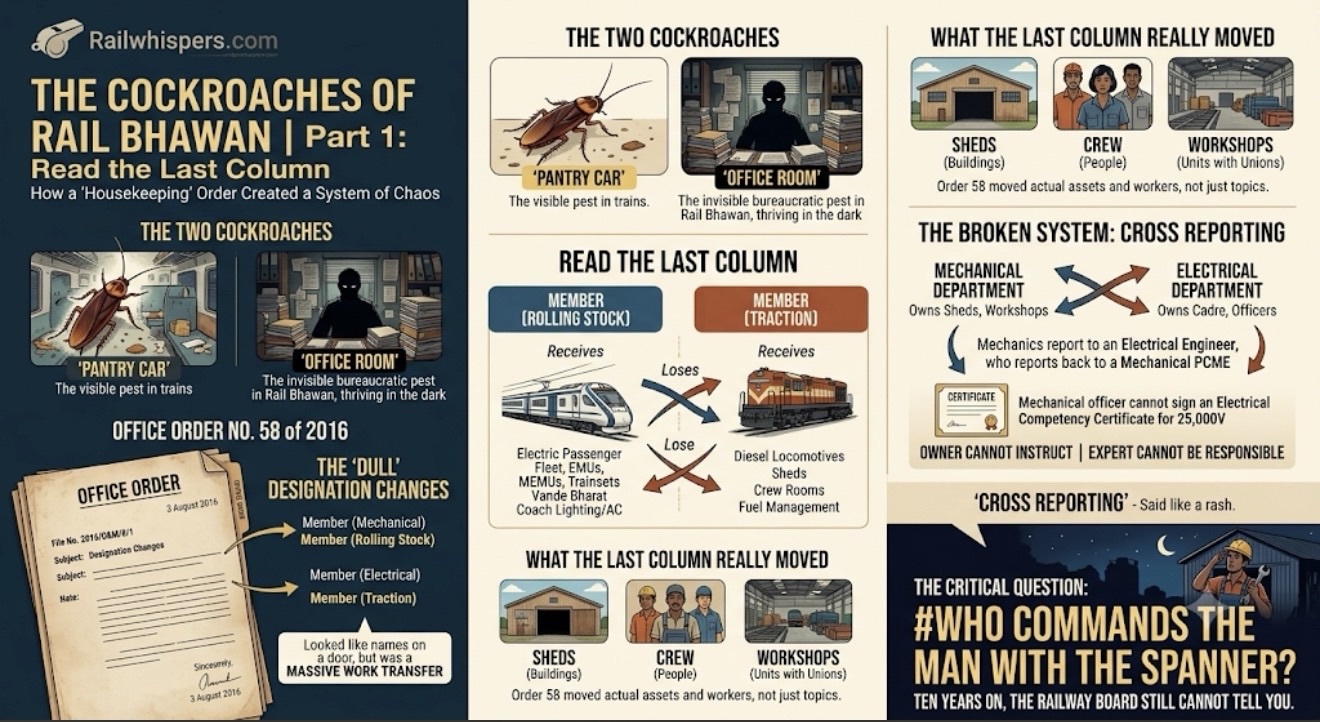
The Cockroaches of Rail Bhawan | Part-1: Read the Last Column
Indian Railways does not reorganise itself in public. It does it in office orders. Numbered, dated, two pages long, signed by a Joint Secretary, and filed to a folder on a website that the railway’s own officers struggle to find. Each order is small. Each order is lawful. Read one and you learn nothing. Read them in sequence, across eleven years, and you watch one department grow and grow, while nobody in Rail Bhawan ever writes the word expansion. This series reads them in sequence—
First, about that title. I mean it twice over.
Anyone who has taken a long distance train in this country knows the first meaning. The #cockroach in the pantry car and even in all the coaches. The rat that runs along the corridor at three in the morning. And lately, the snake, which the railway would very much prefer you did not photograph.
There is a department responsible for that. It has a directorate, a duty list, an Additional Member and eleven years of orders behind it. In Part 4 I will show you what that department has been doing instead, and you will find it hard to believe it is in the same job description.
Now the second meaning.
There is another kind of cockroach in this story, and he does not live in the pantry car. He lives in Rail Bhawan. He has a job that no order ever created, in a room that no organisation chart shows, doing work that every department nearby believes belongs to someone else. He has outlasted Chairmen, Cabinet decisions and gazette notifications. He will outlast this article.
The two have more in common than the coincidence of a word. Both thrive in the dark. Both are extremely hard to find. And both have survived every campaign ever launched to be rid of them, because the campaign was announced in a press release and the survival was arranged in a file.
Here is the irony this series is built on. Indian Railways spends a great deal of money to exterminate the first kind. Over eleven years, by office order, it has been quietly feeding the second.
I am going to show you how, and I am going to do it without a single anonymous source. Just office orders. Each one named, dated, and with a note on where I found it, because finding them turned out to be the story.
Let us begin with the one that started it.
An order about two names
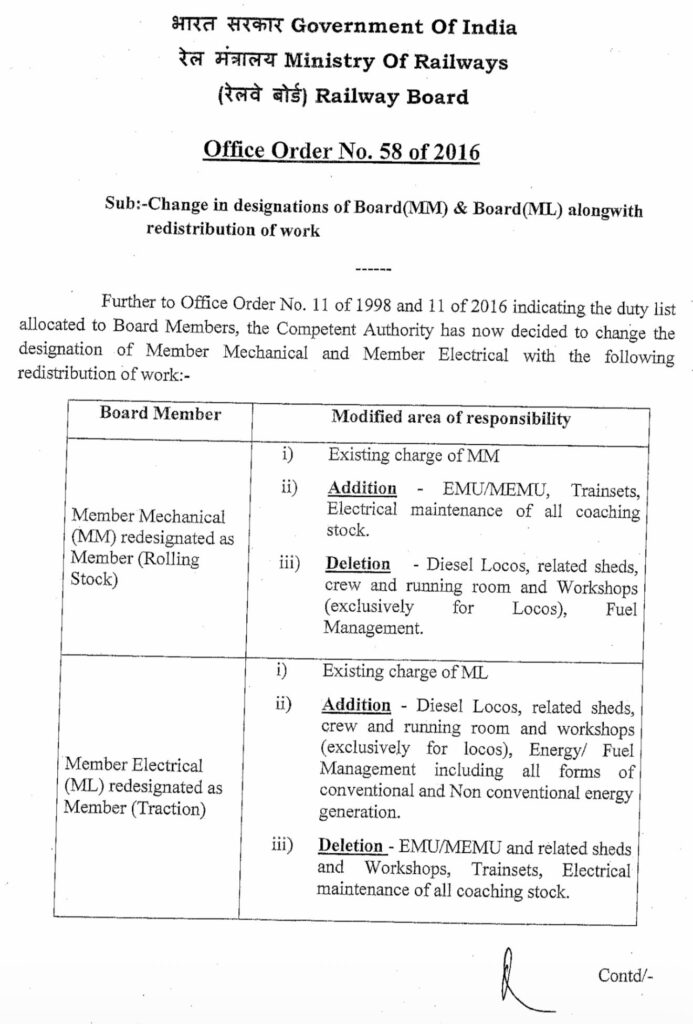
On 3 August 2016 the Secretary of the Railway Board, R. K. Verma, signed Office Order No. 58 of 2016. File number 2016/O&M/8/1. Two pages. The subject line is as dull as the railway’s file room can make it: “Change in designations of Board (MM) & Board (ML) alongwith redistribution of work.”
Read that and you would file it, and I would not blame you for a moment. Two Board Members were being renamed. Member Mechanical would now be Member (Rolling Stock), Member Electrical would now be Member (Traction), and if you have ever sat through a designation change in a government office you will know how little one usually means. A housekeeping order. Names on a door.
This one was the largest transfer of work inside Indian Railways in thirty years, and it was done in a table.
The last column is where the bodies are
The order has two columns. The second one lists, for each Member, what is added to his charge and what is deleted from it. Everyone who has argued about this order for the last ten years has argued about the first few words of that column. Almost nobody has read to the end of it.
To Member (Rolling Stock), the mechanical man, it added: EMU and MEMU, trainsets, and the electrical maintenance of all coaching stock. In plain words, the electric passenger fleet. The suburban trains of Mumbai and Chennai, the Vande Bharat that came later, and the wiring, the air conditioning and the lighting of every coach on the system.
From him it deleted: “diesel locomotives, their related sheds, crew and running rooms, and the workshops exclusively for locomotives, and fuel management.”
To Member (Traction), the electrical man, it added exactly what the other lost, in the same words. And it deleted from him the EMU and MEMU sheds and workshops, the trainsets, and the coach electrical work.
Now read those bold words again.
A shed is not a subject. It is a building, with a pit, a crane, a store and a night shift. A running room is where a crew sleeps between trips. Crew are men. A workshop has a sanctioned strength, a wage bill and a union.
Office Order 58 did not move a list of topics between two officers in Delhi. It moved buildings and it moved people. That is why it matters, and that is the thing the ten year argument has mostly missed.
What clause 3 kept behind
Here is the part that turns an aggressive reorganisation into a broken one.
Having moved the sheds, the order then went out of its way to leave the men where they were.
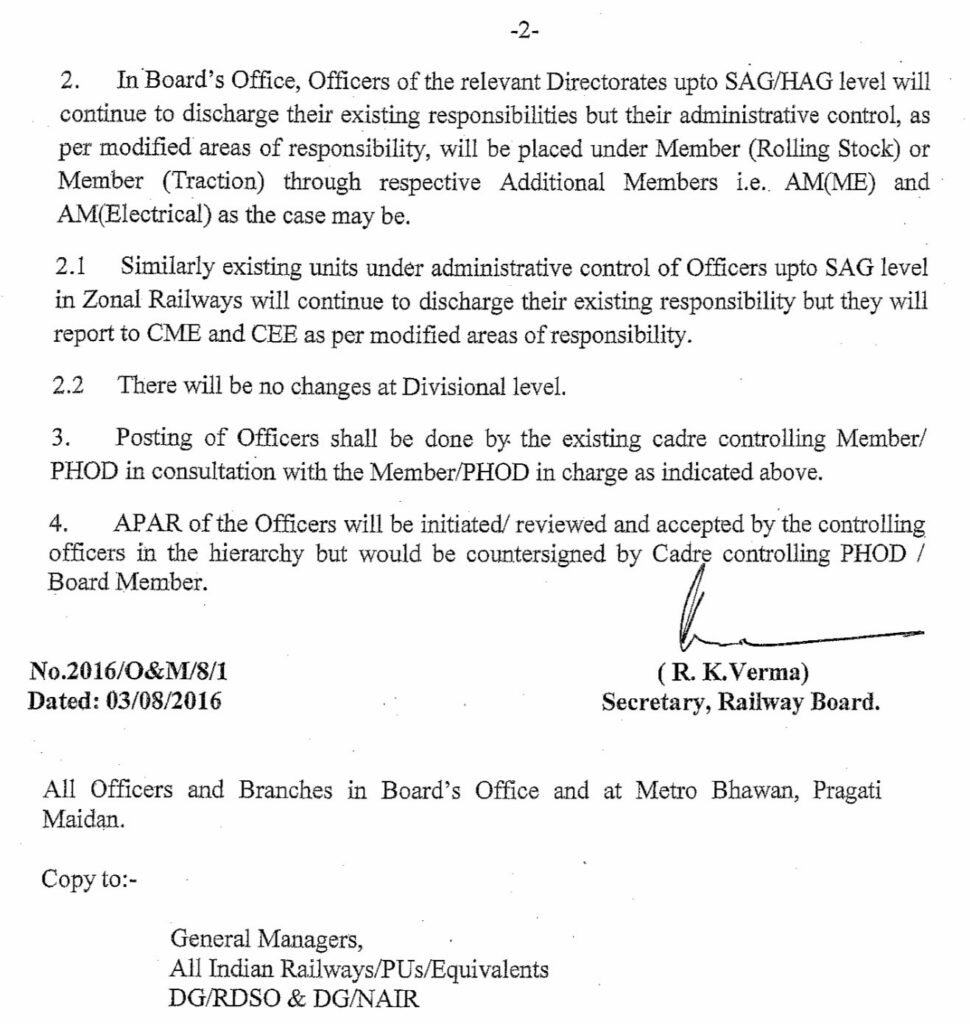
Clause 2 said that in the Board’s own office, officers up to Senior Administrative Grade (#SAG) and Higher Administrative Grade (#HAG) keep their existing responsibilities. Clause 2.1 said the same for the zonal railways. Clause 2.2 is a single sentence: “There will be no changes at Divisional level.” Eight words.
And then clause 3, which is the one to remember. Posting of officers stays with the existing cadre controlling Member or head of department. Clause 4 adds that the annual performance appraisal report (#APAR) continues to be countersigned in the old chain.
So the mechanical department got the EMU shed. The electrical department kept the officer in it, kept the power to post him, and kept the power to write his confidential report.
Three years later the Board wrote this design down in black and white. Its letter 2019/O&M/8/3 of 18 July 2019 says EMU and MEMU work is done by electrical officers, under the Chief Electrical General Engineer or his equivalent, reporting to the Principal Chief Mechanical Engineer (#PCME). Diesel locomotives are done by mechanical officers under the Chief Motive Power Engineer (Diesel), reporting to the Principal Chief Electrical Engineer (#PCEE).
Each department now supervises the other’s men. In Rail Bhawan they have a word for it. They call it ‘cross reporting’, and they say it the way you would say a rash.
The railway says so itself
You do not have to take my word that this is a problem. Take the Additional Member for Traction’s.
On 31 July 2025, in a note to the Chairman numbered 2025/AM Tr./O01, he demanded that the cross reporting system be scrapped at all levels. That is a Board level officer telling the head of the organisation that the arrangement his own Board has run for nine years does not work.
I will come to what happened to that note in Part 3, where it sits with the rest of this fight.
Now the fair bit
Let me put the other side, because it is a serious one and this series will not be worth reading if I skip it.
The principle behind Office Order 58 was sound. One asset, one manager. A train is one machine, and splitting it between two departments at the top produces exactly the buck passing that the travelling public has complained about for decades. Every railway system in the world wrestles with this. Somebody in 2016 tried to solve it, and trying was not a crime.
The problem is not the ambition. The problem is that the order did half the job.
You may move the asset. You may move the cadre. Doing both is a reform. Doing neither is the status quo. Doing the first and not the second is the worst of the three, because you have created an owner who cannot instruct and an expert who cannot be held responsible.
And there is a practical edge to this that has nothing to do with organisation charts. An electric multiple unit runs on twenty five thousand volts. The men who work on it carry a competency certificate, and that certificate is issued by a designated electrical engineer. This is the point the All India Railwaymen’s Federation made in its long submission on the subject, set out in “Cadre Control/Manpower Management of Mechanical & Electrical Staff“, 23 January 2021. A mechanical officer does not sign it. He cannot.
So the department that owns the shed cannot certify the man who works in it.
The question this series will keep asking
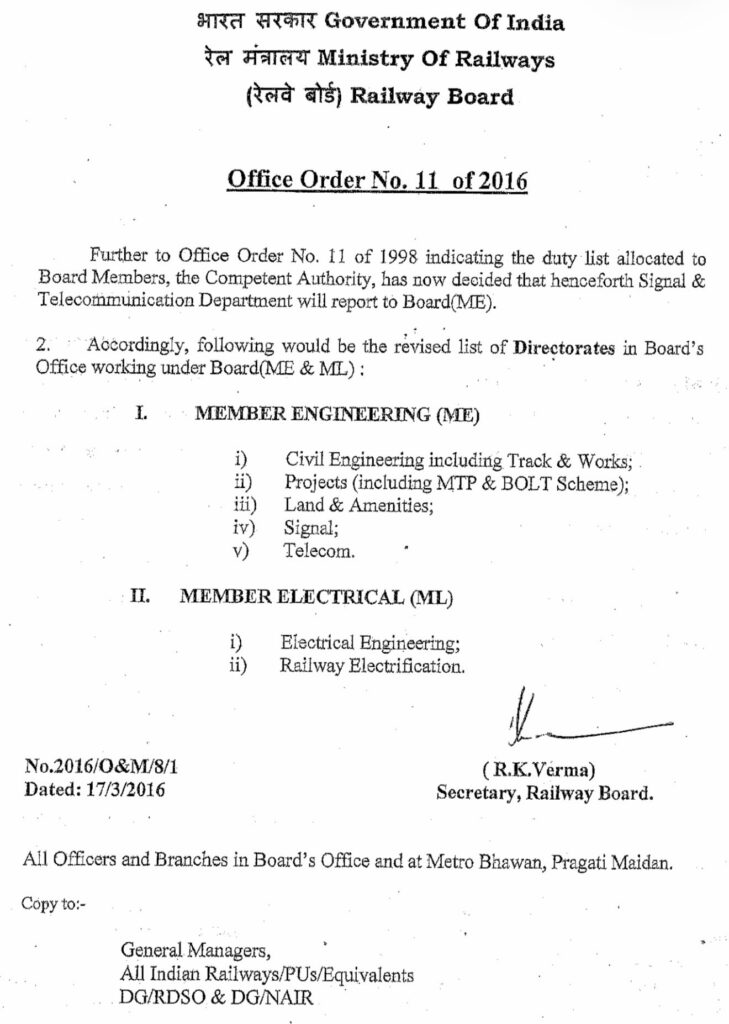
Office Order 58 of 2016 has never been amended. Not once in ten years. In Part 2 I will show you what else the same Railway Board did to itself in the same decade, and how much of it was torn up, and how quickly, which makes the survival of this one order rather more interesting than it looks.
For now I will leave you with the question that every part of this series is going to end with, in one form or another. It is the only question that matters in a railway shed at two in the morning, when a fitter is standing in front of a machine he has been told is not his department’s problem.
Who commands the man with the spanner?
Ten years on, the Railway Board still cannot tell you.