

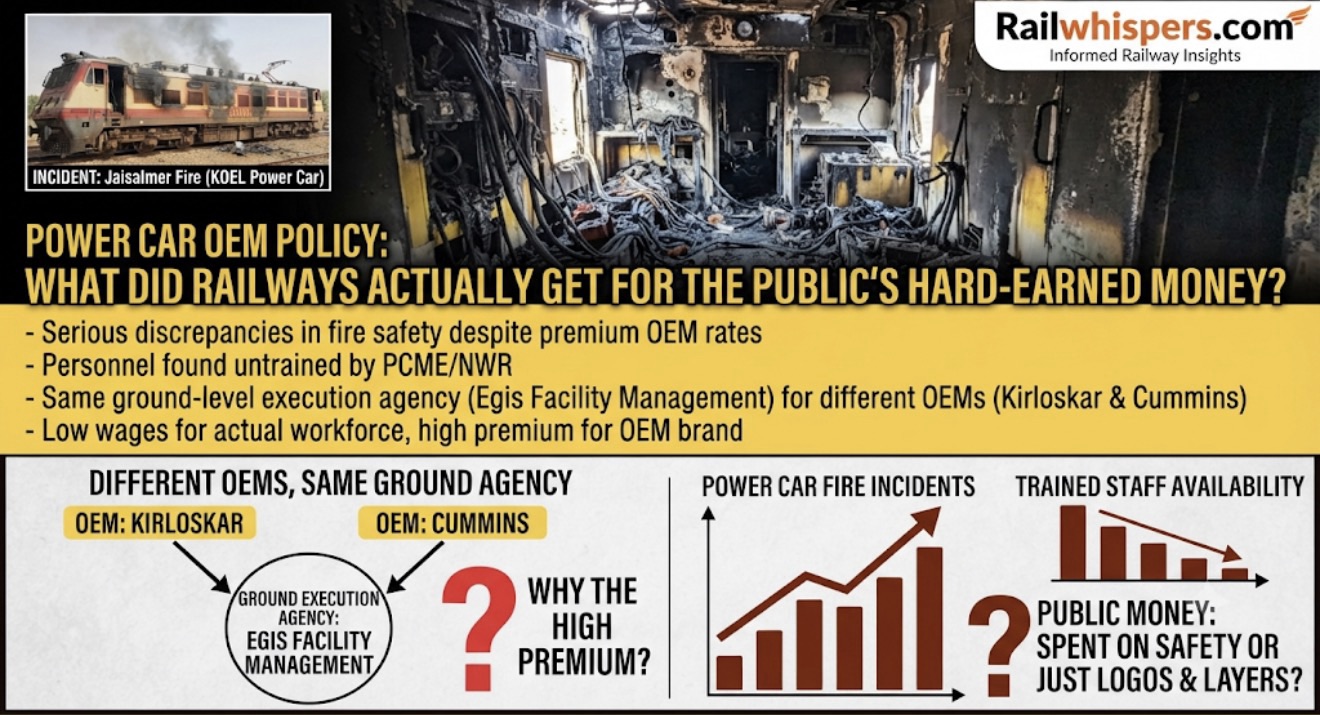
‘OEM Only Policy’ for Power Cars: What Did We Actually Get in Return for the Public’s Hard-Earned Money?
Public money should not be spent on OEM logos and contracting layers, but on better safety and reliability
It has now become necessary to raise serious questions regarding the ‘OEM-only policy’ of Indian Railways for power car escorting and maintenance. The rationale for paying premium rates to OEMs and limiting competition can only be justified if it provides the railways with better service and safety, enhanced reliability, and specialized OEM expertise. However, ground realities are telling a completely different story.
On July 29, 2026, a serious fire incident occurred in power car no. 251071 in Jaisalmer. North Western Railway (#NWR) termed it a “very serious incident of fire” in its official letter. Even more alarming is the fact that after speaking with the authorized OEM employee, PCME/NWR recorded that the concerned personnel “were not properly trained.” The railways also noted severe discrepancies in maintenance quality, fire safety procedures, and operational vigilance.
This means that despite paying premium rates—meaning arbitrary, high charges—to the OEM, the railways were forced to instruct their officials after the incident to verify the ITI qualifications, training, technical competency, and OEM competency certificates of the personnel deployed on the power cars.
OEMs Different, but Ground Agency the Same?
This raises the biggest question here:
In Jaisalmer/Jodhpur, the involvement of another company, Egis Facility Management, has been reported in the maintenance/escorting of Kirloskar power cars. Meanwhile, the branding of Egis Facility Management has also appeared in the recruitment of operator and maintenance staff for Cummins power cars in Santragachi. Recruitment advertisements showed monthly salaries of ₹23,000 for ‘freshers’ and ₹26,000 + benefits for experienced staff.
While it is true that low wages do not inherently make an employee unqualified, the policy issue is entirely different:
If Kirloskar or Cummins—regardless of the brand—relies on the same facility management agency for ground-level manpower and execution, then why is the railways paying such a heavy premium to the OEMs for specialized services?
When the name of the OEM changes, but the execution agency remains the same, what is the technical and financial justification for ‘OEM exclusivity’?
Isn’t this turning into a system akin to the “looting/distribution” of the public’s hard-earned money?
Without a complete financial trail, labeling any such distribution as a definitive fact would not be appropriate. However, field conditions certainly create the basis for asking this question.
The railways award contracts at premium rates to OEMs. Beneath the OEM, a facility management agency appears to handle the execution. The same agency recruits manpower at relatively very low monthly wages. Yet, after a major fire breaks out, the railways discover that the hired personnel were not properly trained.
So where is the extra premium paid from the public’s hard-earned money actually going, and what did the railways get in return?
If the objective of paying premium rates was to secure ‘OEM-level expertise’, its outcome should have been visible in the form of fewer fire incidents, fewer failures, better availability, and improved safety.
Now the Policy Must Be Audited
The railways should conduct an independent financial and technical audit of this ‘OEM-only policy’ focusing strictly on four aspects:
- Old competitive rates versus new OEM rates
- Funds paid by the railways to the OEM versus downstream execution costs
- The actual improvements in reliability and safety in exchange for power car fire/failure rates
- Premium expenditures before and after the policy
If the data proves that safety and reliability have improved due to the premium, the policy is justified.
However, if outsourced manpower is doing the work, the railways themselves are forced to question their qualifications, and serious fires/failures continue, then the ‘OEM-only policy’ needs to be reconsidered.
The straightforward question:
When the OEMs are different, but the ground-level facility management agency is the same, why pay an OEM premium?
Public money should not be spent on OEM logos and contracting layers, but on better safety and reliability.
And if those improvements are not being delivered, the railways must answer: “What on earth did we get by spending all this extra public fund?”