

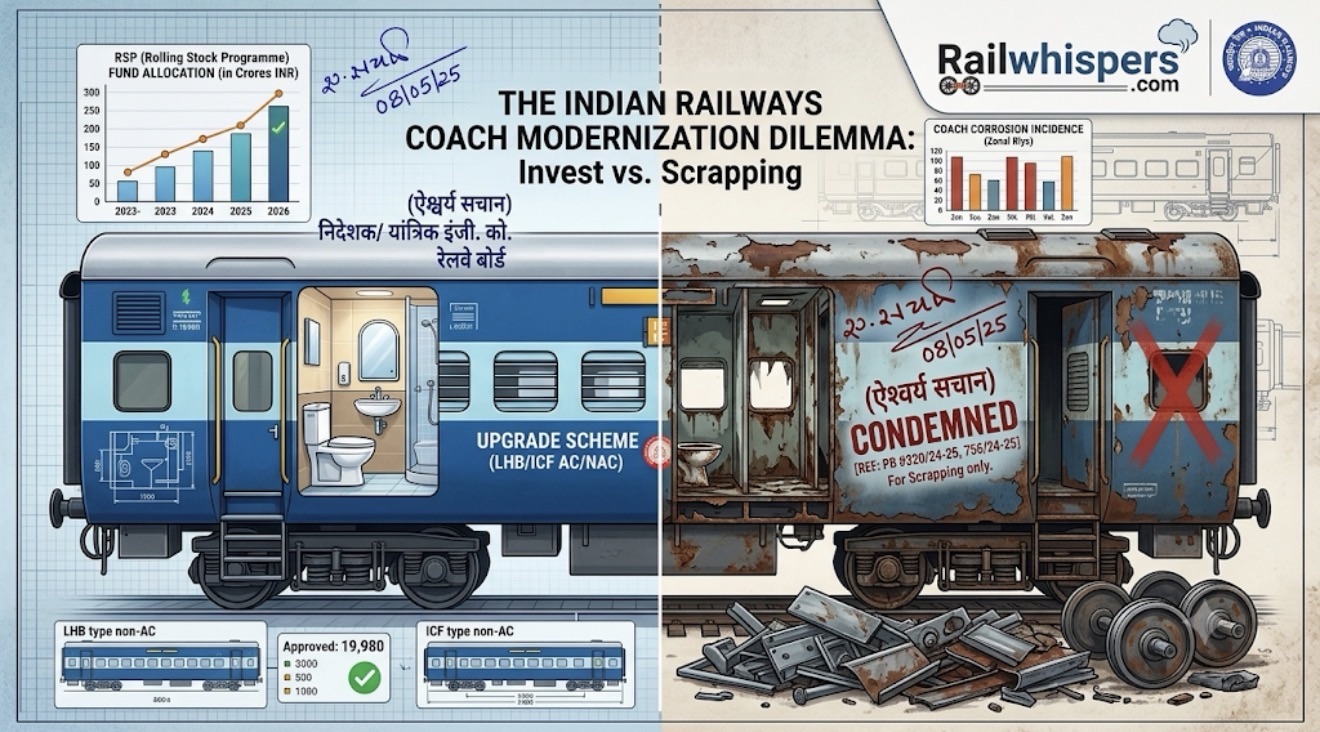
Sinking Crores Into Scrap: How RlyBd’s Cosmetic Retrofit Drive Gave Way To Mass Condemnation of Rusted Coaches
Rolling Stock Dilemma in Indian Railways
NEW DELHI: In a dramatic #policy about-face that raises serious questions regarding financial prudence and procurement integrity, the Ministry of Railways has abruptly empowered Principal Chief Mechanical Engineers (#PCMEs) across all Zonal Railways to condemn and scrap thousands of Integral Coach Factory (#ICF) and #hybrid coaches aged thirteen years or older.
Also Read: “Policy Corruption: Concerns Over the Upgradation of Toilets in 4000 ICF Conventional Coaches” 4 April, 2025
This sweeping condemnation directive, issued on July 23, 2026 under Railway Board letter number 2019/M(C)/202/1CORONA, grants full local powers to declare stock unfit so-called due to corrosion, safety hazards, or prohibitive repair costs, even if the coaches retain more than one complete Periodic Overhaul (#POH) cycle of residual operational life. The move comes as a startling reversal just fourteen months after the Railway Board aggressively pushed multi-crore Rolling Stock Programme (#RSP) allocations to revamp the interiors and lavatories of these very fleets.
Official circulars reveal a systematic, high-value expenditure drive that continued well into 2025 despite longstanding knowledge of the structural decay afflicting older coach shells. On May 8, 2025, Railway Board letter no. 2020/M(C)/142/4ptIX distributed massive targets under Pink Book No. 320/24-25, ordering the interior and toilet upgradation of nearly twenty thousand AC and non-AC coaches across twelve railway zones.
This followed extensive directives issued through 2024, including letter no. 2022/EDME(EnHM&Project)/Misc.12 dated December 26, 2024, which detailed extensive modular schemes, new paneling, flooring, washbasins, and pressure-reducing tap installations for passenger stock. Major zones such as Northern Railway, South Central Railway, Eastern Railway, and Southern Railway received mammoth targets, committing hundreds of crores in public funds toward cosmetic revamps under the guise of improving passenger amenities.
The immediate collision between these multi-crore retrofit schemes and the sudden condemnation mandate has triggered intense scrutiny within railway engineering and vigilance circles.
Insiders point out that allocating substantial Rolling Stock Programme capital to fit brand-new, high-grade interiors and modular lavatories onto severely corroded corten-steel shells represents either monumental planning negligence or an institutionalised corruption racket designed to exhaust capital budgets and benefit favored interior contractors.
Because structural rust and underframe corrosion in legacy ICF stock are detectable during routine depot maintenance and intermediate overhauls, mechanical officers question why large-scale procurement tenders were sanctioned and executed on aging rolling stock that was destined for the cutter’s torch only a year later.
The persistent lack of tangible improvement in passenger hygiene and safety on the ground adds weight to allegations of financial irregularities. Commuters across zonal networks continued to lodge complaints regarding leaking tanks, foul odors, broken fittings, and poor sanitation despite the massive outlays booked under the Pink Book works.
With the new July 2026 order effectively permitting zones to discard these newly modified coaches straight into scrap yards, the expensive modular fittings, plumbing fixtures, and composite panels are rendered total write-offs. Transport economists and anti-corruption watchdogs are now calling for a comprehensive audit by the Comptroller and Auditor General (#CAG) to investigate the vendor procurement trail, establish accountability for the wasted Rolling Stock Programme expenditure, and examine whether kickbacks drove the cosmetic overhaul of doomed rolling stock.