

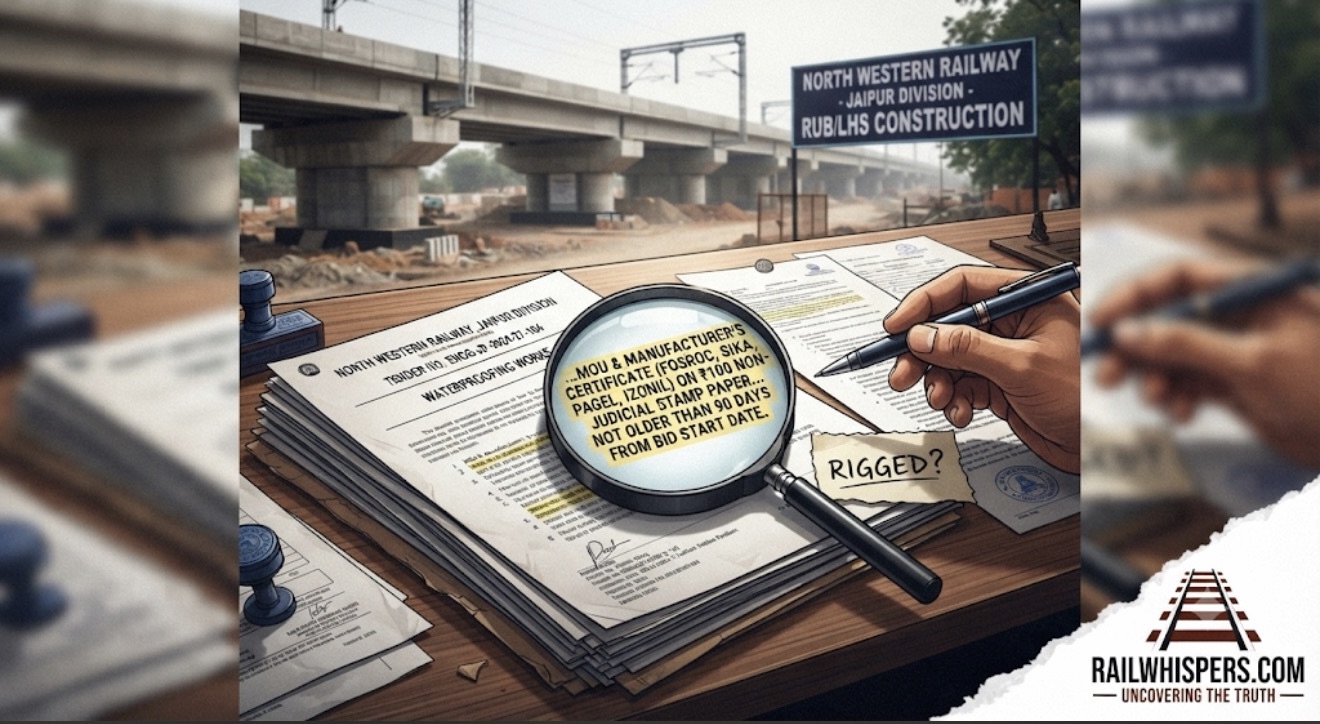
A New Mode of Corruption—“Tender Setting”?
Jaipur: Serious questions have started arising regarding the transparency of RUB (Road Under Bridge) and LHS tenders under the Jaipur Division of North Western Railway. A review of the tender documents and conditions indicates that the conditions laid down for waterproofing works have been designed to benefit a specific agency or select contractors.
Suspicious Conditions and Provisions of the Tender
In the #RUB tenders issued by the North Western Railway (#NWR), Jaipur Division (such as Tender No. ENGG-JP-2026-27-104 and ENGG-JP-2026-27-105), a provision has been made that for waterproofing works, the contractor must submit an MOU and a manufacturer’s certificate on a ₹100 non-judicial stamp paper with a specialist agency that is an approved applicator of Fosroc, Sika, Pagel, Izonil, or equivalent. Along with this, a condition has been added that this certificate must not be older than 90 days from the bid submission start date of the tender.
The following serious questions are being raised regarding this entire process and its conditions:
- The Game of Prior Preparation: When the tender has just been issued, why and how are documents and arrangements for such specific conditions and MOUs prepared even before the tender is issued?
- Limited Information: How many contractors actually had information about the back-dated MOU on a ₹100 non-judicial stamp paper and the specialist agency’s documents prepared prior to the tender? If this requirement was not widely available before the tender, did it provide an opportunity for only a select few contractors to get this information and prepare the documents in advance?
- Rationale of the 90-Day Validity: When a contractor’s credentials are accepted based on past experience and their financial securities like EMD, BG, and Security Deposit are valid in the tender, why was a 90-day time-limit condition imposed for waterproofing? What is the actual technical objective of such a 90-day condition?
- The obvious outcome of this would be that whichever contractor is aware of this condition in advance can get an MOU made with a specialist agency in time, whereas other contractors would come to know about it only after the tender is floated.
Is This Just a Formalality?
Experts believe that if the field is set in advance and a match-fixing-like situation is created, what is the point of fulfilling the formality of a tender process? If the process is fair, why should all bidders not be given equal opportunity and equal information? If this is an arrangement to pre-benefit a specific contractor, then instead of healthy tender competition, it remains merely a show.
Demand for Independent Vigilance and CVC Investigation
In view of these serious doubts, it has become essential that:
- A fair investigation be conducted into the entire tendering process, pre-tender decisions, eligibility conditions, and related documents of the RUB tenders floated by the DRM and ADRM in NWR Jaipur.
- A thorough Vigilance/CVC investigation be carried out to find out who received information when, when the MOU was prepared, when the stamp paper was purchased, and how the documents were prepared before the tender was issued.
The railway administration must clarify under which technical necessity or rule this 90-day condition was incorporated. If the response is not satisfactory, a high-level scrutiny of this condition is imperative to determine whether the tender was truly for competition or meant for a favored ‘preferred contractor’.