

Question Mark on ₹94.91 Crore SLT Tender in NER
Demand for Independent Investigation into Earthwork, Blanketing, Royalty, and Transparency
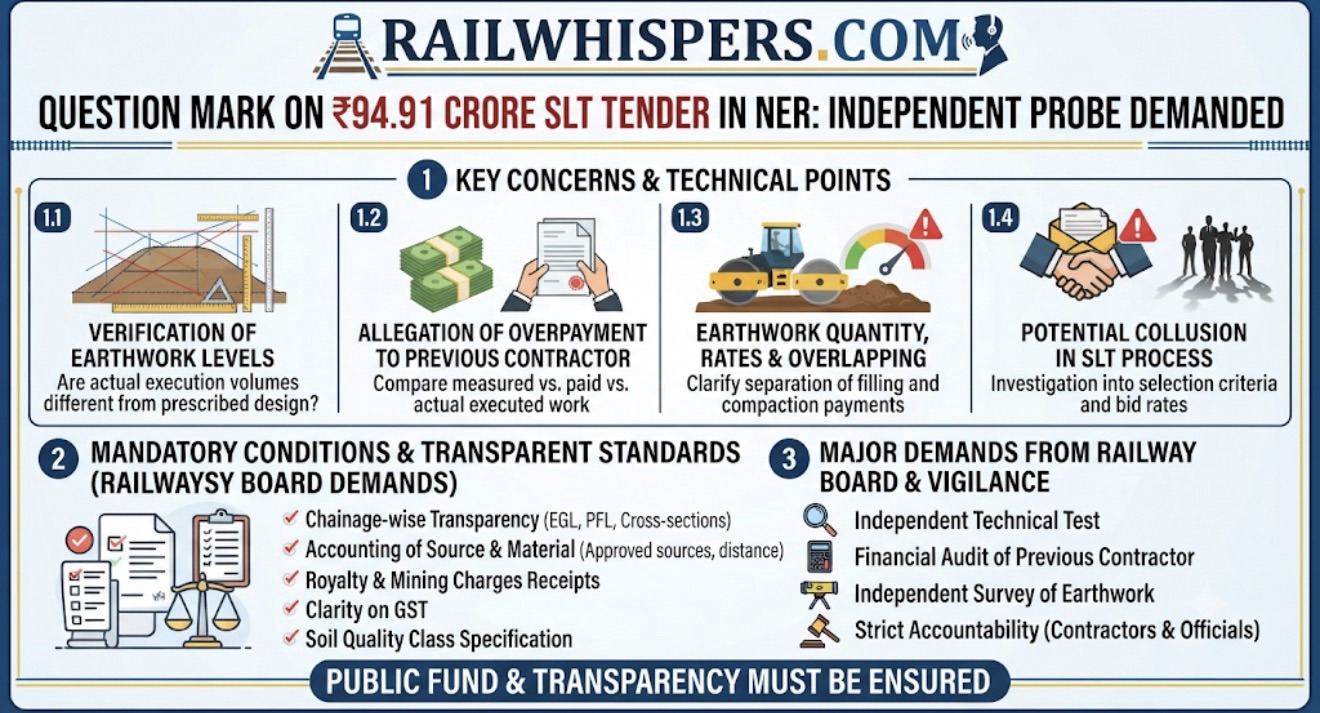
Several serious questions are being raised regarding the Special Limited Tender (#SLT) (Tender No.: DYCE-CON-G-GKP-08-2026) valued at approximately ₹94.91 crore (advertised value ₹94,90,98,102.56) issued for remaining works of formation earthwork, blanketing, and minor bridges (Nos. 15, 25, 35, and 37) in the Bhagouli (excluding) to Bakhira (including) section under the Khalilabad–Bahraich new broad-gauge railway line project of North Eastern Railway (#NER).
An impartial investigation is being demanded into the standards of earthwork, payments made to the previous contractor, quantity of remaining work, rates, sources, and potential collusion in this 9-month duration tender (closing date: October 28, 2026).
However, a major question among experts is also why such a large tender is “limited”?
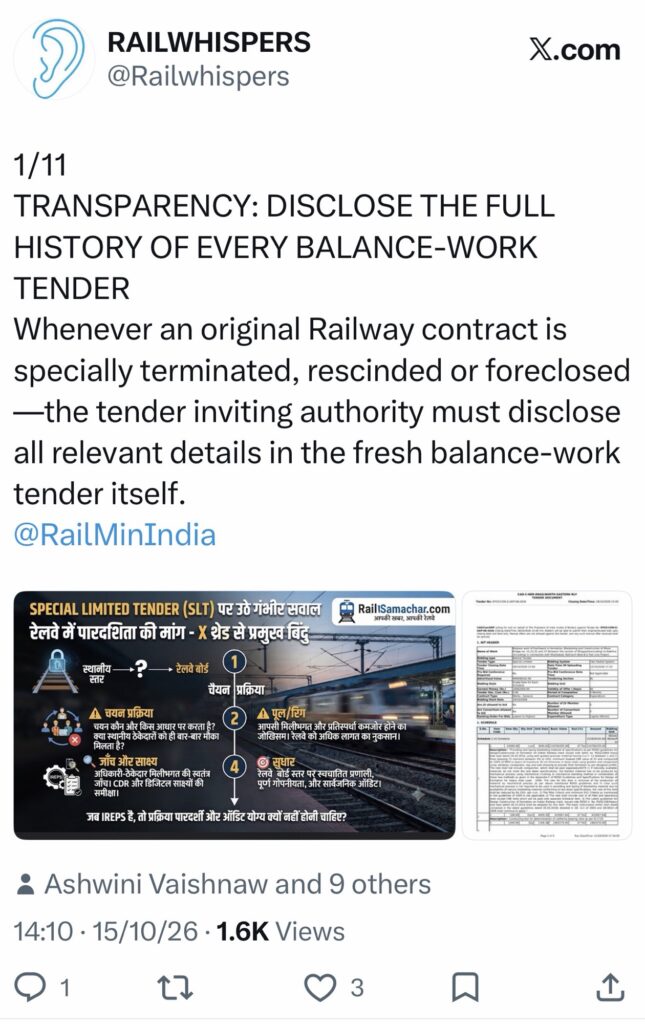
Oct. 14, 2026: “Major Questions Raised on Indian Railways’ SLT: How Transparent is the Local Contractor Selection Process?”
Key Concerns and Technical Points
1. Verification of Earthwork Levels and Actual Quantity
Apprehensions are being raised regarding discrepancies between the prescribed levels and the actual quantity of earthwork executed in the concerned section.
Formation height, design levels, cross-sections, fill thickness, and blanketing quantity directly impact costs. If there is a variance between the actual condition of previous work and the approved design, it could affect the calculation of remaining work and the cost of the new tender.
An independent technical reconciliation of original design drawings, longitudinal sections, cross-sections, level books, measurement books (MB), physical site surveys, and payment records must be conducted.
2. Allegation of Overpayment to Previous Contractor
In the current tender, the work has been termed as ‘balance work’. Therefore, a comparative examination of the measured quantity under the previous contract, bills paid, work available at site, and the quantity now included in the re-tender is essential.
The investigation should specifically check whether a situation arose where work quantities were incorrectly measured, incomplete work was shown as completed, or any item was paid in excess of reality. (Note: Since details of payments to the previous contractor are not available in the tender documents, this should not be considered a verified fact yet.)
3. Earthwork Quantity, Rates, and Overlapping Issue
Page 2 of the tender records a quantity of 10,50,000 cubic meters for earthwork filling at a rate of ₹265 per cubic meter, resulting in a base value of ₹27.825 crore.
For the same quantity, a separate item for mechanical compaction records a rate of ₹30.83 per cubic meter, amounting to a total value of approximately ₹3.24 crore.
The description mentions compacting the blanketing up to 100% MDD, but further states that compaction is not included in the rate and will be paid separately.
Experts state that it must be clarified which work is included in Item 1 and which work in Item 11 (or other compaction items), so that payment overlaps or disputes can be avoided, and compaction is not paid twice.
4. Allegations of Potential Collusion in SLT Process and Rates
Some contractors invited in the Special Limited Tender may manage bidding rates in mutual coordination with the alleged help of local railway clerks and officials.
If there is prior rate coordination or any other improper agreement among contractors, actual competition could be affected, placing an additional burden on public funds.
The investigation should examine contractor selection criteria, the list of invited firms, received bids, rate variances, and the digital audit trail.
Mandatory Conditions and Transparent Standards (Demands from Railway Board)
1. Chainage-wise Transparency:
- The Railway Board should ensure that chainage-wise level books, existing ground level (EGL), proposed formation level (PFL), longitudinal sections, cross-section graphs, cutting-filling quantities, and earthwork quantity calculations are uploaded on IREPS with every earthwork tender. No major earthwork tender should be issued without chainage-wise survey records and certified quantity statements.
2. Accounting of Source and Material:
- Approved Earth Source: Name of the approved soil source, complete location, distance from the railway site, details of approval and applicable permissions.
- Approved Blanketing Source: Details of the approved source/quarry for blanketing material, technical specifications, quality test reports, approvals, and distance up to the railway site.
- Before-and-After Survey: Certified pre-excavation and post-excavation level records must be available in cases where soil is excavated from railway land.
- Material Accounting: Separate accounting must be maintained for soil available from railway’s own land and soil brought from outside.
3. Receipts of Royalty and Mining Charges:
- The railway must ensure that prior to the payment for earthwork and blanketing material in filling, the contractor submits valid source documents, receipts for payment of applicable royalty/mining charges, transit passes/mineral transport challans, and other necessary statutory documents. Payments should not be approved without these.
4. Clarity on GST:
- Item-wise details should be provided specifying the applicable GST rate percentage, whether the advertised cost is inclusive or exclusive of GST, and the basis on which GST payments will be made.
5. Soil Quality Class (SQ1/SQ2/SQ3):
- Clear conditions regarding the soil quality class for filling and the use or prohibition of black cotton soil should be specified in the tender.
Major Demands from Railway Board and Vigilance
- Independent Test: An independent test of the selection process, basis, and approval of the ₹94.91 crore SLT tender should be conducted.
- Financial Audit: All related running account bills, final bills, measurement books, and payment records of the previous contractor should be audited.
- Technical Survey: An independent survey of original design levels, actual site levels, and earthwork quantities should be carried out.
- Strict Accountability (for both contractors and officials):
- Higher EMD & Performance Guarantee: The justification for higher EMD/performance guarantee in SLT compared to comparable open tender conditions should be evaluated.
- Timely Execution: Termination and penal actions as per rules should be taken for contractor defaults.
- Railway Accountability: If work is stalled due to failure by the railways to provide the site, approved drawings, designs, or clearances on time, responsibility should be fixed on officials of the GM, CAO, Chief Engineer, and Deputy Chief Engineer levels as well as field staff, and disciplinary action should be taken for gross negligence.
Conclusion
In the interest of public funds and transparency, it is essential to ensure clarity, fair competition, and accountability at every level in all such major projects involving public money, so that railway funds are not compromised due to missing records or system loopholes.