

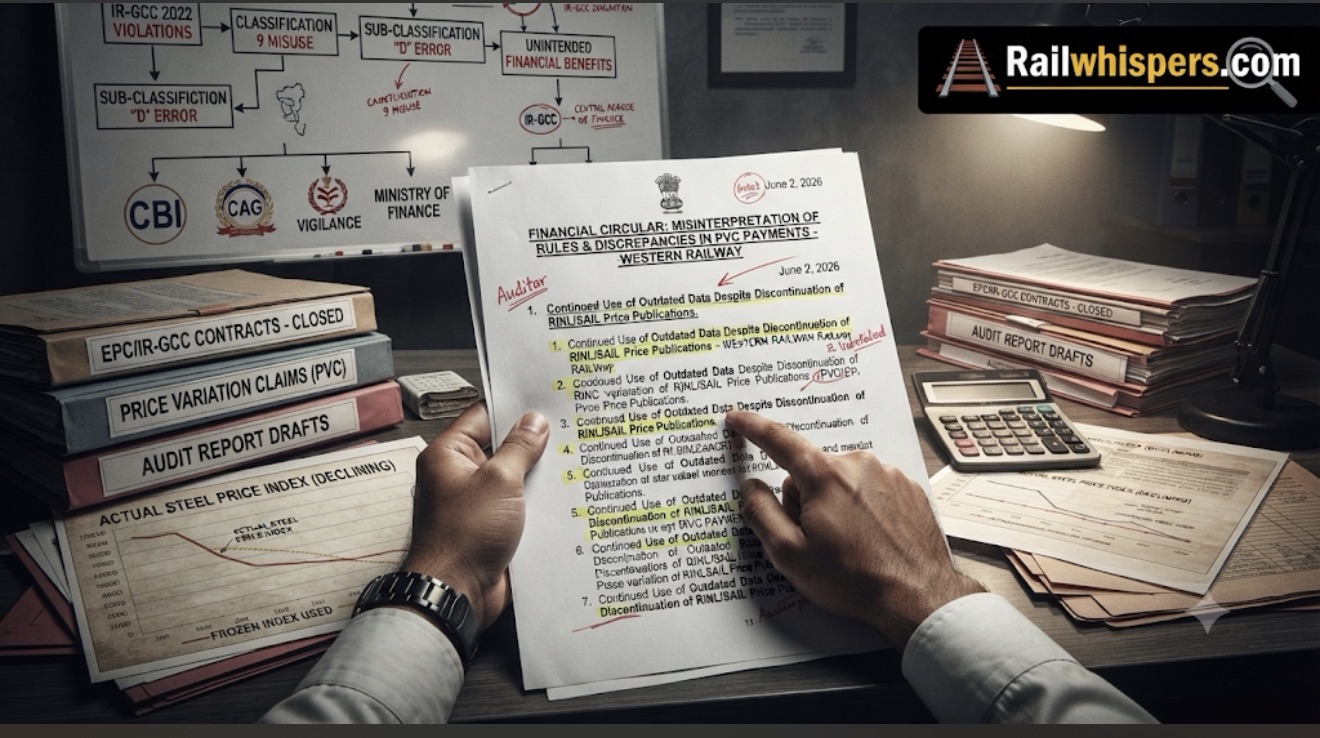
Misinterpretation of Rules: Local Arbitrariness and Disregard of Rules Exposed in PVC Payments
Mumbai: A significant financial circular issued by the FA&CAO-II (Construction), #WesternRailway on June 2, 2026 (No. WR/S&C/AC/Int Circular/2026/06), has brought to light serious discrepancies concerning the calculation of Price Variation (PV) for steel in EPC/IR-GCC contracts. This is a case of incorrect, arbitrary, and immature interpretation of rules and regulations, which has been self-admitted and brought on record by the railways themselves.
Major Discrepancies and Self-Admission by the Railways
The circular clearly states that divergent practices deviating from the provisions of IR-GCC 2022 were being followed across various railway units:
- Continued Use of Outdated Data Despite Discontinuation of RINL/SAIL Price Publications: Even though RINL and SAIL discontinued the publication of steel prices/rates, certain units continued calculating PV based on frozen rates from about 3 years ago. Continuing to adopt outdated or frozen higher indices despite a significant decline in steel prices could grant unintended financial benefits to contractors.
- Misuse of Classification 9: For building works and similar cases, Classification 9 (a residual category) was being resorted to merely for reasons of convenience or interpretation, whereas it should only apply when work does not fall under specific classifications 1 to 8.
- Incorrect Adoption of Sub-classification ‘D’: PV on reinforcement steel used in RCC structures, bridges, and buildings was computed under Sub-classification ‘D’ (meant for fabricated structural steel items like girders and FOBs), whereas it should appropriately be regulated under Sub-classification ‘B’.
- Local Modification Based on Analysis of Rates (AOR): Even after adopting Sub-classification ‘B’, modifications and redistribution were being made locally in the PV formula component percentages based on AOR. Doing so despite Railway Board’s ACS No. 01 effectively alters Railway Board instructions and can lead to irregular payments and under-recoveries.
A Major Crisis for Old and Closed Contracts: The Need for a Retrospective Audit
This financial circular is not limited to future PV bills alone; it raises critical questions about old and previously closed contracts.
If prescribed component weightages were altered locally during past works, crucial questions arise:
- Will a retrospective audit be conducted for all such closed contracts?
- In which contracts was the PV formula changed, and which authority approved it?
- Were Railway Board’s prescribed weightages altered based on AOR to make extra payments to contractors?
- Did under-recoveries occur in cases of negative PV?
The Role of Central Agencies: CBI, CAG, Vigilance, and Others
Since Railway Finance has self-admitted these irregular practices on record, vital public questions emerge:
- Will CAG, NITI Aayog, PMO, and the Ministry of Finance conduct an independent audit of closed contracts, final bills, and PVC/PV payments from previous years?
- If preliminary evidence shows rules were intentionally altered to grant wrong payments or cause financial loss, will the matter be referred to the CBI or Vigilance?
- The Railway Board should make public how many contracts adopted such calculations prior to this circular and how many of them are already closed.
Conclusion
Western Railway’s circular stands as clear proof that financial rules were violated due to arbitrary interpretations and local modifications across railway units. The issue is not restricted to future PVC bills, but extends to crores of rupees already disbursed by the railways. Alongside future corrections, executing a past audit and fixing strict accountability has now become imperative to safeguard public revenue.
#CAG #NITIAayog #PMO #FinanceMinistry #IndianRailways #PVC #PriceVariation #IRGCC2022 #RailwayAudit #Accountability