

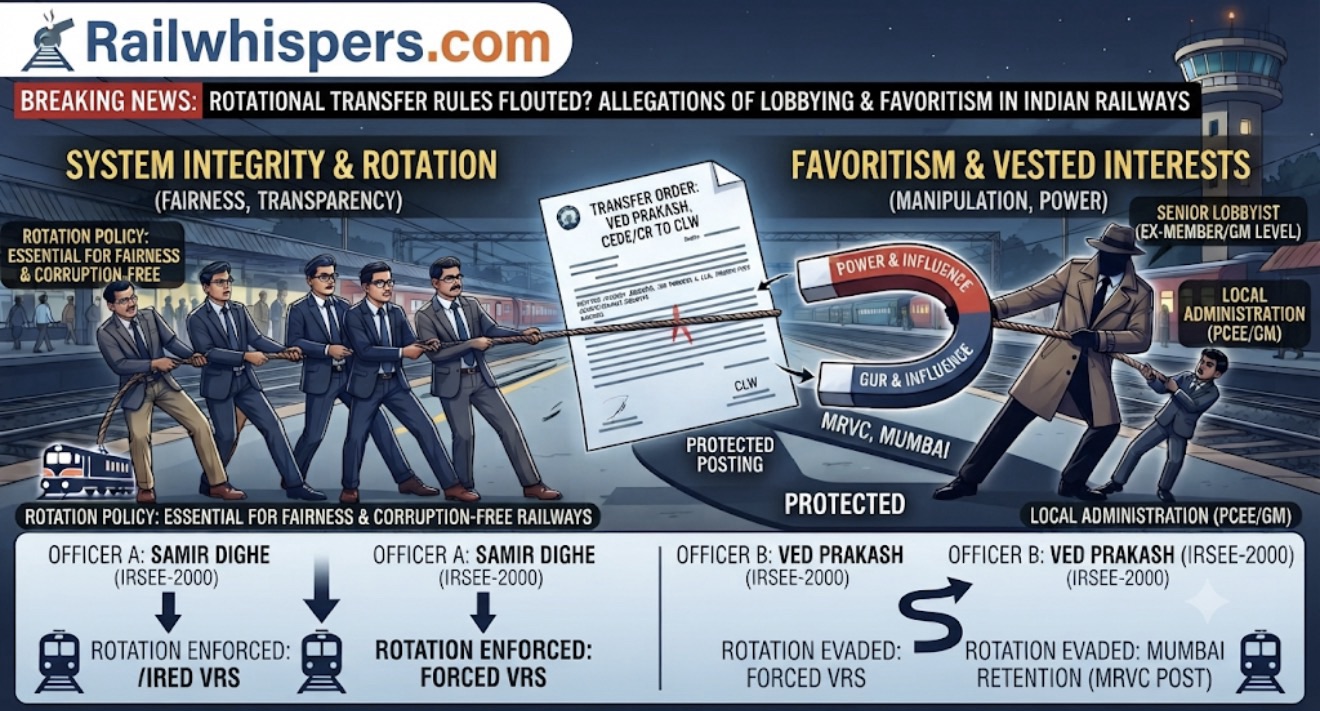
The Game of Flouting Rotational Transfers: Corruption, Favoritism, and the Crisis of Accountability in the Indian Railways
To ensure administrative reforms, transparency, and good governance in Indian Railways, rules have been established for the regular rotational transfers of officers. However, when those sitting in top positions bypass rules to protect their favorites, the credibility of the entire system is placed at stake. A serious case of this nature has emerged from Central Railway, where norms were brazenly disregarded to keep a senior officer stationed in Mumbai through a web of alleged high-level manipulations.
The Sequence of Events: How Are Favored Officers Protected?
The controversy began with the transfer of the then Chief Electrical Distribution Engineer (#CEDE) of Central Railway, Ved Prakash (#IRSEE-2000), to Chittaranjan Locomotive Works (#CLW). According to sources, verbal instructions or messages were sent to #PCEE/CR by the top echelons of the Railway Board (#MTRS and #CRB) not to relieve him immediately from Central Railway. After media platform #Railwhispers broke this news on X (formerly Twitter), he was eventually relieved, but PCEE/CR simultaneously sanctioned a two-month leave for his close aide, #VedPrakash. Consequently, despite being transferred outside Mumbai for the first time in his nearly 26-year continuous service, Ved Prakash never actually joined CLW.
To retain him in Mumbai, a new scheme was hatched from the Railway Board down to the local level, arranging a post for him in the Mumbai Rail Vikas Corporation (#MRVC). However, MRVC’s official stance is that since one of their officers was transferred to IRIEEN, Nashik, a vacancy arose, and an advertisement was duly issued for the post.
According to available information, only two officers—Ved Prakash and V. S. Parihar—applied for this post, both belonging to Central Railway. During the interview held on Monday, October 12, the second officer, Parihar, was reportedly made to understand that the entire selection process was structured solely to accommodate Ved Prakash.
Double Standards: Forcing VRS on One While Protecting Another
The most damning aspect of this case is the adoption of double standards by the Railway Board. Just prior to this, another officer from Southern Railway, Samir Dighe (IRSEE-2000)—whose transfer to CLW also marked his first outside Chennai in a 26-year career—was forced to take Voluntary Retirement (VRS) after he did not accept his rotational transfer.
Insiders reports indicate that Samir Dighe’s transfer had been stalled by former MTRS/DGHR/MInfra Naveen Gulati, while heavy lobbying to block Ved Prakash’s transfer was carried out by a former Member, Railway Board Ghamasan Singh.
Damage Caused to the Rail System Due to Non-Rotation of Officers
The primary objective of regular rotational transfers is to prevent any officer from entrenched anchoring at a single location or chair, ensuring that corruption, local manipulation networks and nepotism cannot take root. In their absence, the railway system suffers severe detriments:
- Conflict of Interest: Remaining entrenched in the same zone or city for decades allows officers to cultivate cozy nexus with local contractors, vendors, and private interests, destroying transparent workflows.
- Corruption and Nepotism: Long tenures in administrative posts enable officials to build local networks that favor cronies in tender allocations and high-ranking postings.
- Systemic Frustration and Demoralization: Officers who faithfully follow rules and accept transfers to remote areas or new stations see their morale crushed. Conversely, the ability of well-connected officers to evade transfers spreads deep dismay among general personnel.
- Impact on Safety and Administrative Efficiency: When political or administrative lobbying overrides professional competence in crucial technical and safety posts, rail safety and project timelines ultimately suffer.
The Direct Link Between Corruption and Non-Rotation
Evading rotational transfers and corruption are directly correlated. When an officer is insulated and allowed to stay in a prime posting or single jurisdiction for years, they rise above systemic accountability. The lobbying by past and present Board-level officials to secure preferred postings proves that rules apply only to vulnerable or ordinary officers, while administrative machinery is held hostage for well-connected elites.
Where Does Responsibility Lie at Board and Zonal Levels?
Clear accountability for such irregularities and arbitrariness must be fixed at the following levels:
- Railway Board Level: The primary responsibility for policy decisions, transparent transfers, and cadre management rests with the CRB and the concerned Board members (MTRS, MInfra, MOBD & MF). If transfers of select officers are being blocked via verbal orders at the Board level itself, it amounts to direct administrative corruption.
- Zonal Level (PHOD/GM): General Managers (GMs) and Principal Heads of Departments (PHOD, such as PCEE) at zonal headquarters have a moral and administrative duty to enforce Board orders impartially. Conversely, if they protect favorites by granting prolonged leaves or creating artificial posts, they are equal participants in this connivance, corruption and favouritism.
Burning Questions Awaiting Answers
The critical question now is: when an officer like Samir Dighe was pressured to take VRS under the #rotation-policy, who orchestrated the elaborate layout to protect and facilitate Ved Prakash from his batch continuous in Mumbai? Will the Minister for Railways order a high-level, impartial probe into this entire episode? When former GMs and ‘Member’-level officials engage in such malpractices right under the Minister’s nose to subvert the rail system, what are the railway’s vigilance mechanism and ministerial cell doing? The gaze of railway enthusiasts and honest officers is now fixed on the Ministry’s next move.