

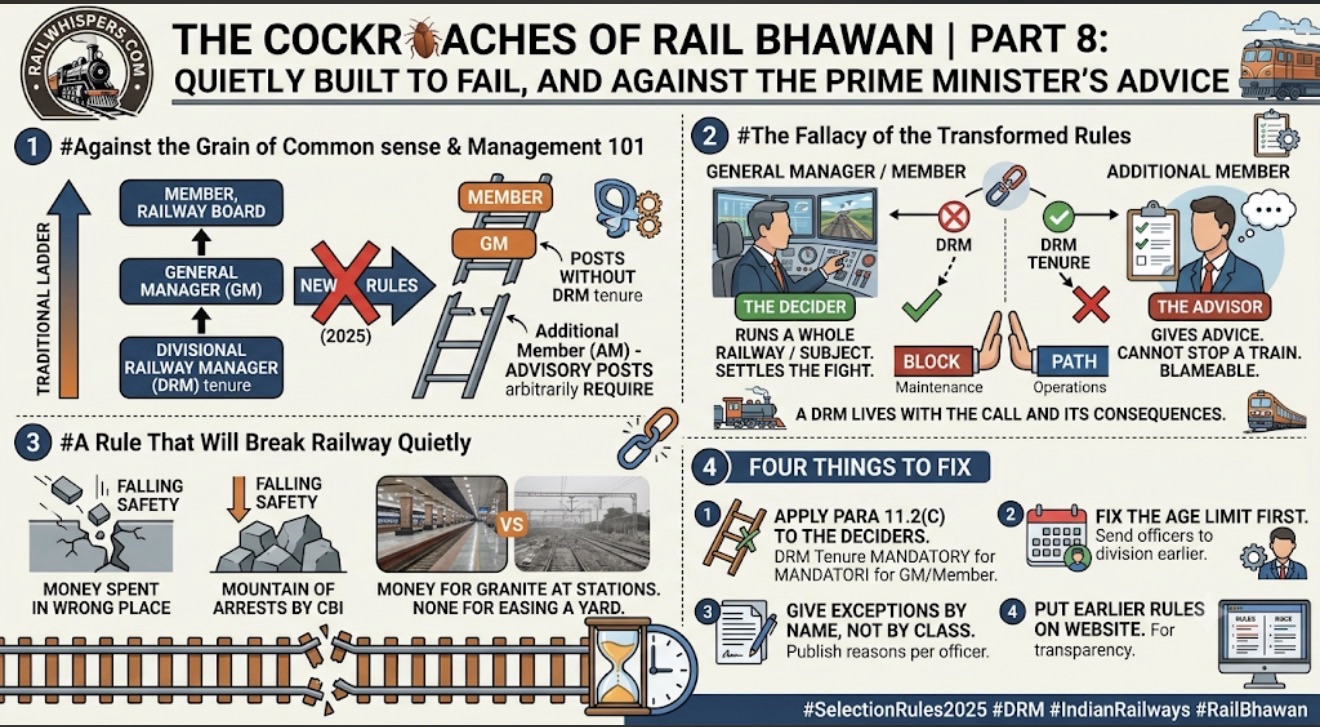
The Cockroaches of Rail Bhawan | Part 8: Quietly Built to Fail, and Against the Prime Minister’s Advice
The 2025 selection rules of Level 16 and 17 ask for fifteen month tenure as a Divisional Railway Manager for five posts that only give advice, and ask nothing of the kind from the officers who decide. The Ministry of Railways (Railway Board) has written down confirming why running a division matters, and then applied that finding where it matters least.
Against the Grain of Common sense & Management 101
Historically positions of Additional Members (#AMs) was considered the one without a prerequisite of having done a tenure of #DRM, while it was considered ‘must’ for being considered to be a #GM or a #Member.
Indian Railways in their itch to transform, acknowledged the value of DRM tenure, wrote the reason down, and then applied it to five posts that only give advice. Not to the men who run the zonal railways. Not to the men who sit on the Railway Board. Not to the officer who signs for safety across the whole system.
What the Rule Says
Read paragraph 11.2(c) of the Indian Railway (Selection to Senior Posts) Rules, 2025, notified on 7 November 2025.
An officer cannot become Additional Member for Traffic, Mechanical, Civil, Traction or Signal unless he has worked as a Divisional Railway Manager for at least fifteen months.
The rule gives its reason in the same line: “as the incumbents of these posts are directly involved in Railway operations”.
Now find the posts where the rule does not ask for it.
Where the Rule Does a Somersault
Paragraph 9.2 covers the 29 senior posts at Level-16, eighteen of them the General Managers who run the zonal railways, and to be considered an officer must belong to one of the eight organised Group ‘A’ services and must already be working in Level 15.
That is all. No experience of running a Division, flipping on its head the age old field tested wisdom.
Paragraph 5(b) covers Level-17, where the Members of the Railway Board sit, and an officer qualifies for it if he holds any Level-16 post. So a man can run a zonal railway without ever having run a division, and he can then join the Board, and nobody asks him about a division at either step.
Director General (Safety) is filled the same way. #SelectionRules2025
This is precise inversion of earlier requirement of DRM-ship as precondition for GM-ship and GM-ship a precondition for Member-ship.
The Fallacy of the Transformed Rules
An Additional Member gives advice. He runs no railway. He signs no zonal budget. He cannot stop a train.
A General Manager runs a whole railway, and a Member runs one subject across eighteen of them.
The rule tests the man who advises.
A man who only advises can be easily blamed. He cannot take the decision, because the decision is taken above him.
Trains or Maintenance, and Somebody Has to Choose: Why the Man Who Decides on Trenches Must Have Fought in Them
Here is the conflict, and every railway officer knows it.
The operating department wants the line free so that more trains can run. The departments that own the track, the overhead wires, the signalling and the coaches want the trains stopped so that those assets can be repaired.
One side asks for the path. The other asks for the block.
Both are right. They cannot both be right at the same hour on the same stretch of line.
Somebody has to choose.
No departmental officer settles this, because a departmental officer is paid to argue one side of it. It is settled by a DRM in a division, where he finally agrees to the block or refuses it, and then lives with the punctuality figures and with the asset he could not get repaired.
That is what fifteen months in a division buys. Not a lecture about the choice, but the memory of having made the call and lived with it.
You Cannot Test What You Have Never Watched
A division and a zone are not the same job, because in a division an officer settles the fight himself, and in a zone he decides where the money goes and which fight is worth having at all.
But the second job rests on the first.
Allocation is not arithmetic. An officer choosing between a block and a path, or between one shed and another, is deciding whose case he believes. If he has never stood inside that argument himself, he cannot weigh what either side tells him, and he will fund whichever officer argues best-not the most deserving.
Making that call grounds him. He has paid a price once for getting it wrong, so he makes it better the second time.
A zone is a set of divisions. The Board is a set of zones. The judgement does not change as he climbs, only the number of divisions it covers. That is why the ladder ran in one direction. The zone cannot be managed honestly without the divisional experience.
So ask how a committee is supposed to find that judgement in a man who was never sent to a division. Nobody can be judged on a skill that nobody has seen him use.
Ask seven people how an officer would have handled a block he was never asked to give, and seven people will tell you what they imagine.
That is reputation. Reputation is useful. It is not evidence.
A Railway Is Not Built for One Man’s Tenure
An alignment lasts a hundred years. A signalling standard chosen this year will still be failing trains in 2060.
A Member holds his chair for two years, sometimes three.
A system that outlives its own leaders by fifty years needs leaders trained on the long clock, and a man who has seen one of his own decisions come back to him has learnt what no interview can teach.
The Ladder That Has Gone
The progression existed. A tenure as Divisional Railway Manager came before a General Manager’s chair, and a General Manager’s chair came before a seat on the Board.
It shaped these appointments for decades, through the leanest years this railway has known.
Nobody voted to end it. Nobody defended it. It was simply replaced.
A Rule That Will Break Railway Quietly
The Railway Board wrote the new rule. The Board changes its mind often. This series counted the reversals in one department. There were fourteen that we could count.
Aug 7, 2026: “The Cockroaches of Rail Bhawan | Part-2: Fourteen Reversals and One Survivor”
A bridge that fails brings an inquiry, a report and a name. A rule about men that fails brings none of the three.
The consequences are already being faced, and it arrives as money spent in the wrong place, falling safety, poor quality of output from workshops and the mountain of arrests made by CBI.
The Minister has asked more than once that the money go where the railway needs it, and the railway has answered him with a floor.
There is money for polished granite at a station. There is none for easing a yard.
An officer who has run a division knows which of those two moves a train.
There will be no such appointed day that somebody can point to when we find the leadership started to act like headless chicken. There will be no finding that points to this rule. There will only be a railway, twenty years from now, run by officers who were never made to choose between a block and a path, and nobody will connect the two.
This, dear reader is a ‘transformation’ quietly built to fail.
How to Write an Exception Properly
The Americans met this problem and solved it in law. Under section 619a of Title 10 of the United States Code, no officer becomes a one-star general unless he has served outside his own service and has done the course that goes with it.
There are five exceptions, and every one of them has a price. A waiver goes to one named officer at a time and never to a whole class. An officer who takes the commonest waiver must spend his first posting as a general in exactly the sort of job he skipped. And an old waiver follows him, blocking three-star rank until he does the missing tour.
A rule, five ways out, and a price written against each one.
That is what a rule looks like when the men who wrote it expected an argument.
Four Things to Fix
- Apply paragraph 11.2(c) to the men who decide. Mandate that minimum fifteen months in a division before any officer goes on to become a General Manager, and a General Manager before any Level-17 appointment.
- Fix the age limit first. An officer sent to a division at fifty-two cannot climb two more rungs before he retires at sixty, so send him earlier and let him hold the post in his own grade.
- Give exceptions by name, not by class. Paragraph 13 already allows a relaxation, so publish the reason, one officer at a time.
- Put the earlier rules on the website, so that anyone can see what was asked for before and what is asked for now. A change nobody can read is a change nobody has to defend. #DRM
Put It in the Rule
Division. Zone. Board. At every step an officer met a problem he could not hand to anybody else.
The reason is now on paper, in paragraph 11.2(c). The railway used it on five posts that only give advice, and handed the zonal railways and the Board to men it never tested.
From the Red Fort the Prime Minister asked for quality with no compromise. He has asked for more than a decade for minimum government and maximum governance, which means fewer tiers between a problem and the officer who settles it.
Aug 11, 2026: “Maximum Government at Rail Bhawan—Damn What the Prime Minister Said”
This rule answers neither ask. It puts the test on the tier that advises and leaves the tiers that decide untested. A man who was never made to choose between a block and a path will decide both, and the quality of that decision is fixed before he signs it.
Put the ladder into the rule, at the level where the decisions are taken.
Leave a door open at the top for the exceptional officer. Just make him walk past a published reason on his way through.
The series so far—
Aug 6, 2026: “The Cockroaches of Rail Bhawan | Part-1: Read the Last Column”
Aug 7, 2026: “The Cockroaches of Rail Bhawan | Part-2: Fourteen Reversals and One Survivor”
Aug 8, 2026: “The Cockroaches of Rail Bhawan | Part 3: Six Times Asked, Four Times Refused”
Aug 9, 2026: “The Cockroaches of Rail Bhawan | Part 4: Feeding the Cockroaches”
Aug 10, 2026: “The Cockroaches of Rail Bhawan | Part 5: Who Pays, Who Runs It”
Aug 11, 2026: “Maximum Government at Rail Bhawan—Damn What the Prime Minister Said”
Aug 12, 2026: “The Cockroaches of Rail Bhawan | Hand the Machine to the Man Who Sold It”
Aug 17, 2026: “The Cockroaches of Rail Bhawan | Part 6: Read the Passenger List”
Aug 18, 2026: “The Cockroaches of Rail Bhawan | Part 7: Who Does the Railway Ask?”