

The Cockroaches of Rail Bhawan | Part 5: Who Pays, Who Runs It
The organisation is very good at extermination when it decides to be!
The question is not whether the arrangement is legal or even whether it is efficient—The question is what it costs you in thirty years, and whether anybody in Rail Bhawan is still able to tell???
Indian Railways does not reorganise itself in public. It does it in office orders. Numbered, dated, two pages long, signed by a Joint Secretary, and filed to a folder on a website that the railway’s own officers struggle to find. Each order is small. Each order is lawful. Read one and you learn nothing. Read them in sequence, across eleven years, and you watch one department grow and grow, while nobody in Rail Bhawan ever writes the word expansion. This series reads them in sequence!
Four parts of this series have been an argument between two departments of Indian Railways about who commands the man with the spanner.
I have kept you waiting for the answer since Part-1. Here it is—
“Neither of them.”
Aug 6, 2026: “The Cockroaches of Rail Bhawan | Part-1: Read the Last Column”
Aug 7, 2026: “The Cockroaches of Rail Bhawan | Part-2: Fourteen Reversals and One Survivor”
Aug 8, 2026: “The Cockroaches of Rail Bhawan | Part 3: Six Times Asked, Four Times Refused”
Aug 9, 2026: “The Cockroaches of Rail Bhawan | Part 4: Feeding the Cockroaches”
Follow the money first
Start with what the exchequer puts in, because it is the part nobody disputes.
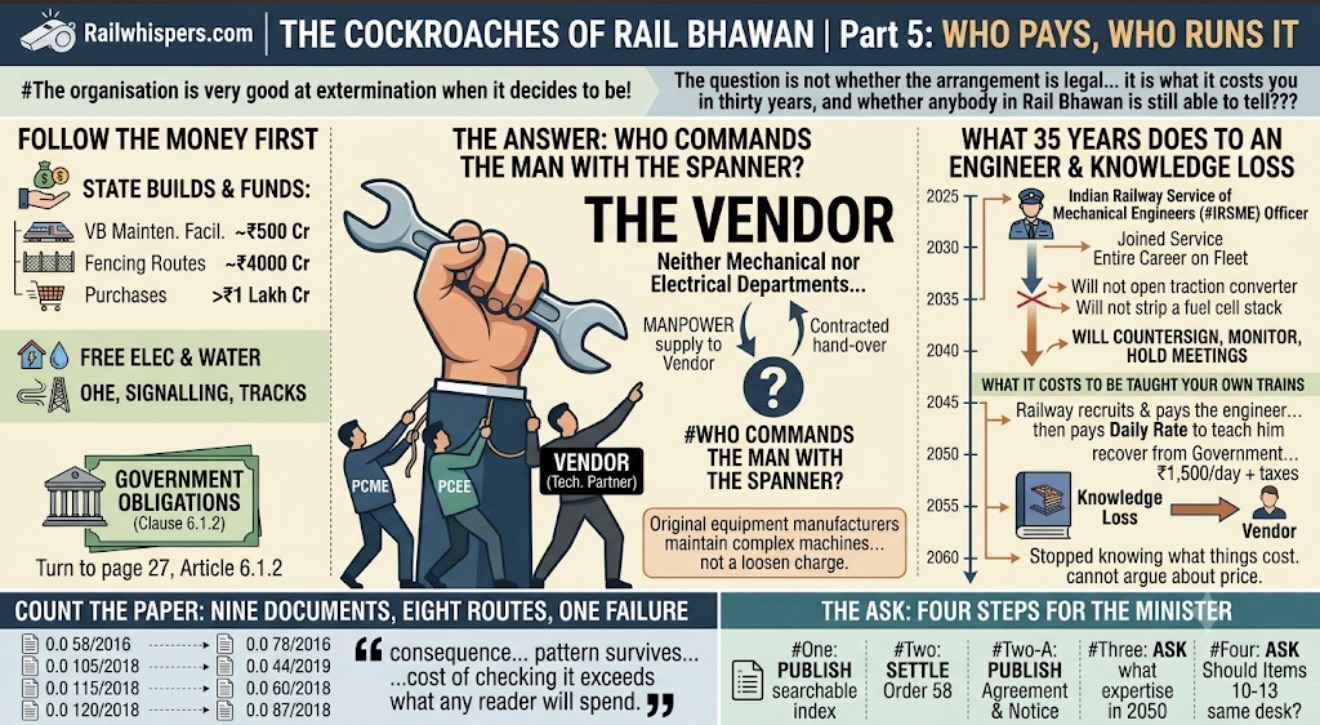
A single Vande Bharat maintenance facility costs public exchequer about ₹500 crore. Fencing the routes those trains need, so that they can run somewhere near the speed they were designed for, runs to almost ₹4,000 crore. Rolling stock purchases of more than ₹1 lakh crore have been reported. These figures come from published reporting and not from any Board order I hold, and I attribute them below rather than dress them up as findings.
That is the public side of the ledger. Now read the terms—
Srinand Jha reported these terms four years ago in “Vande Bharat: The good and the bad“, 31 October 2022, and almost nobody in the railway seems to have read him.
I have now read the agreement itself.
It is the Manufacturing cum Maintenance Agreement attached to Railway Board #Tender WTA-527, published on 27 April 2022 and closed on 26 July 2022, for two hundred sleeper Vande Bharat trains.
Let me be precise about where it is and is not, because the railway deserves the exact charge and not a loose one.
The tender itself is on the Railway Board’s website. Go to the Board’s tender page for WTA-527 and you will find the notice inviting tenders, and 15 (fifteen) corrigenda to it, running from June 2022 to November 2022. I downloaded all of them. The notice is a scanned image with no text in it, so you cannot search it, but it is there.
What is not there is the agreement. Nor the bid document, nor the specifications, nor the annexures.
So the Ministry of Railways publishes fifteen corrigenda amending a document it does not publish.
Those documents live on the Indian Railways E-Procurement System (#IREPS), so I went there. The home page offers a link called Search E-Tenders. In the page’s own code it is named anonymous search.
It is not anonymous. Click it and you get a page headed “Authenticate Yourself”, asking for your mobile number and a one time password. The link for High Value Tenders, which is where a contract of this size belongs, goes to the same place and asks the same thing.
I stopped there, because I am not going to register a mobile number with a procurement system to read a public contract, and I do not think you should have to either.
I eventually read the agreement as a #PDF file on a website run by railway enthusiasts, which is not a sentence I expected to write about two hundred trains and a reported 1 lakh crore rupees.
Set the two routes side by side and neither needs an adjective from me. The Ministry’s site gives you the notice and fifteen amendments to a contract you cannot see. The procurement portal has the contract and wants your phone number first.
Turn to page no. 27, Article 6.1.2, headed Obligations of the Government. The railway undertakes to do the following, and I quote the sub-clauses as they stand—
- Clause (a). To “provide unexclusive access to the Manufacturing Unit, Trainset Depots and Washing Lines”.
- Clause (b). To “provide the rail track and the electrified traction lines connecting those depots to the network”.
- Clause (d). To “provide, or cause to be provided, free electricity and water” at all of them.
Elsewhere, at clause 12.3.5, all work on tracks, overhead equipment (#OHE) and signalling for developing those depots, and the maintenance of that work, is to be done by the Government at its own expense.
The state builds the shed, wires it, waters it and lights it. None of that is in dispute and none of it is new.
The sentence this whole series was walking towards
Now go back to page 27 and read clause (c).
The Government shall “provide manpower for manufacturing and maintenance of the Trains”.
Nine words. Read them twice.
For ten years the Principal Chief Mechanical Engineer (#PCME) and the Principal Chief Electrical Engineer (#PCEE) have written to each other, and to the Board, about which of them commands the fitter. In April 2022, in a numbered sub-clause on page 27 of a tender document, the Ministry of Railways undertook to supply that fitter to somebody else.
Jha’s report puts it more sharply still, quoting the bid documents to the effect that railway manpower will work under the “supervision and technical control of the technology partner”.
I cannot trace those words to a clause, and I am not going to pretend otherwise. The agreement runs to an Article 22 headed “Manpower and Training”, whose second clause is headed “Government Staff”, and that is the clause I would expect them to sit in. I have not been able to read it. So take that phrase as what it is, a quotation in a news report, and clause 6.1.2(c) as what it is, the agreement itself.
The clause I can prove is enough.
The fitter is a railway employee. The railway recruits him, trains him and pays him. And on the trains that matter most to this government, the Ministry has contracted to hand him over for the working life of the fleet.
So the answer to the question this series has asked five times is the vendor.
Not mechanical. Not electrical. Both of those departments spent a decade fighting over a prize that was being quietly transferred out of the building while they argued.
And I want to be careful here, because this is the point at which a piece like this usually loses its head. There is nothing unlawful about any of this. Original equipment manufacturers (#OEMs) maintain complex machines all over the world. Airlines do it. Metro systems do it. There is a serious argument that a manufacturer maintains its own product better than a government department can.
The question is not whether the arrangement is legal or even whether it is efficient. The question is what it costs you in thirty years, and whether anybody in Rail Bhawan is still able to tell???
What 35 years does to an engineer
The thirty five years is not a reported figure either. It is clause 17.2 of the same agreement. The technology partner performs its maintenance obligations for every train “until its design life of 35 Years from the date of acceptance of such Train”. The agreement calls that the “Maintenance Period”.
Somebody did object to it, and here the Ministry’s own website will help you.
Corrigendum No. 6 to tender WTA-527, numbered 2022/RS(WTA)-149/TENDER/527 and dated 11 August 2022, reproduces the questions bidders asked and the answers the Board gave. One bidder asked that the maintenance period be cut from thirty five years to fifteen.
The reasons were not sentimental. Too many uncertainties over so long a period. Those risks have to be priced into the offer. The rolling stock will need mid-life rehabilitation at about eighteen years anyway. And there was precedent, because the #Marhowra and #Madhepura locomotive projects were done on a maintenance period of thirteen years.
The Board’s answer is printed beside the question. It runs to four words—
“No change is envisaged”.
So the thirty five years was not an oversight, and nobody can say it went unexamined. A bidder raised it, argued it, cited precedent, and was told “NO”.
What it costs to be taught your own trains
One more clause, and this one I do have. It sits in that same Article 22, and it reached me by an odd route. I could not read the article in the agreement, but #Corrigendum 6 amends clause 22.8.1 and, as corrigenda do, prints the clause it is amending. So the Ministry published the text after all, inside a document correcting it.
The technology partner may recover from the Government ₹1,500 a day, plus taxes, for each officer or engineer it trains, and ₹1,000 a day for every other member of staff. For training abroad the rate is US$250 per head per day, plus taxes.
Put that beside clause 6.1.2(c) and read the two together slowly.
The railway recruits the engineer. The railway pays the engineer. The railway is contracted to hand the engineer over. And then the railway pays the firm a daily rate to teach the engineer how the train works.
Now think about that engineer.
An officer who joins the Indian Railway Service of Mechanical Engineers (#IRSME) next year will retire before that contract expires. In an entire career, on that fleet, he will not open a traction converter. He will not strip a fuel cell stack. He will not stand over an apprentice while the apprentice does it, because there will be no apprentice and no stripped converter to stand over.
He will countersign. He will monitor. He will hold coordination meetings.
And when the railway comes to write the specification for the next generation of trains, that officer will be the one holding the pen, and the only people in the room who know how the last generation actually worked will be sitting on the other side of the table.
We reported the power car case in “The OEM vis-vis Third Party Maintenance Conundrum”, 15 April 2025. The A-check on a power car, once done departmentally by train lighting and air conditioning (TL/AC) staff, is reported to have risen from a few hundred rupees to about 5,000 after the policy changed.
And in “A Coach Broke in Two—The Real Crack Is in Rail Bhavan”, 8 June 2026, our own earlier work, a single locomotive was reported to carry close to a dozen separate annual maintenance contracts.
A department that cannot argue about the price of an A-check has not saved money. It has stopped knowing what things cost.
Now count the paper
There is a second thing this series has been doing quietly, and this is the place to say it out loud, once.
Nine primary Railway Board documents were needed to tell this story. Every one of them took a different route to reach.
- Office Order 58 of 2016 is an image with no text layer, and had to be read by optical character recognition.
- Office Order 105 of 2018 sits on the Board’s website inside the folder for 2019.
- Office Order 111 of 2018 never surfaced in any search of that site at all, and was finally read from a photograph in a blog post.
- Office Order 97 of 2017, the order that placed housekeeping under mechanical, was not known to exist until a later order mentioned it in its opening line.
- Office Order 72 of 2025, the hydrogen order in Part 4, was found as an enclosure on page two of a twenty five page file on a zonal railway’s server.
- The Northern Railway order of 22 April 2024 was never published as a file and exists here as a photograph.
- Office Orders 28 and 30 of 2015, which created the housekeeping directorate, were never found at all.
- Two different orders of 2018 carry the same file number.
Nine documents. Eight routes. One failure.
Make that ten, and the tenth is the neatest of the lot. The Ministry publishes the notice for tender WTA-527 and fifteen corrigenda to it. It does not publish the agreement that all fifteen are amending.
I am not going to tell you that this was designed, because I cannot show you a document in which anybody decided it. What I can tell you is the consequence, and the consequence does not depend on anybody’s intention.
A pattern survives for ten years when the cost of checking it exceeds what any reader will spend. That is the whole trick, and it needs no conspirator.
The other cockroach
I owe you a return to the title.
In Part-1, I said there were two kinds. The one in the pantry car, which Indian Railways spends real money to exterminate. And the other one, which lives in Rail Bhawan, holds a job no order created, and outlasts every campaign.
I have spent five parts showing you the second kind being fed. Not by anybody’s design. By eleven years of small, lawful, numbered orders, each of which passed a Joint Secretary and a Member and a file, and not one of which anybody read alongside the others.
Here is the uncomfortable part. The organisation is very good at extermination when it decides to be. It reversed a Cabinet decision. It unmade an entire service in seven gazettes. It closed the Central Organisation for Railway Electrification and, when it changed its mind, reopened it in a matter of weeks.
It can do this. It simply has not, here.
The ask
So, as this site did at the end of The Tyranny of Traffic, let me put it to the Minister rather than to the officials, because the officials have had ten years.
- #One. Publish every Railway Board office order of the last fifteen years in a single searchable index, with the file number, the date and the subject. Not a folder tree. An index. If the sequence is innocent, an index costs the railway nothing and settles the matter.
- #Two. Settle Office Order 58 of 2016. Amend it, withdraw it, or complete it. Ten years of refusing, reversing and staying is not a decision, and the shed floor cannot run on an unresolved file.
- #Two-A, and it should not need asking. Put the Manufacturing cum Maintenance Agreement on the Ministry’s own website, beside the fifteen corrigenda that amend it. Publish the notice as text rather than as a photograph of a page. And let a citizen search closed tenders on the procurement portal without handing over a mobile number.
- #Three. Ask what expertise the railway will hold in 2050 on a fleet it does not maintain. Not who owns the subject. What the organisation will still know.
- #Four. Before hydrogen goes any further, ask one question of one duty list. Should items 10 to 13 sit on the same desk?
I have named every order in this series, given its number and its date, and told you where I found it. Every one of them is a public document of the Government of India. You are welcome to check all nine.
That, in the end, is the only real defence any of this has ever had. That you would not bother.
Who commands the man with the spanner?
Not the department that owns the shed. Not the department that trained him. Somebody who is not in this argument at all, who has a 35 years contract, and to whom the Ministry promised him in writing on page no. 27.