

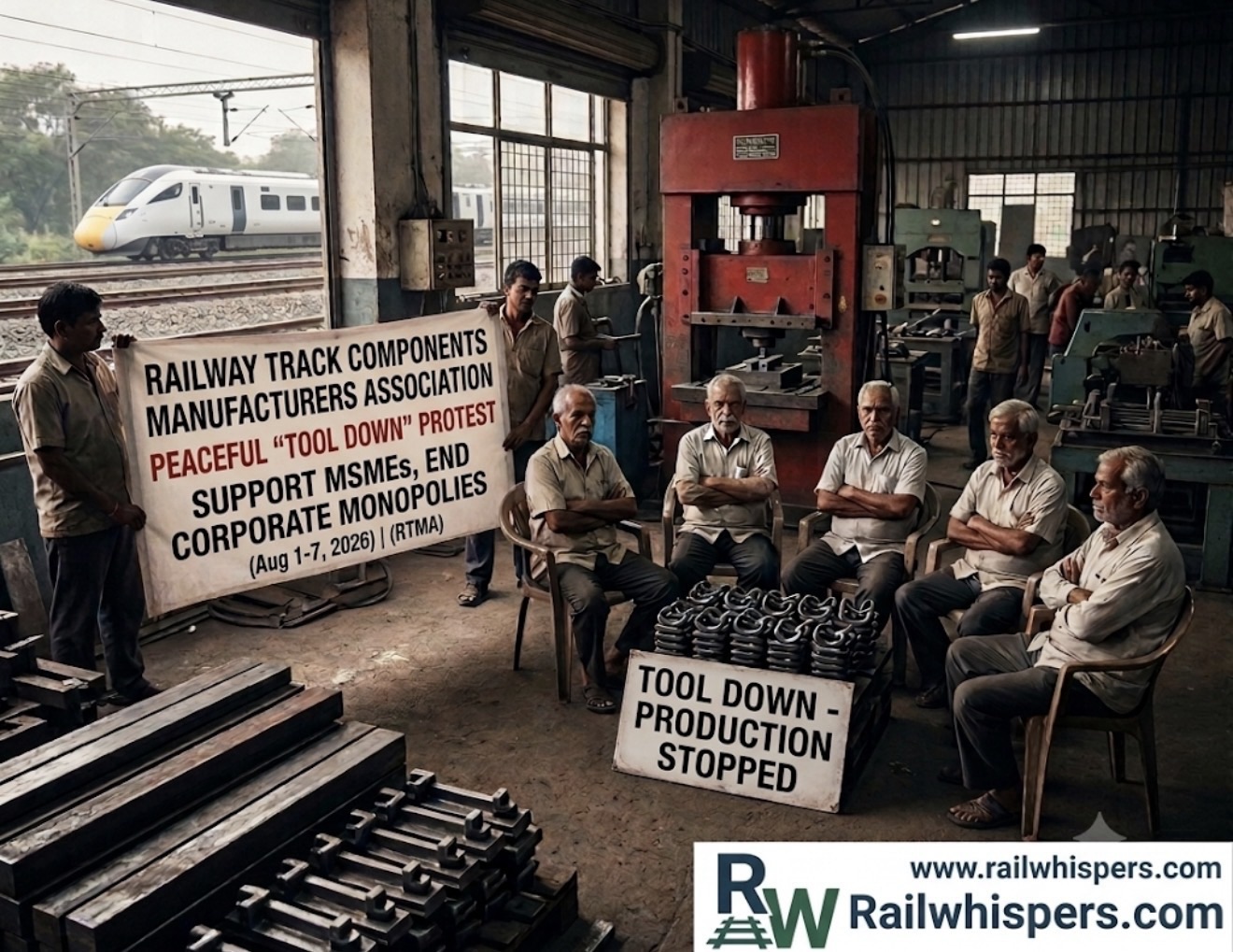
RAIL CRISIS: 40 MSME Track Component Manufacturers Launch Nationwide Strike Against Railway Board
‘Tool Down’ Strike: Small Rail Component Suppliers Fight Bureaucratic Monopolization
MSME Track Manufacturers Call Nationwide Protest Over Flawed RDSO Norms
A Special Investigative Report
New Delhi • July 24, 2026: A first kind of event is going to happen in the history of Indian Railways. A major industrial crisis is unfolding across India’s core infrastructure sector as nearly forty Micro, Small, and Medium Enterprises (#MSME) manufacturing critical railway track components have officially announced a nationwide peaceful “#ToolDown” protest, halting production operations from August 1 to August 7, 2026. The participating industrial units, operating under the banner of the Railway Track Components Manufacturers Association (#RTMA), have also resolved to stage a massive demonstration at New Delhi’s Jantar-Mantar. The drastic measure comes in response to recently enforced quality inspection guidelines by the Research Designs and Standards Organisation (#RDSO), which the association claims are commercially unsustainable, legally flawed, and designed to deliberately crush small-scale manufacturers to establish a corporate monopoly for select large firms.
In a formal representation addressed to the Member (Infrastructure), Railway Board, dispatched to top authorities on July 19, 2026, and officially received by the Railway Board on July 22, 2026, the RTMA highlighted that its member units were forced into this industrial action after all reasonable avenues of administrative dialogue, technical consultation, and written representation were exhausted. According to industry leaders, while the overarching economic vision of Prime Minister Narendra Modi’s government places job creation and the promotion of MSMEs at the forefront of national policy, senior railway bureaucrats are acting in direct opposition to these goals. Industry representatives allege that administrative officials are arbitrarily altering regulatory frameworks to curry favor with big corporate entities, thereby damaging the reputation of the Union Government, which relies heavily on small industries to generate employment across manufacturing hubs.
The controversy stems from a series of regulatory developments initiated earlier this year. On June 24, 2026, a joint stakeholder meeting was convened between railway officials and track component manufacturers to address long-standing disputes concerning inspection methodology, quality assurance, post-supply testing, warranty administration, vendor rating, and delisting procedures. Following detailed deliberations, the RTMA submitted a comprehensive set of recommendations to the Railway Board and RDSO on June 28, 2026. The industry expected these recommendations to form the basis of a balanced regulatory framework that would preserve stringent safety standards while maintaining contractual certainty for approved manufacturers.
However, bypassing the consensus reached during the joint meeting, RDSO unilaterally issued the #ISO Apex Guidelines (Version 4.0), which came into effect on July 07, 2026. The association asserts that the new guidelines completely disregard the recommendations submitted by manufacturers and introduce an aggressive post-supply surveillance regimen lacking basic procedural safeguards and natural justice. Under the new protocol, materials that have already undergone rigorous multi-stage pre-dispatch testing and received formal inspection certificates (#IC) and dispatch clearances (#DC) from authorized railway inspecting agencies are subjected to repeated, random post-supply laboratory sampling after reaching consignee depots. These late-stage tests are being conducted even in the complete absence of field failures, safety complaints, or operational deficiencies.
Small-scale manufacturers argue that the Union Government itself would never intentionally seek the destruction of MSMEs, given that small industries form the backbone of the national economy and serve as the largest employment generator after agriculture. Instead, industry sources point to a growing disconnect between political policy and bureaucratic execution. They charge that certain railway officials are driving policies that artificially favor a few large conglomerates, motivated by individual administrative self-interest rather than public welfare. By creating an environment filled with arbitrary punitive measures, unwarranted financial recoveries, and immediate vendor delisting, the administration is effectively squeezing out small enterprises that have invested substantial capital over decades to build dedicated manufacturing plants, testing laboratories, and skilled workforces for the Indian Railways.
Furthermore, the RTMA pointed out technical flaws in RDSO’s approach by citing RDSO’s own published literature. In its technical paper titled “Introduction of Modern Fastening System on Indian Railways,” RDSO acknowledged that elastic fastening systems consist of multiple independently manufactured components, each carrying individual manufacturing tolerances that cumulatively impact performance. The paper specifically noted that components like the Elastic Rail Clip (#ERC Mk-V) possess inherent engineering and metallurgical complexities affecting uniform hardness and fatigue performance, concluding that assemblies must be evaluated as integrated systems rather than isolated components. Manufacturers contend that subjecting individual components to isolated post-supply laboratory tests contradicts RDSO’s own technical research and exposes suppliers to unfair penalties.
The manufacturing association has also raised serious questions regarding the technical competency of external National Accreditation Board for Testing and Calibration Laboratories (#NABL) and National Test House (#NTH) facilities. The RTMA stated that every RDSO-approved manufacturing unit possesses fully equipped in-house testing infrastructure and trained staff operating strictly under Indian Railway Standards (#IRS) specifications. In contrast, outside non-railway laboratories lack specialized technical personnel and standardized testing setups required for railway track components, leading to erratic, contradictory, and erroneous test results that falsely penalize compliant vendors.
To resolve the deadlock, the RTMA has offered a constructive compromise. The association stated that it has no objection to Indian Railways strengthening its quality control by deploying joint inspecting teams, including national or international independent agencies, to inspect manufacturing processes and raw materials at the factory site before dispatch. However, once goods undergo joint pre-dispatch inspection and receive clearance, the decision must attain contractual finality, with post-supply testing restricted strictly to instances where genuine, substantiated field performance failures occur.
While the majority of the forty affected MSME units have committed to the week-long Tool Down strike and the Jantar Mantar protest starting August 1, the association clarified that participation in the strike remains voluntary. Certain approved vendors have opted out of the physical protest to seek legal redress through the high courts. The RTMA noted that while larger firms can afford prolonged, expensive litigation in court, small and medium enterprises lack the financial resources for extended legal battles, making a peaceful industrial protest their only viable tool to seek immediate administrative intervention.
With only days remaining before the scheduled production shutdown on August 1, 2026, the track manufacturing industry has appealed directly to the Railway Board to intervene in the larger public interest. The association has urged top ministry leadership to convene an urgent high-level meeting with all stakeholders to review the ISO Apex Guidelines and restore trust. Industry leaders warn that if the strike proceeds, the disruption in the supply of critical track components could severely impact track maintenance, safety upgrades, and ongoing railway expansion projects across the country.