

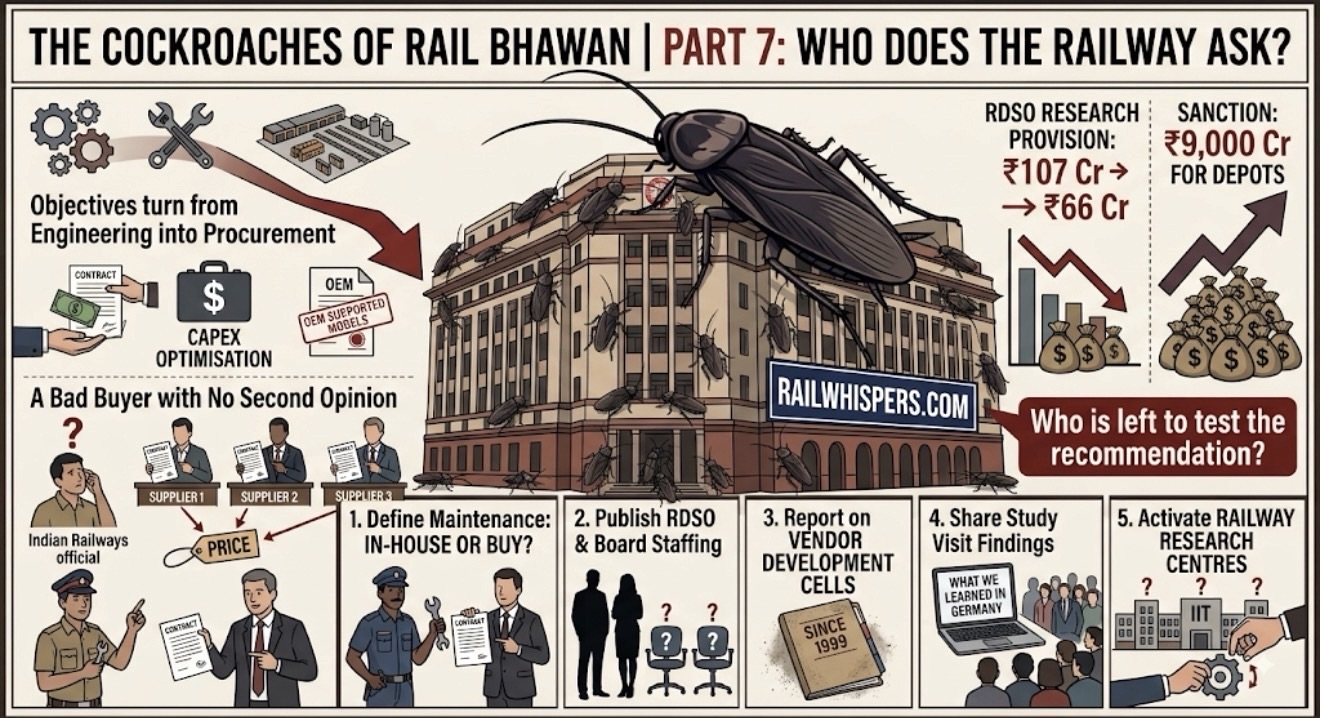
The Cockroaches of Rail Bhawan | Part 7: Who Does the Railway Ask?
Fifteen officers will come home with a recommendation. Somebody has to test it
Nine objectives were set for a foreign study visit. Read them in order and watch the list turn from engineering into procurement. Then ask who is left in Rail Bhawan to say no
Editor’s Note: Indian Railways does not reorganise itself in public. It does it in office orders. Numbered, dated, two pages long, signed by a Joint Secretary, and filed to a folder on a website that the railway’s own officers struggle to find. Each order is small. Each order is lawful. Read one and you learn nothing. Read them in sequence, across eleven years, and you watch one department grow and grow, while nobody in Rail Bhawan ever writes the word “expansion”. This series reads them in sequence!
The VI & VII part of #Cockroach-series comes from a whistleblower input. Counter views are welcome. This article aims to promote discussion and debate in larger circle of railway Zones, instead of close coterie working in dark corners of Railway Board.
Part-6 was about a passenger list. Fifteen officers, three countries, and a visit to study the depots that will maintain electric trains. Eleven of the fifteen are mechanical officers, three are traffic and one is finance. Not even one of them is an electrical engineer.
Aug 17, 2026: “The Cockroaches of Rail Bhawan | Part 6: Read the Passenger List”
That is the small story, and it is the one that will annoy people. This is the larger one, and I think it should frighten them.
Because a travel list is a symptom. The disease is what happens when those fifteen come back, put up a note, and there is nobody in the building competent to argue with it.
Read the objectives, and watch the list turn
The proposal sets out nine objectives for the study teams, and the order in which the note prints them is worth keeping.
The first four are unambiguously engineering: depot layout and workshop planning, inspection regimes, plant, machinery and shunting systems, and preventive, predictive and condition based maintenance.
Then the list turns.
It asks the teams to assess “financial and commercial models”, and it names them: capital expenditure optimisation, lifecycle costing, total cost of ownership, public private partnership (#PPP), Original Equipment Manufacturer (#OEM) supported maintenance models, performance based maintenance contracts, outsourcing strategies, financial risk allocation. It asks them to study centralised spare part warehouses, component exchange programmes, vendor integration and digital material management. It asks them to look at competency development, training ecosystems and change management for large maintenance organisations.
Those are not the skills of a man who maintains a train. They are the skills of a man who buys the maintenance of a train from somebody else, and then checks whether the invoice is right.
The three country comparison in the note tells you the same thing before the objectives do. Germany is represented by a manufacturer’s own works at Munich-Allach. Australia by an operator owned and OEM supported model. Japan is the outlier, because the note’s own entry records that the depot there does full in house overhaul, strips the body and the bogie, repaints, and doubles as the railway’s training and technology transfer hub.
One of the three models keeps the knowledge inside the railway. The other two buy it.
I will not overstate even that. The note’s Japan entry also says new build cars are restored jointly with the builder. Nobody anywhere maintains a modern train without the manufacturer in the room. The question is who is standing next to him, and whose premises they are both standing on.
How the buying is going so far
Before we scale this model up nine thousand crore worth, it is worth asking how the existing one runs.
In the same fortnight that proposal was going round, the Central Bureau of Investigation (#CBI) arrested five officers of a single zonal railway (#NWR), in two separate cases, over the clearing of contractors’ running account bills and price variation claims.
Those are not exotic instruments. A running account bill is how a contractor gets paid in stages, a price variation clause (#PVC) adjusts what he is paid when input costs move, and a supplementary agreement adds work to a contract that has already been signed.
They have one thing in common. Every one of them operates after the tender has closed and the competition is over.
That is where the money moves in a long contract. Not at the bid, which everybody watches, but at the #variation, which almost nobody does. And the longer the #contract, the more variations it will carry.
I am not going to build an argument about #specifications on a #bribery case, because those cases are about a #billing-chain and not a #design-chain, and the two are different things. Nothing in them touches who wrote the specification. But they do answer one question, and it is the question this proposal ought to have asked first. How good is Indian Railways today at administering the commercial models it is flying fifteen officers abroad to learn?
And when the railway wants a second opinion, who gives it?
Suppose the teams come home and recommend an #OEM supported model for the Mega Depots. Somebody then has to test that recommendation.
Is the price right? Is the specification the railway’s, or the seller’s, and is thirty five years a considered engineering judgement or simply what the man selling the thirty five years proposed?
The body that exists to answer those questions is the Research Design and Standards Organisation (#RDSO) at Lucknow.
So consider #Kavach, the train protection system, which is the most important thing this railway has bought in a decade.
Kavach was developed by RDSO in collaboration with three private firms. Those same three firms, #MedhaServoDrives, #HBL and #Kernex, are the approved suppliers. The Minister’s own answer in the Rajya Sabha on 9 February 2024 puts the number of approved manufacturers at three.
I want to be fair about what that is and is not. Co-development with industry is normal practice, it is how most signalling systems in the world get built, and it is a great deal better than importing the lot. Nobody has found anything wrong with it, and I am not alleging that anybody has.
But look at the shape of it, because the shape is the argument of this whole series.
The body that writes the specification helped build the product. The firms that helped build it are the only firms allowed to sell it. And the railway, which pays ₹50 lakh a route kilometre and ₹70 lakh a locomotive for it, has nowhere else to go for a view on whether that is a fair price.
That is not #corruption. It is something duller and more expensive.
It is a railway with no second opinion.
Three firms, and a finding from 2013
There is an honest answer to all of that, and it deserves to be put first. #Train-protection is difficult, #Safety critical work, the market for it is small, and no country acquires six competent signalling firms by wishing for them. Three may be all there are.
Very well. Then read what the Comptroller and Auditor General (#CAG) found thirteen years ago, in the railway’s own buying.
“Requisite steps were not taken for development of more vendors. This led to #monopoly of existing #vendors and #procurement of items on higher rates.”
That is CAG Report No. 25 of 2013, chapter 5, on five years of purchases made against a Proprietary Article Certificate. The auditor is not describing an accident of technology, he is describing work that was ordered and never done.
The Railway Board directed every zonal railway to set up a #Vendor Development Cell (#VDC) in September 1999, and twelve years later the auditor found one in three zonal railways and two production units. Vendor rating existed in four organisations in the entire system.
And the consequences were counted, which is why this finding is worth more than any adjective: of 130 cases in which a single tender rate could be set against an open or limited tender rate, 86 were higher. At Metro Railway Kolkata the auditor found buying at 56 per cent and at 341 per cent above the last purchase rate, with no alternative source developed.
So when the railway explains that there are only three firms, the answer is already on the record and it is not a rebuttal. A monopoly that a public body was told to break in 1999, and had not broken by 2011, is not a fact of nature. It is an outcome.
28 crore out of ₹66 crore
Here is the obvious answer to everything above. The railway has its own research organisation, it has technical directorates in the Board, and none of them needs a foreign study visit to know how a depot works.
So look at what that research organisation actually spends.
In 2022-23 the railway’s research provision, at revised estimate, was ₹107 crore. ₹39.12 crore was spent. In 2023-24 the revised provision was ₹66.52 crore. ₹28.34 crore was spent.
Then the provision itself was cut, from ₹72.01 crore at budget estimate for 2024-25 to ₹60.80 crore for 2025-26. A fall of more than fifteen per cent.
Read those two rows again, because the second one matters more. A budget cut can be defended as thrift. An organisation that spends forty three per cent of what it is given is not telling you about money. It is telling you about people.
There is a live example of what thin capacity costs, and it is in the same system. Kavach version 4.0 needs RDSO clearance before anybody can install it, and in May 2025 exactly one of the three approved firms held that clearance. The deadline for New Delhi to Mumbai and New Delhi to Kolkata moved from March 2025 to December 2025. A railway official, quoted without a name, put it in one line: “there are no technological bottlenecks from the OEM side, the approvals are lagging behind.”
Now put the whole thing beside the sanction. We found ₹9000 crore to build the depots. We could not spend ₹66 crore thinking about them.
The part nobody has written down
I want to be careful here, because this is the point at which a piece like this usually loses its head.
Nothing in that proposal is unlawful. Study visits are normal, and this one may well be sensible. Manufacturers maintain their own machines everywhere in the world, and there is a serious argument that they do it better. Airlines work that way. Metro systems work that way. I have made this concession three times in this series and I make it again.
But there is a difference between deciding to buy your maintenance and drifting into it, and the difference is whether anybody wrote it down.
Nobody has written this down.
There is no order saying Indian Railways will move to OEM led maintenance of its new fleet, no Board decision, no gazette, and no policy paper laid before Parliament.
What there is, is a sanction of ₹9,000 crore, nine objectives that lean commercial, fifteen seats allotted in a way that only makes sense if the engineering question has already been answered, and a research organisation that cannot spend half its budget.
Aug 12, 2026: “The Cockroaches of Rail Bhawan | Hand the Machine to the Man Who Sold It”
That essay argued that the railway has been arranging to be a worse buyer than it needs to be, through longer contracts, fewer bidders, and prices fixed as a percentage rather than as a rate for work done.
This is the same argument one storey up. A bad buyer at least knows he is buying. A buyer with no independent technical opinion does not know what he is buying, and cannot tell whether the price is a price or a ransom.
Five asks, and they cost nothing
- Lay down, in writing and before the money is committed, whether Indian Railways intends to maintain its new fleet in house or to buy that maintenance. ₹9,000 crore of depot design will bake in the answer either way, and a depot built for a contractor cannot be un-built for an artisan.
- Publish RDSO’s sanctioned strength and its filled strength, directorate by directorate, and the same for the technical directorates of the Board. Then publish the number that actually decides this question. How many of those officers have taken a further qualification since they joined, in their own time and at their own cost, and how many have published in a refereed journal? A filled post is not a research mind. And do not answer with a count of patents, because a patent count is a slippery measure without good legal advice standing behind it. I could not find any of these numbers in the public record, and much of this article turns on them. If the establishment is full and the officers are publishing, say so, and I will withdraw the section above.
- Publish the number of firms RDSO has approved for each critical subsystem: traction converters, propulsion control, electronic interlocking and axle counters, and then publish what the Vendor Development Cells ordered in 1999 have done since the auditor last counted them. If the answer to the first is three or fewer, the second is the more urgent number.
- Require every returning team to publish what it learned. A study visit whose report nobody reads is a holiday with a file number.
- And before any of that, answer a question about something this government has already built. Centres for Railway Research exist at the Indian Institutes of Technology, set up by memoranda between the Ministry and the institutes, three of them in 2015, and the Innovation Policy of 2022 offers a start-up a grant of ₹1.5 crore to work on a railway problem. The buildings are there and the money is sanctioned. So name the railway officers who are running them, mentoring those start-ups and carrying the problems to them. If the answer is a handful of officers holding the work as an additional charge, then the railway did not lack a policy. It lacked the people to use one, and it is now flying fifteen of them to Germany.
A railway that can strip a converter can argue about what a converter is worth. A railway that cannot has exactly one option left when the quotation arrives.
It can pay it ???
The series so far
Aug 6, 2026, “The Cockroaches of Rail Bhawan | Part-1: Read the Last Column”
Aug 7, 2026, “The Cockroaches of Rail Bhawan | Part-2: Fourteen Reversals and One Survivor”
Aug 8, 2026, “The Cockroaches of Rail Bhawan | Part 3: Six Times Asked, Four Times Refused”
Aug 9, 2026, “The Cockroaches of Rail Bhawan | Part 4: Feeding the Cockroaches”
Aug 10, 2026, “The Cockroaches of Rail Bhawan | Part 5: Who Pays, Who Runs It”
Aug 12, 2026, “The Cockroaches of Rail Bhawan | Hand the Machine to the Man Who Sold It”
Aug 17, 2026, “The Cockroaches of Rail Bhawan | Part 6: Read the Passenger List”
#IndianRailways #RailBhawan #RDSO #Kavach #MegaDepots #OEM #Outsourcing #Procurement #Deskilling #IRSSE #IRSEE #IRSME