

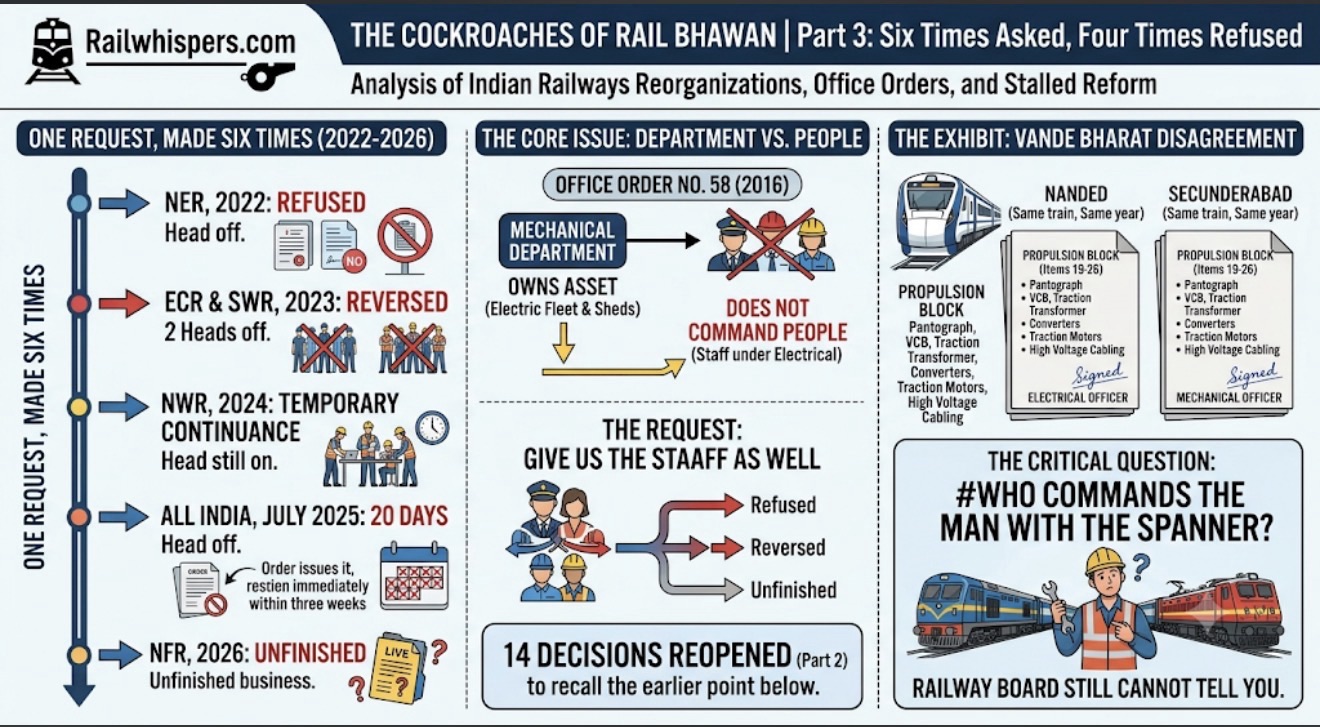
The Cockroaches of Rail Bhawan | Part 3: Six Times Asked, Four Times Refused
Everything in this part is one request, made six times, in six places, over four years
Indian Railways does not reorganise itself in public. It does it in office orders. Numbered, dated, two pages long, signed by a Joint Secretary, and filed to a folder on a website that the railway’s own officers struggle to find. Each order is small. Each order is lawful. Read one and you learn nothing. Read them in sequence, across eleven years, and you watch one department grow and grow, while nobody in Rail Bhawan ever writes the word expansion. This series reads them in sequence!
The hydra is the one creature in Greek mythology that beats you by losing.
Cut off a head and it grows another. You are not fighting an opponent, you are fighting a process, and each victory produces the next problem. Hercules did not win by cutting faster.
I have been reading Railway Board files for eleven years of this story, and I cannot find a better description of what follows.
What everybody is actually asking for
Part-1 left the mechanical department in a strange position. Office Order No. 58 of 2016, file number 2016/O&M/8/1, dated 3 August 2016, gave it the electric passenger fleet and the sheds those trains sit in. Clause 3 left the officers and the staff under the department they came from.
So the department owns the asset and does not command the people who work on it. Everything in this part is one request, made six times, in six places, over four years.
Give us the staff as well.
That request is not unreasonable. Hold on to that, because I am going to press hard on what happened to it, and the request itself was always defensible.
One. NER, 2022. Refused
The Principal Chief Mechanical Engineer (#PCME) of North Eastern Railway (#NER) asked first, by letter M/555/6/Pt XVIII of 24 June 2022. I have not seen that letter. I know its number because the Board’s reply quotes it, which is how a great deal of this series was assembled.
The reply is Board letter 2022/Elect(TRS)/225/14(NER) of 1 September 2022. It refuses, and it does not merely refuse the zone that asked, because it goes on to restate the position to every Principal Chief Electrical Engineer and every Principal Chief Mechanical Engineer on Indian Railways.
Head off.
Two and three. ECR and SWR, 2023. Reversed
Two other zones had gone ahead without asking.
On 2 February 2023 the Member (Traction and Rolling Stock), Naveen Gulati, wrote a demi official letter, 2022/Elect(G)/180/5, to all General Managers, recording that East Central Railway (#ECR) and South Western Railway (#SWR) were not implementing the 2019 position and directing compliance.
That is a Board Member telling the entire system, in writing, that two zones have to put things back.
Head off. Two heads, in fact.
Four. NWR, 2024. The word temporary
Now watch the shape change.
North Western Railway (#NWR) did not write to the Board asking permission. It issued a Gazetted Memorandum, 52/2024, numbered E/HQ/NWR/838/1(Mech.), on 15 July 2024. Train lighting and air conditioning staff, along with the infrastructure, the contracts, the annual maintenance contracts, the budget and the imprest, went under the Senior Divisional Mechanical Engineer for Carriage and Wagon.
I found that memorandum as an enclosure to a later letter, not as a published order.
The arrangement was described as temporary.
On 10 July 2026, two years later, the North Western Railway Employees Union wrote letter NWREU/DO-PNM/19/2026/181 recording that the temporary arrangement was still running, a day after a union memorandum of 9 July 2026 had asked for electrical control to be restored.
Nobody reversed it. Nobody had to approve it either. It simply continued, which is the most efficient way to win an argument you were told not to have.
Head still on.
Five. All India, July 2025. Twenty days
Then the same claim turned up at the top, in the Board’s own hand and over the whole of Indian Railways.
On 25 July 2025 the Board issued letter 2025/O&M/8/2. It is the largest single transfer in this whole story. Trainsets, including Vande Bharat and Namo Bharat, to depots managed by mechanical officers under the Chief Rolling Stock Engineer (Coaching), reporting to the Principal Chief Mechanical Engineer. Coaching depots and diesel multiple unit sheds brought under the same arrangement, and at the Research Designs and Standards Organisation the Carriage Directorate displacing the Power Supply and Electric Multiple Unit Directorate.
On 31 July 2025, six days later, the Additional Member for Traction sent note 2025/AM Tr./O01 to the Chairman. He demanded withdrawal. He recorded that the recognised federations had not been consulted, that no expert committee had examined it, and that it had not gone to the Full Board, unlike the 2019 exercise.
On 14 August 2025 the Board issued a letter under the same number, 2025/O&M/8/2. It runs to two sentences. It keeps the order of 25 July in abeyance until further orders.
Twenty days. An all India reorganisation of who maintains the country’s fastest trains, issued and suspended inside three weeks.
I do not need an adjective for that. The calendar is the adjective.
Head off.
Six. NFR, 2026. Unfinished
And here it is again, this month, at the other end of the country.
On 8 July 2026 the Principal Chief Mechanical Engineer of North Frontier Railway (#NFR) issued order Mech/MEMU Corr/2026-27/Pt. I. Mainline electric multiple unit rakes go to integrated coaching depots at Agartala and Lumding. Propulsion, suspension, pneumatics and undergear move to mechanical under the Senior Divisional Mechanical Engineer, while train lighting and cab air conditioning stay with electrical.
Read the first item on that list again. Propulsion.
On 13 July 2026 the Principal Chief Electrical Engineer of the same railway sent note EL/268/52/MEMU to the General Manager, opposing it. He cites the 2022 refusal and the 2023 reversal, which is to say he cites the heads that were already cut off.
What happened next, I do not know. I have no document after 13 July 2026 and I am not going to guess at the outcome of a live file. If it has been settled, I will report the settlement.
The exhibit
If you read nothing else in this series, read this.
Three joint procedure orders govern the maintenance of Vande Bharat trains at three depots, at Nanded, at Secunderabad and at Kacheguda. All three use the same table of twenty six items. Items 1 to 11 are the mechanical side, bogies and brakes and doors and couplers. Items 12 to 18 are the electrical side, air conditioning and lighting and batteries.
Items 19 to 26 are the propulsion block. Pantograph, vacuum circuit breaker, traction transformer, converters, traction motors, high voltage cabling.
At Nanded that block is signed for by an electrical officer.
At Secunderabad the same block, on the same train, from the same table, is signed for by a mechanical officer.
That is not my analysis. It is two signed orders of Indian Railways, in the same year, disagreeing with each other about who is responsible for twenty five thousand volts.
Now the fair bit, and it is genuinely fair
Six requests in four years is not a conspiracy. It is a department that believes it is right and keeps saying so, which is what departments are supposed to do.
And it may be right. The one asset, one manager principle is sound engineering administration. A train is one machine. Splitting responsibility for it between two departments produces exactly the buck passing that the travelling public has complained about for as long as there have been trains.
North Western Railway says its arrangement worked. In a letter of 29 June 2026 to the Chairman, the General Manager asked for the model to be adopted across India and claimed 52 per cent fewer unscheduled sick markings on electrical account and 43 per cent fewer Rail Madad electrical complaints. That is a claim by the party asking for the change, and I report it as such.
So I am not going to tell you which department should hold the spanner. That is an engineering question and better people than me disagree about it.
Here is what I will say, “In ten years the Railway Board has never answered the question.” It has refused, reversed, stayed and gone quiet. It has never amended the order that created the problem, and it has never let anybody finish the job either.
Cut a head, and the claim comes back at a different zone with a different file number. That is not a Board settling a dispute. That is a Board outlasting one.
And reversal is not a difficult act for this Board. Part 2 counted fourteen decisions of the same era reversed, withdrawn, or quietly never implemented, and some of them were Cabinet decisions.
So it can revisit an order. It does it readily.
Then why not this one?
The order it will not touch is the order its own zones have contested six times in four years. It is the order under which two depots, maintaining the same train from the same table, disagree about who is responsible for twenty five thousand volts.
Fourteen decisions of that era were reopened. This one was not. The question of who commands the staff on the passenger fleet is the question left open.
In Part-4 I will show you what the department was collecting while this argument ran.
Meanwhile, in a shed at Lumding tonight, a fitter is standing in front of a traction converter, and his supervisor is on the phone to Delhi.
Who commands the man with the spanner?