

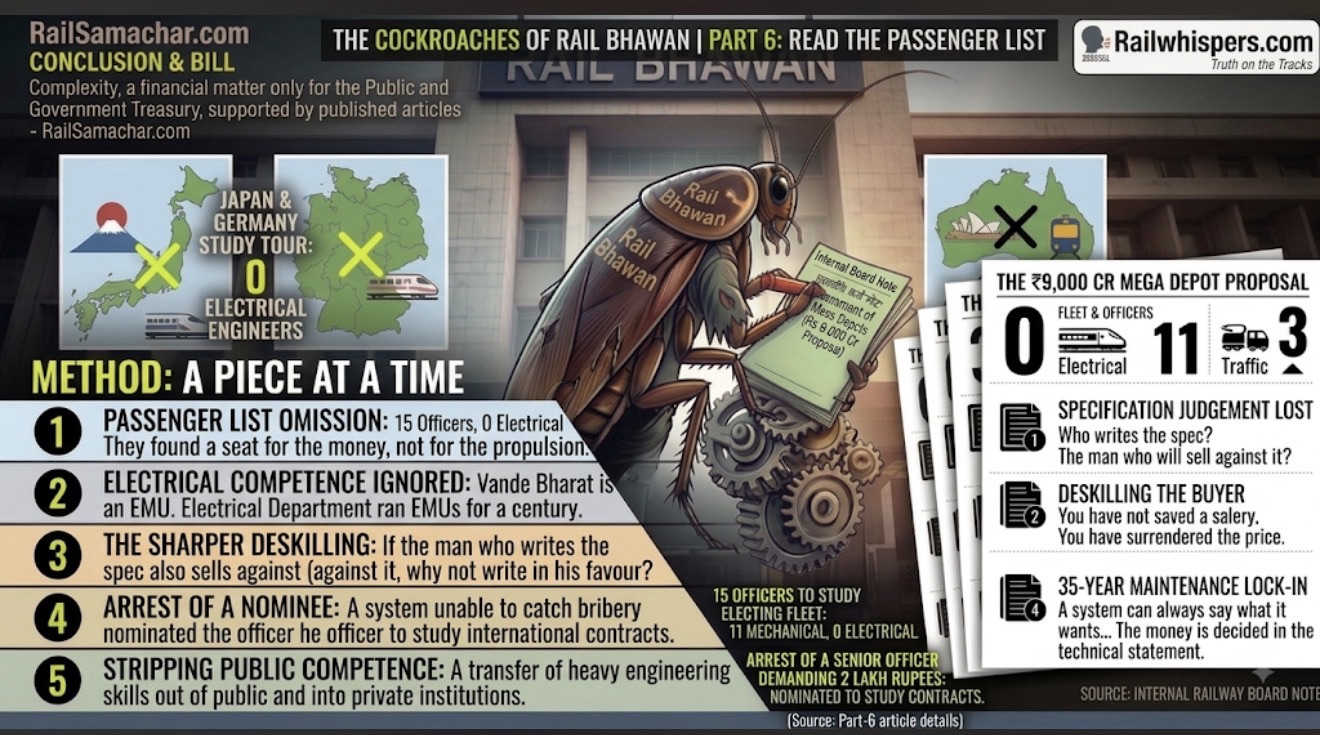
The Cockroaches of Rail Bhawan | Part 6: Read the Passenger List
This series ended six days ago. Then a whistleblower sent four pages..
Fifteen officers are to fly to Japan, Germany and Australia, to study how the world maintains its trains. Eleven are mechanical. Three are traffic. One is a finance officer. Not one is electrical. And the trains in question run on electricity.
Indian Railways does not reorganise itself in public. It does it in office orders. Numbered, dated, two pages long, signed by a Joint Secretary, and filed to a folder on a website that the railway’s own officers struggle to find. Each order is small. Each order is lawful. Read one and you learn nothing. Read them in sequence, across eleven years, and you watch one department grow and grow, while nobody in Rail Bhawan ever writes the word expansion. This series reads them in sequence!
The VI part of Cockroach series comes from a whistleblower input. Counter views are welcome. This article aims to promote discussion and debate in larger circle of railway Zones, instead of close coterie working in dark corners of Railway Board.
This series closed on 10 August. Two days later it presented the bill, in four invoices.
Aug 12, 2026: “The Cockroaches of Rail Bhawan | Hand the Machine to the Man Who Sold It”
A locomotive that costs half as much again and pulls less. A maintenance fee charged as a percentage rather than as a rate for work done. An “A-check” that went up ten times. The same item bought two ways from the same contractor, at two prices.
The argument running under all four was that the railway has been arranging, order by order, to be a worse buyer of its own maintenance than it needs to be. The essay’s closing line was about the young engineer who would have learned the machine, and is given an invoice to check instead.
Deskill the buyer, it said, and you have not saved a salary. You have surrendered the price.
There is a sharper version of that, and any officer who has sat through a tender committee (#TC) will recognise it at once.
A railway can always say what it wants at the level of a wish. More trains. Faster turnround. Fewer failures. Air conditioning that works in Nagpur in May. Any Member of the Board can put that on the table, and none of it is a technical statement.
The technical statement is the specification. That is the document which turns “we need a train that does this” into a list of what the train must have, down to the converter rating, the bogie design and the software interface. The money is decided there, long before the tender opens.
And that is the document the railway has been quietly getting out of the business of writing.
Once your own engineers are out of that room, you lose the single judgement that matters most in public buying. It is the judgement that tells you when a Maruti Alto will do the job you were about to buy a Mercedes for.
Nobody makes that call off a wish list. You make it from knowing the machine, and knowing what the machine actually needs to do.
So ask the obvious question, and ask it without any indignation, because the answer is not a scandal. It is arithmetic.
If the man who writes the specification is also the man who will sell against it, and then maintain what he sold for thirty-five years, why would he not write it in his own favour?
He would be a poor businessman if he did not. The fault is not his.
Four days later, a whistleblower sent me a document.
I am satisfied it is genuine. I will not say more than that, for reasons any serving officer will understand.
So let me tell you exactly what it is, and you can weigh it yourself.
Four pages, and page four is a photograph of a table rather than a printed page. That is what a paper looks like when it comes out of an office instead of off a website.
The subject line reads: “Proposal for visit regarding Development of Mega Depots over Indian Railways.”
₹9,000 crore, and three aircraft
The background section is the part any railwayman will recognise. The coaching fleet has grown. The mix has changed, from the old Integral Coach Factory (#ICF) stock to Linke Hofmann Busch (#LHB) rakes and then to Vande Bharat Chair Car, Vande Bharat Sleeper, Namo Bharat, Amrit Bharat and Vande Freight. Wagon numbers will rise sharply over five years. The sheds cannot cope, and in the metropolitan cities there is no room to build more of the sheds that already exist.
The answer proposed is the Mega Depot. One depot doing Routine Overhaul (#ROH) for 750 to 1,000 wagons a month and Periodic Overhaul (#POH) for 500. Four zonal railways with the heaviest loading are named as the planners: South Eastern, East Central, South Central and West Central.
Two works already stand sanctioned in the 2025-26 books. ₹6,000 crore for “Development/Up-gradation of Mega Coaching Depots”. ₹3,000 crore for “Creation of Mega Maintenance Depot for Freight Rolling Stock”.
₹9,000 crore, and that is only what has been sanctioned so far.
The railway needs these depots. I want that on the record before anything else, because it is true. The fleet has changed. A depot built for a twenty-four coach ICF rake will not maintain a trainset well. If a Mega Depot is the right answer, somebody should go and see how the rest of the world builds one.
Which is what the second half of the note proposes. Three teams, five officers each. Germany from 7 to 11 September, Japan from 21 to 25 September, Australia from 5 to 9 October.
There are nine objectives set for those teams, and what they ask for is the subject of Part 7. This part is about something simpler. It is about who is going.
Now read the passenger list
Fifteen officers travel. I am giving you designations and no names, because a posting is not a decision and these men did not put themselves on this list.
- Team one, to #Japan: an Executive Director, Mechanical Engineering (Coaching); a Director, Projects and Development, who is also a mechanical officer; a Senior Divisional Operations Manager (#SrDOM); a Senior Divisional Mechanical Engineer (#SrDME) for Carriage and Wagon; and a SrDME/Freight.
- Team two, to #Germany: an Executive Director for Gati Shakti and Finance, who is a finance officer; a Joint Director, Mechanical (Coaching); a second Senior DOM; a third Senior DME, Freight; and a Senior Chief Depot Officer, who is mechanical.
- Team three, to #Australia: an Executive Director, Mechanical Engineering (Freight); a Director, Mechanical Engineering (Coaching); an Additional Divisional Railway Manager, who is traffic; a second Senior Chief Depot Officer, also mechanical; and a fourth Senior DME.
Count them by department. It takes a minute, and every one of the fifteen can be placed.
Eleven are mechanical. Three are traffic. One is finance.
Not one is electrical.
Hold those first and last numbers together for a moment, because they are this series in a single line. Mechanical and electrical are the two departments that have written to each other, and to the Board, for a decade, about which of them commands the man who maintains these trains. Part 3 counted six attempts to settle it and four refusals.
On this list, one of those two departments has eleven seats. The other has none.
Now set that against the fleet in the note’s own first paragraph. Vande Bharat Chair Car. Vande Bharat Sleeper. Namo Bharat. Vande Freight. Every one of those is an electric train. The costly, difficult, proprietary part of each of them is the traction converter, the propulsion control, the auxiliary supply and the train control electronics. That is not mechanical work and never has been.
They found a seat for the money. They did not find one for the propulsion.
And none of this is new work for anybody
Here is the part that ought to embarrass somebody.
The electrical department built the electric multiple unit car sheds and the suburban depots, and it ran them for the better part of a century. Every Mumbai local that ran before 2016 was maintained under that arrangement, at the intensity Mumbai demands, on stock that is out on the road nineteen hours a day.
Office Order 58 changed the flag on the building. It did not change the men inside it, and it said so in terms. Clause 2.2 reads that there will be no changes at Divisional level.
So in shed after shed, at working level, the same people are still doing the same job today.
Which makes the Vande Bharat story a strange one to sell.
That fleet is being promoted as though it needs maintenance infrastructure of an entirely new kind, and the note assumes it from the first paragraph to the last.
So strip the livery off and ask what a trainset actually is.
It is an electric multiple unit, or it is a push-pull rake. That is the whole of it. The propulsion is distributed along the train instead of sitting in a locomotive at the front, and the electronics are newer and more closely held.
This railway has been maintaining electric multiple units since before India got Rail Bhawan.
The competence is not lost. It is on the shop floor this morning, in every car shed in the country.
So the question this proposal never asks is the one worth asking.
Not whether Indian Railways can maintain a multiple unit. It has been doing that for a century.
And the carriage is not new either.
This railway has been building and maintaining coaches for more than a hundred and fifty years. Highly decorated saloons. Four wheelers. ICF shells. LHB stock. The body, the bogie, the brake gear, the doors, the pantry. Known work, done in railway workshops, by railway hands.
So what is actually new about a Vande Bharat?
The electrics. That is the answer, and it is the entire answer.
Somebody in this chain appears to have forgotten it. Take out the traction converter, the propulsion control and the train control electronics, and a Vande Bharat does not run badly. It does not run at all.
Why does a plan costing nine thousand crore rupees begin from the assumption that Indian Railways cannot do this work?
One more thing about that list
You should hear this here rather than find it later.
On 14 August, three days after this proposal was put into the form I hold, the Central Bureau of Investigation arrested one of the fifteen. He is a Senior Divisional Mechanical Engineer of Bhilai, South East Central Railway.
The allegation, in the agency’s own account, is that he demanded two lakh rupees to clear a contractor’s pending bills and settled at one lakh. The trap recovered fifty thousand, handed over through a middleman. The searches that followed, at his house and his office, recovered about seventy-seven lakh rupees in cash and fourteen lakh rupees in jewellery. He and the middleman were produced in court on 14 August and remanded to four days in CBI custody.
He is charged and not convicted, and I am not going to name him. The point is not the man.
The point is that a system which could not see what was happening to the maintenance bills on one officer’s desk had nominated that officer to fly to Germany and study how the world manages maintenance contracts.
The concession, and it is a real one
Now the counter-argument, at its strongest, because a fair charge is a heavier charge.
This is an extract, and a fuller note may carry a fourth team or a nomination it does not show. Nominations also change between proposal and sanction, as anybody who has waited on a foreign visit clearance will tell you, and sometimes they change on the day before the flight.
I should say that I looked hard for an electrical officer hiding in an abbreviation, and there is not one. Every designation on those three teams has been placed. The two depot officers are mechanical. The Additional Divisional Railway Manager (#ADRM) is traffic. There is no ambiguity left to give the benefit of.
And there is a straightforward institutional answer available. Office Order 58 of 2016 gave the coaching fleet and its sheds to the mechanical department. If mechanical owns the depot, mechanical goes to see depots. On that reading the list is not a slight at all. It is an organisation chart, walking through an airport.
That answer is the whole problem, and Part 1 of this series was about why.
The gap, ten years on, boarding a flight
Office Order 58 moved the asset. Clause 3 left the cadre where it was. The department was handed the shed and not the hand that holds the spanner, and every part of this series since has been an account of what followed. Six attempts to close that gap in four years. Four of them stopped by the Board. The order never amended.
Aug 6, 2026: “The Cockroaches of Rail Bhawan | Part-1: Read the Last Column”
Aug 8, 2026: “The Cockroaches of Rail Bhawan | Part 3: Six Times Asked, Four Times Refused”
We already know what that gap looks like on paper, because Part 3 printed it.
Three joint procedure orders (#JPO) govern Vande Bharat maintenance, at Nanded and at Secunderabad. All three use the same twenty-six item table. Items 19 to 26 are the propulsion block, the heart of the train and the costliest thing on it. At one depot those eight items sit with an electrical officer. At the other, with a mechanical one.
Same train. Same table. Same railway. Two answers.
The Ministry has not settled that question in a decade of correspondence, so it gets settled depot by depot, in whichever direction the local file happened to fall.
This proposal settles it too. It settles it by not inviting anybody.
And that is a different kind of decision from the ones this series has been reading. An office order can be produced, cited, argued with and reversed, and Part 2 counted 14 (fourteen) decisions of the same era reversed exactly that way. A travel list cannot be argued with, because nothing in it says no to anybody. There is no clause to attack. There is only an absence, and absences do not generate files.
A note tells you what a department intends. A passenger list tells you what it believes it owns.
Why nobody in the room will miss experts in high voltage electrical systems and high power electronics
Part 5 of this series read clause 6.1.2(c) of the Vande Bharat agreement, in which the Government undertakes to “provide manpower for manufacturing and maintenance of the Trains”. It read clause 17.2, which fixes the maintenance period at thirty-five years, and it printed the Board’s four-word answer to the bidder who asked for fifteen.
Aug 10, 2026: “The Cockroaches of Rail Bhawan | Part 5: Who Pays, Who Runs It”
Read the passenger list against those clauses and the absence stops looking careless.
If the propulsion equipment is to be maintained by the firm that built it, for the design life of the train, under a contract already signed, then you do not need a propulsion engineer in the room when the depot is planned. You need a contract manager. You need somebody easy with lifecycle costing and risk allocation. You need a buyer.
The list is not missing an electrical officer. It was drawn up by people who have concluded that the railway will not need one.
What a railway is for
This is where I part company with the arrangement, and I want to be plain about the ground I am standing on.
Indian Railways is not a transport company. It is public infrastructure, and it carries obligations that a transport company does not.
It is required to buy a quarter of its goods and services from micro and small enterprises. That is not an aspiration. It is the Public Procurement Policy for Micro and Small Enterprises, mandatory since 1 April 2015, with four per cent reserved for enterprises owned by Scheduled Castes and Scheduled Tribes and three per cent for those owned by women. The Ministry buys more than seventy thousand crore rupees of goods and services a year.
It employs eleven lakh seventy-five thousand people, and it is held up by this government, correctly, as one of the country’s great engines of employment.
And it is the largest single repository of heavy engineering skill the Republic possesses.
Measure this method against those three things.
A depot designed around a single technology partner does not build a supplier base. A thirty-five year maintenance contract does not create an apprentice. An officer sent abroad to study contract structuring does not come home a better engineer, however good the trip.
Part 5 made that point about one man’s career. Widen it to a service.
By the time a thirty-five year contract has run its life, Indian Railways will be staffed, top to bottom, by officers who have known no other arrangement. Not one of them will have stripped a traction converter. Every one of them will have verified an invoice.
And on the day somebody has to write the next specification, they will do the only thing left open to them.
They will ask the vendor what the railway needs.
A method that strips technical competence out of the railway is not a saving. It is a transfer, out of a public institution and into a private one, and the country pays for it twice.
The question, in the form this series always asks it
Not who is to blame. Ask who was in a position to prevent this, and had the file in front of him.
Somebody drew up three teams. Somebody counted eleven mechanical officers onto them, and three traffic officers, and one from finance. Somebody in Rail Bhawan then read a proposal to study the maintenance of Vande Bharat and Namo Bharat trains, and did not ask the question a Principal Chief Electrical Engineer would have asked in four seconds.
Where is my department?
So, two asks, and both are cheap.
- Publish the approved delegation, the sanctioned cost and the terms of reference. If a fourth team exists, or an electrical nomination, this article is wrong, and I would rather be corrected in public than right in private.
- Nominate electrical officers to every team that will study a depot maintaining an electric fleet. There is still time. The first flight leaves on 7 September.
The note’s own table says the Japanese depot strips the body, rebuilds the bogie and repaints the car, in house, with the railway’s own people, and doubles as its training centre.
Fifteen Indian Railways officers are going to look at that.
Whether they are being sent to build it or to price it is the subject of Part 7. So is the harder question underneath it.
When those fifteen come home and put up a note, who is left in Rail Bhawan able to argue with it???
#IndianRailways #RailBhawan #MegaDepots #OfficeOrder58 #VandeBharat #NamoBharat #MSME #PublicInfrastructure #RollingStock #IRSEE #IRSME