

The Cockroaches of Rail Bhawan | Part 4: Feeding the Cockroaches
“An officer who has never opened the converter cannot write the specification for the next, and cannot argue about the price of servicing!”
Indian Railways does not reorganise itself in public. It does it in office orders. Numbered, dated, two pages long, signed by a Joint Secretary, and filed to a folder on a website that the railway’s own officers struggle to find. Each order is small. Each order is lawful. Read one and you learn nothing. Read them in sequence, across eleven years, and you watch one department grow and grow, while nobody in Rail Bhawan ever writes the word expansion. This series reads them in sequence!
In January 2015 something small was wheeled into Rail Bhawan and everybody waved it through.
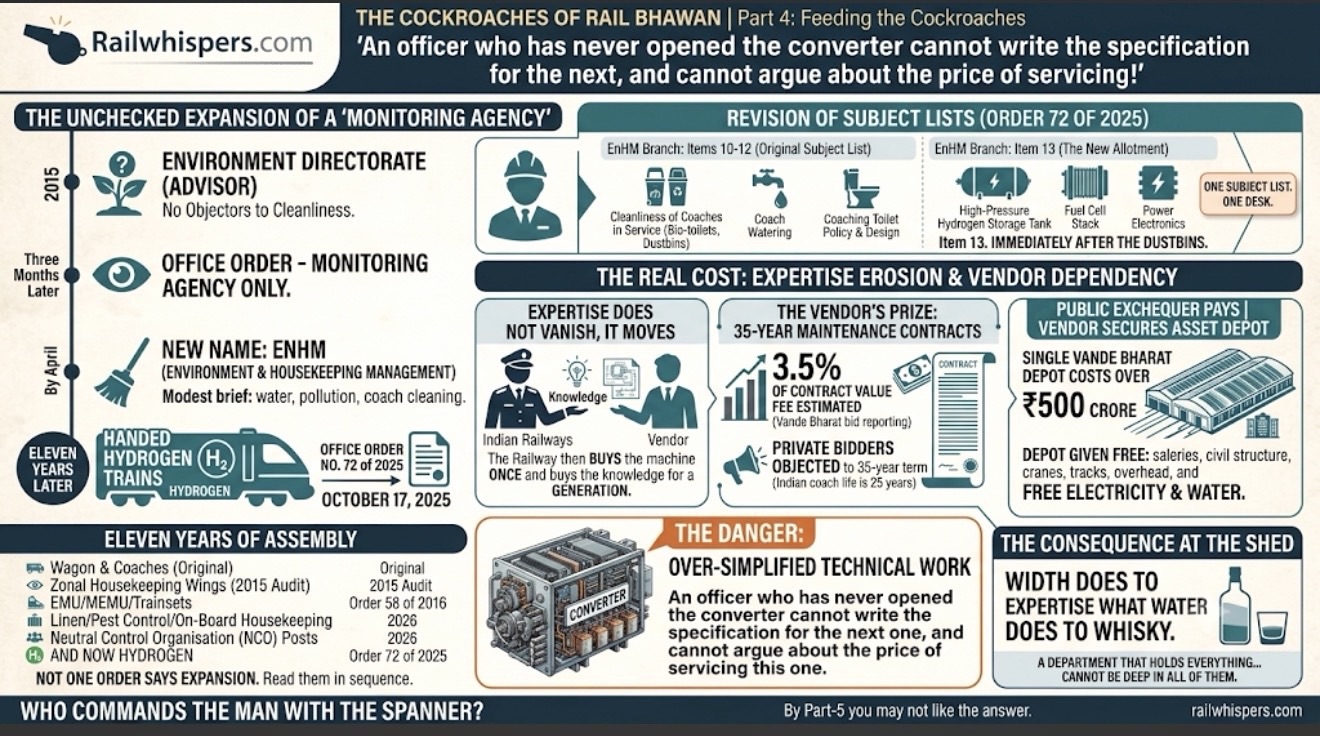
It was called the Environment Directorate. An Advisor ran it, reporting to the Chairman. Six directorates lent it an Executive Director each. Three months later an office order recorded that it was a monitoring agency and not an executing one. By April it had a new name, Environment and Housekeeping Management (#EnHM), and a modest brief. Watch the pollution. Watch the water. Keep the coaches clean.
Nobody objected, because who objects to cleanliness.
Eleven years later, that same branch has been handed hydrogen trains.
I am not being clever. There is an order, with a number, a date and a signature.
The order
Office Order No. 72 of 2025, file number 2025/O&M/7/20, dated 17 October 2025, signed by T. Srinivas, Joint Secretary of the Railway Board.
Where I found it matters, so I will tell you. It is not on the Railway Board’s own order page. I did not know it existed until a Board letter of March 3, 2026 mentioned it in passing. It turned up as an enclosure, on page two of a twenty five page file, on a zonal railway’s server.
Its subject line is a piece of pure Rail Bhawan: “Revision of subject lists of Environment & Housekeeping Management (#EnHM) Branch and Mechanical Engineering (Coaching) Branch.”
Three subjects move out of the Mechanical Engineering (Coaching) Branch and into the Environment & Housekeeping Management Branch. Cleanliness of coaches in service, including bio-toilets and dustbins. Coach watering. And coaching toilet policy, with the design and maintenance of coach toilet systems. They become items 10, 11 and 12.
Then comes clause 2, and I will quote it whole so that nobody accuses me of trimming it.
“It has also been decided to allot the subject of ‘Hydrogen related projects and Hydrogen Trainsets’ to EnHM Branch under Item No. 13 of their subject list.”
Item 13. Immediately after the dustbins.
Items 10 to 13, read together
I will resist the adjective here, because the two subjects do the work themselves.
Item 10 is a lavatory pan with a water seal and a bin beside it. Item 11 is a hose on a platform. Item 12 is the policy on the pan. Item 13 is high pressure hydrogen storage, a fuel cell stack, and the power electronics that turn the output of that stack into traction current.
One subject list. Four consecutive numbers. One desk.
This is not a filing quirk
Somebody will tell you that a subject list is administrative housekeeping, that the work still happens in the zones, and that I am making a meal of a stationery cupboard.
I would take that seriously if a subject list did nothing. It does three things. The branch that holds a subject frames the specification. It sits on the committee that evaluates the bids against that specification. And it signs off on the design that comes back.
Put a lavatory and a hydrogen fuel cell on the same desk and you have not saved a post. You have guaranteed that neither subject gets an officer who understands it.
What happens when the railway stops understanding its own machines
Here is the charge, and it is not about cleanliness at all.
Expertise does not vanish when a railway stops holding it. It moves to the only party left in the room who has it, which is the firm that sold you the machine. The railway then buys the machine once and buys the knowledge for a generation.
The figures that follow are published reporting, not orders I hold, and I attribute each one.
Srinand Jha, reporting on the Vande Bharat bid documents in, “Vande Bharat: The good and the bad”, 31 October 2022, set out the terms. The railway provides the manufacturing units, the depots, the washing lines, the civil structure, the cranes, the tracks, the overhead equipment, and free electricity and water. It pays the salaries of its own staff. It then pays the technology partner an annual maintenance fee estimated at 3.5 per cent of the total contract value.
And it provides the men. That one is not a matter of reporting at all. The Manufacturing cum Maintenance Agreement attached to Railway Board tender WTA-527, at Article 6.1.2(c) on page 27, obliges the Government to “provide manpower for manufacturing and maintenance of the Trains”.
Nine words, in a tender document, in April 2022. Hold them until Part-5.
The same report records that the private bidders objected to the 35 (thirty five) year maintenance period, on the ground that the codal life of an Indian coach is twenty five years. Note who was objecting. Not the railway.
As we wrote in, “A Coach Broke in Two—The Real Crack Is in Rail Bhavan”, 8 June 2026, a single Vande Bharat depot costs the public exchequer more than ₹500 crore, and a single locomotive can carry close to a dozen annual maintenance contracts.
And in “The OEM vis-vis Third Party Maintenance Conundrum”, 15 April 2025, the A-check on a power car, once done departmentally by train lighting and air conditioning staff, is reported to have risen from a few hundred rupees to about 5,000.
The author of this series puts it more bluntly than I will. The sale is no longer the prize. The spares and the maintenance contract are the prize. That is characterisation, not a finding, and I mark it as such. The mechanism underneath it needs no adjective. An officer who has never opened the converter cannot write the specification for the next one, and cannot argue about the price of servicing this one.
The fair bit, and it is genuinely fair
On April 22, 2024 the Chief Mechanical Engineer for Planning and Environment and Housekeeping Management on Northern Railway, Archana Mittal, signed letter 143-M/44 forming housekeeping wings in the Delhi, Lucknow, Moradabad and Ambala divisions. I found it as a photograph in a blog post, because it was never published as a file.
Read the reason clause. The wings were formed to comply with an audit observation and a Parliamentary report. The Comptroller and Auditor General, in Report 16 of 2022, had found that of fifty four divisions audited, eleven had no housekeeping wing at all. Four of the eleven were on Northern Railway. The Public Accounts Committee said the same thing again on 5 January 2024.
So concede it, and concede it fully. That order creates no new post. It renames four existing ones. A department slow to form a wing is not a department seizing work.
Now turn it over. The directorate was created in 2015. Nine years later, four divisions of the country’s most scrutinised zone had still not formed the wing, and formed it only when the national auditor and a Parliamentary committee said so. Compare that with the speed at which this same organisation moves a subject it wants. Office Order 72 took one page.
A reform that has to be audited into existence was never a reform. It was a directorate looking for a duty list.
The width, assembled
Now put the eleven years in one paragraph, which is the only way anyone ever sees it.
Wagons and coaches, held from the beginning. Zonal housekeeping wings under the Chief Mechanical Engineer from 28 August 2015. Electric multiple units, mainline electric multiple units and trainsets, by Office Order 58 of 2016. Linen, pest control and on board housekeeping. The housekeeping directorate itself placed under the Mechanical Engineering Directorate on December 5, 2017, by Office Order 97 of 2017, a document whose existence I learned of only because a later order cited it. Five officer posts of the #IRSME (Indian Railway Service of Mechanical Engineers), from the revival of the Neutral Control Organisation (#NCO) on 28 July 2026, carved out of existing strength so that nobody had to ask for new posts.
And now hydrogen.
Not one of those orders says expansion. Read them one at a time and you will not find a villain in any of them.
Four days in August
Between 2 and 3 August 2026 three motor coaches failed on the electric fleet this department owns.
A mainline electric multiple unit caught fire at Simri Bakhtiyarpur on East Central Railway at 3.25 in the morning. The extinguishers did not hold it. Four fire units and two hours and fifteen minutes did. At Mahidpur Road on West Central Railway a train manager watched sparking inside the vacuum circuit breaker of a motor coach, which then caught fire. That coach had been given a trip inspection the previous day. At Pune the tin roof of a motor coach broke and touched the overhead wire.
I am not going to tell you this is a trend, because I cannot. Nobody has given me the denominator, and Indian Railways runs several thousand such services every day.
What the three do show is what the work looks like at the shed. A vacuum circuit breaker is not a fitting. It is the device that isolates twenty five thousand volts from the rest of the train, and treating it as one more line on a maintenance sheet is what an oversimplified view of technical work produces at the far end of a muddled command.
The charge, stated exactly
I am not saying that mechanical engineers are incompetent. That charge would be stupid and unfair, and the men running these sheds are as good as any in the service.
I am saying something narrower and worse. “Width does to expertise what water does to whisky.”
A department that holds wagons, coaches, workshops, the electric passenger fleet, linen, pest control, coach watering, lavatory design and hydrogen traction cannot be deep in all of them. Nobody could be. And the depth it loses does not stay in Rail Bhawan. It ends up in a vendor’s technical services division, on a thirty five year contract.
So do not ask who is to blame. Every one of those orders passed a Joint Secretary, a Member and a file. Ask instead who—at any point in eleven years—was in a position to read them in sequence and say that this branch already had enough.
Who commands the man with the spanner? By Part-5 you may not like the answer.