

The Cockroaches of Rail Bhawan | Part-2: Fourteen Reversals and One Survivor
“An organisation that reverses its own bad decision is better than one that defends it to the grave!”
Indian Railways does not reorganise itself in public. It does it in office orders. Numbered, dated, two pages long, signed by a Joint Secretary, and filed to a folder on a website that the railway’s own officers struggle to find. Each order is small. Each order is lawful. Read one and you learn nothing. Read them in sequence, across eleven years, and you watch one department grow and grow, while nobody in Rail Bhawan ever writes the word expansion. This series reads them in sequence!
Let me start by paying the Railway Board a compliment, because it has one coming and because the rest of this piece is going to be hard on it.
An organisation that reverses its own bad decision is better than one that defends it to the grave. Indian Railways has spent the last six years quietly undoing a great deal of what it announced with fanfare in December 2019, and on the merits most of that undoing was right. It takes something to admit that a Cabinet decision did not work.
So this is not a piece about a Board that cannot make up its mind.
It is a piece about a Board that can change its mind on anything you like, at speed, in the Gazette of India, and has never once changed its mind about the order in Part-1.
What the Board is capable of when it wants to be
In Part-1, I showed you Office Order No. 58 of 2016, file number 2016/O&M/8/1, dated 3 August 2016, which moved the electric passenger fleet and its sheds from one Board Member to another and left the men behind. It is not on the Railway Board’s order page. The copy I read is the one annexed to Board letter 2019/O&M/8/3 of 18 July 2019.
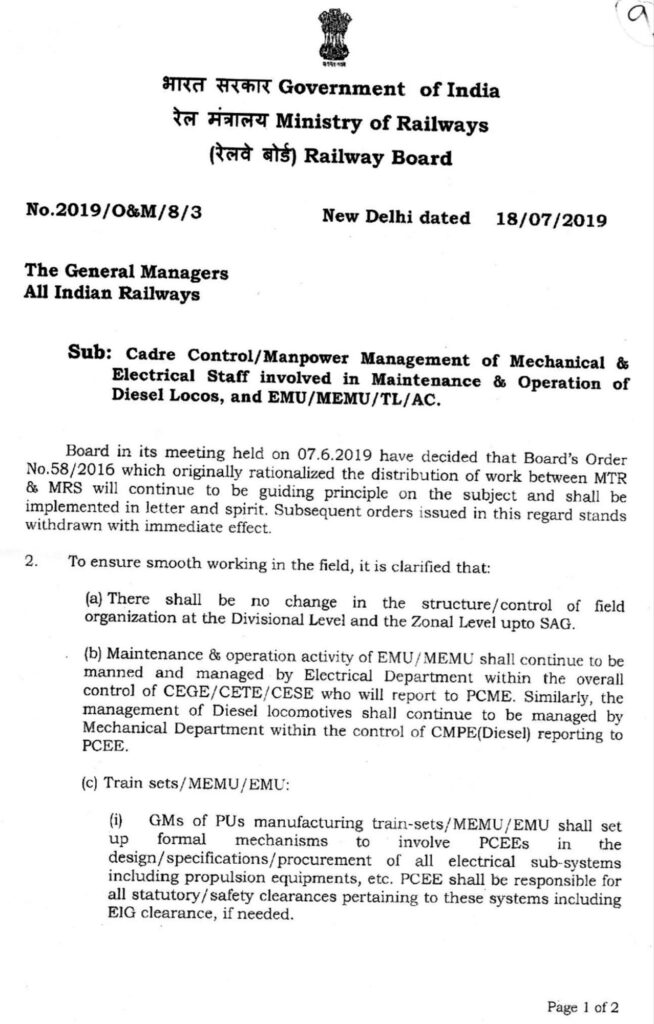
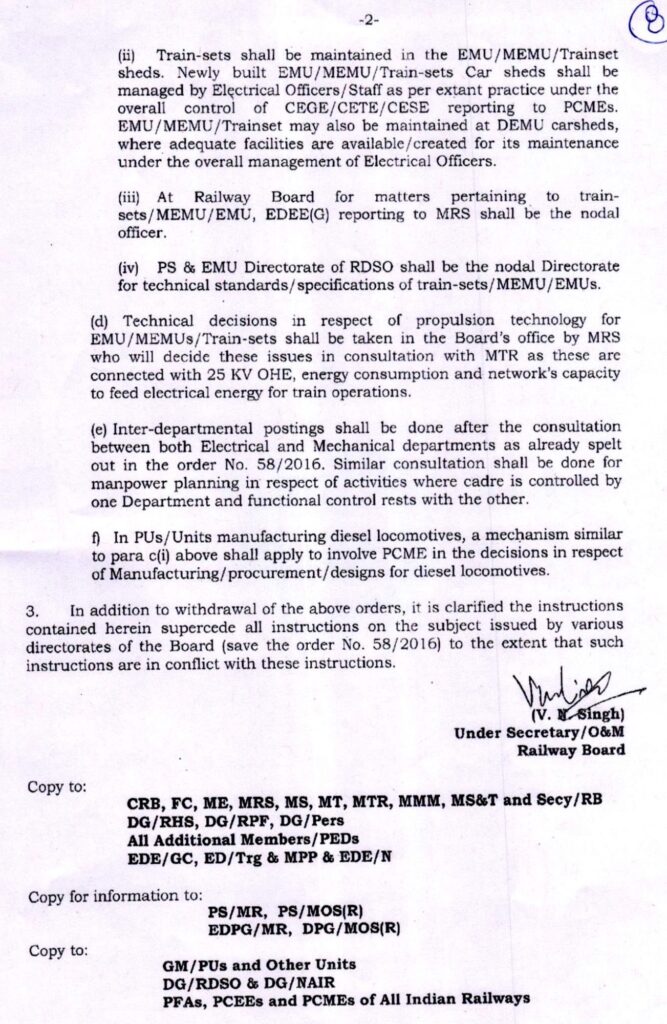
Hold that order in your head. Now watch what the same building did to everything else.
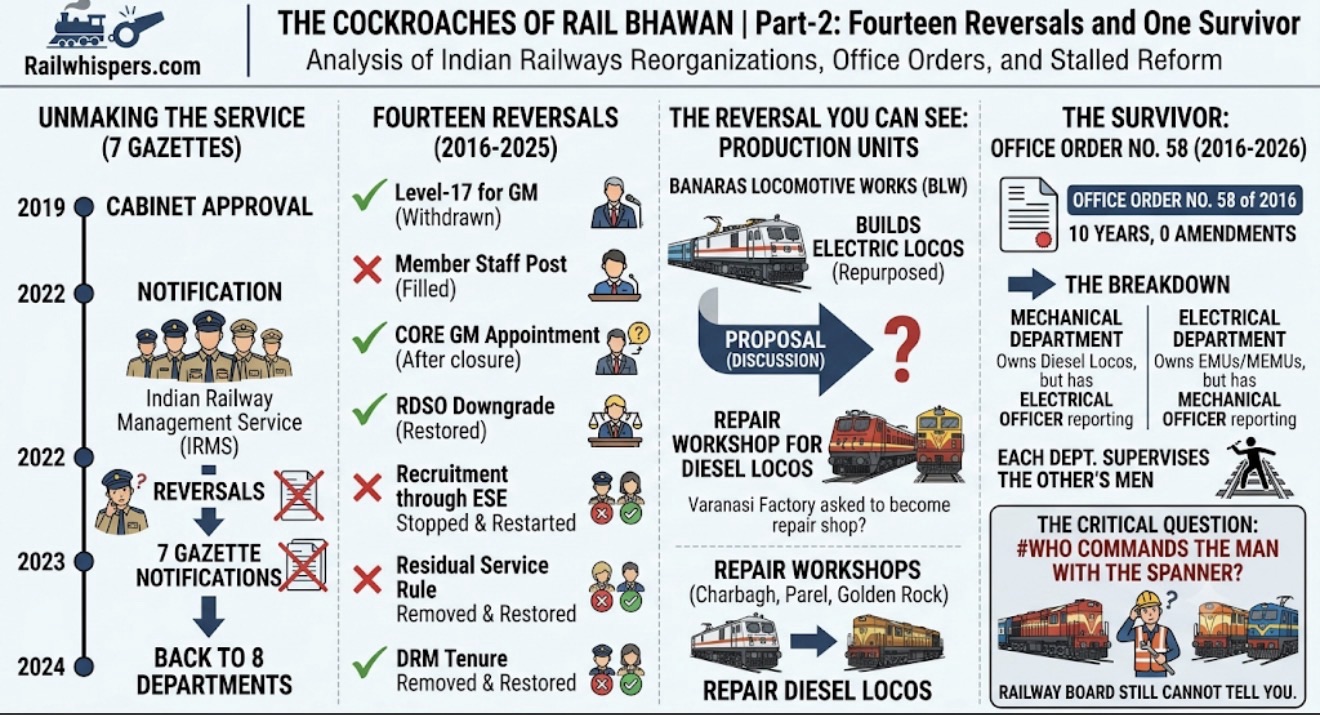
In December 2019 the Union Cabinet approved the merger of eight Group ‘A’ railway services into one Indian Railway Management Service (#IRMS). It was the reform of the era. It followed the Parivartan Sangoshthi of 7 and 8 December 2019 and an extraordinary Board meeting on the second day. The notification giving it effect came on 9 February 2022.
By the sixth gazette notification on the subject, dated 9 October 2024, Indian Railways was back to eight departments.
Seven gazette notifications were required in all. Seven. To create a service, argue with it, and put the pieces back where they were found.
That one took seven gazettes, and it is not the only case of its kind. Take three more from the same period.
Every General Manager was to be raised to Level-17, which is Secretary grade, and that was withdrawn at Rail Bhawan’s own request. The post of Member Staff was to be surrendered altogether under the Cabinet reform, which is the kind of thing a Cabinet decision is usually taken to settle. It was never surrendered, and the post was filled again by 2021.
And the Central Organisation for Railway Electrification (#CORE) at Prayagraj was closed with effect from 31 December 2023. In January 2024, weeks later, it was given a General Manager.
I could go on, and the ledger does. The emotional intelligence test, introduced by gazette resolution of 27 May 2022, cancelled. Gati Shakti works, taken out of the divisions. The Research Designs and Standards Organisation (#RDSO), downgraded and then restored. Recruitment through the Engineering Services Examination (#ESE), stopped and restarted. The one year residual service rule for Board posts, removed in 2022 and restored by the seventh gazette of November 2025, which in the same breath went the other way on Divisional Railway Manager (#DRM) tenure and struck it out as a prerequisite for the top posts.
Most of this is documented in “The Gazeteers“, 15 March 2025, which is our own earlier work and which I cite for that reason.
Fourteen decisions of the transformation era, between 2016 and November 2025, reversed, withdrawn, or never implemented at all.
Now, a ledger of reversals only tells you that an organisation changed its mind. It does not tell you which way it travelled. So count the chairs.
The 2019 reform existed to end department culture. Today the Member Operations and Business Development (#MOBD) chair is reserved. So is Member Finance (#MF). And the post of Director General Staff (#DGHR) is now reserved as well.
Two of those were reserved already. The third is new.
So the seven gazettes did not put the railway back where it started. They left the Railway Board more rigid than the Board that began the exercise. An organisation that reverses a reform and ends up harder than before has not corrected a mistake. It has spent six years arriving somewhere worse.
The people who wrote both drafts
Here is the part that should trouble you more than the reversals do.
Readers of this site know the phrase the Khan Market Gang (#KMG), and it is usually thrown at somebody else. The railway has its own version, and it is smaller and much better placed.
The same narrow circle in Delhi drafted the making and drafted the unmaking. The note proposing the merger and the note dismantling it moved through the same rooms, past the same desks, in the same handwriting. Nobody was held to account for the first, because the second was presented as the correction.
That is worth stating plainly and then leaving alone, because I cannot prove motive and I am not going to pretend otherwise. What I can show you is the arithmetic. Seven gazettes to unmake one service. And not one line, in ten years, on the order that gave a department a fleet.
The reversal you can see from a train window
All of that is paper. Here is one in brick, and it is happening now.
Diesel Locomotive Works (#DLW) at Varanasi built locomotives, which is what a production unit does and what that unit was built to do. It did not repair them and it did not rehabilitate them, because that is a different trade done in a different kind of establishment, the locomotive workshops.
Under the policy of moving the whole system to electric traction, the unit was repurposed to build electric locomotives and renamed Banaras Locomotive Works (#BLW). A factory that builds electric locomotives has to carry more electrical engineering weight than one that builds diesel locomotives, and its skill mix moved accordingly.
A proposal now under discussion inside Indian Railways would convert that unit into a repair workshop for diesel locomotives. The skill mix would have to move back.
Meanwhile Charbagh at Lucknow, Parel at Mumbai and Golden Rock at Tiruchirappalli continue to repair and rehabilitate diesel locomotives, as they have for decades.
Read those two sentences together and you have the whole argument. A factory that has never repaired a locomotive is being considered for the job of repairing locomotives. The workshops that do repair locomotives carry on repairing them.
Among people who have spent their careers in locomotive production, the reaction to this is bafflement. Officers who have run these workshops do not understand it.
I want to be exact about the tense, because it matters. There is no order. No decision has been taken. This is a proposal under discussion, and I have it from senior officers, serving and retired, several of whom retired in the highest ranks of the service. If the Board tells me tomorrow that it was never seriously considered, I will print that with pleasure.
Which brings me to the one thing that makes this passage different from everything else in this series. Every other document here reached me years after it was signed. This one has not been signed. For once the reader has arrived before the order does, and a proposal—unlike an executed order—can still be stopped.
And one sentence of comment, which I will keep to one sentence. Varanasi, of all cities, is entitled to ask why a factory that builds is being asked to become a factory that mends.
The survivor
Now put Office Order 58 of 2016 back on the table.
Ten years. Fourteen decisions of the same vintage reversed around it. Seven gazettes on the service structure alone. Not one amendment to Office Order 58/2016.
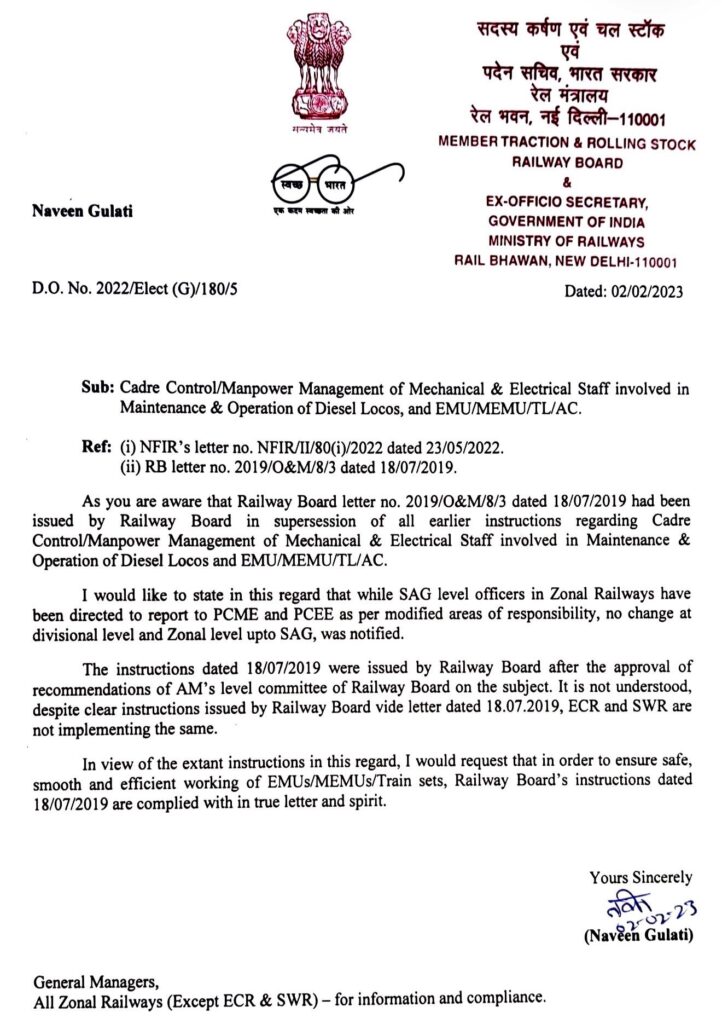
It is worse than unamended, because on 18 July 2019, after a Board meeting of 7 June, the Board issued letter 2019/O&M/8/3, which swept away every later order on the subject and restated Office Order 58 as the guiding principle. Paragraph 2(b) is the operative one. Electric multiple unit (#EMU) and mainline electric multiple unit (#MEMU) work is staffed by electrical officers, reporting to the Principal Chief Mechanical Engineer (#PCME). Diesel locomotives are staffed by mechanical officers, reporting to the Principal Chief Electrical Engineer (#PCEE).
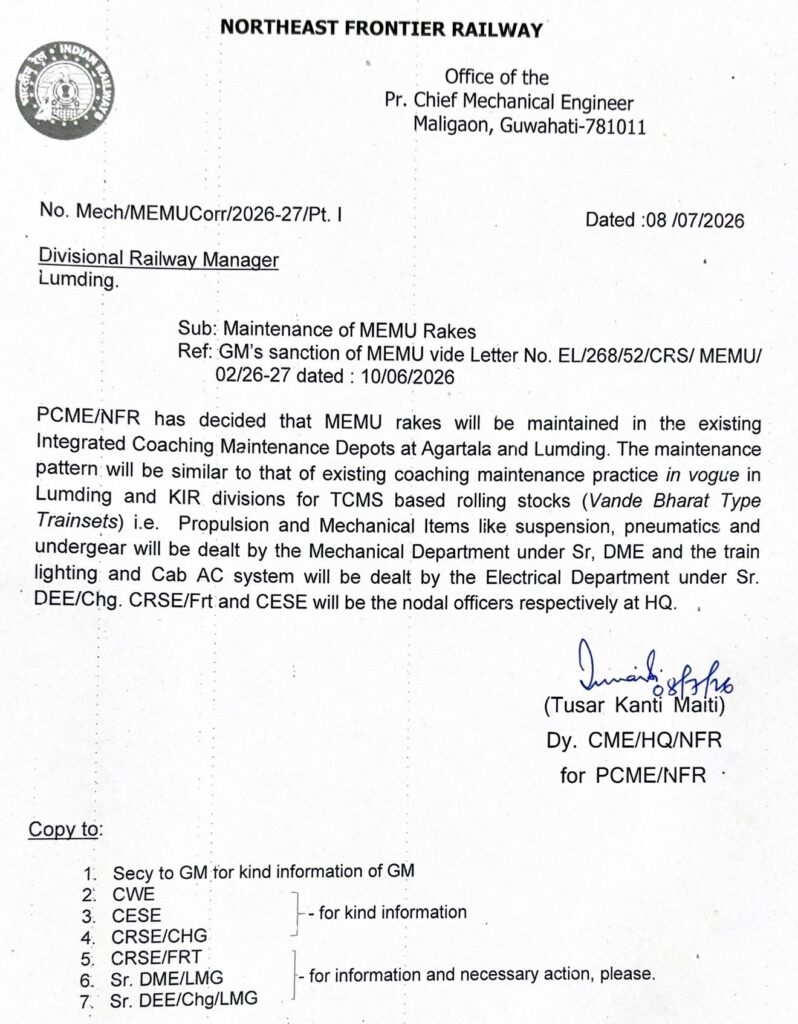
So the Board looked at it once, deliberately, and doubled down.
The obvious answer, and why it does not work
You will say the obvious thing, and it is a fair thing to say. It survived because it works. Reforms that work are not reversed.
I would accept that if the record supported it. It does not.
The Board refused North Eastern Railway an extension of the arrangement in 2022. It told East Central Railway and South Western Railway to reverse what they had done, in 2023. In July 2025 it issued its own all India order on the subject and stayed it twenty days later.
Those are not the marks of a settled policy that everyone has made peace with.
So the honest statement is narrower than the one I would like to make, and stronger for it. Office Order 58 of 2016 has never been reversed. It has never been made to work either. It has been left alone for ten years while the field fights about it.
In Part-3 I will show you that fight, document by document, and count six attempts by zonal railways to finish the job the order started. Four were stopped by the Board that wrote the order.
And still nobody in Rail Bhawan will answer the only question that matters at two in the morning in a shed.
Who commands the man with the spanner?