

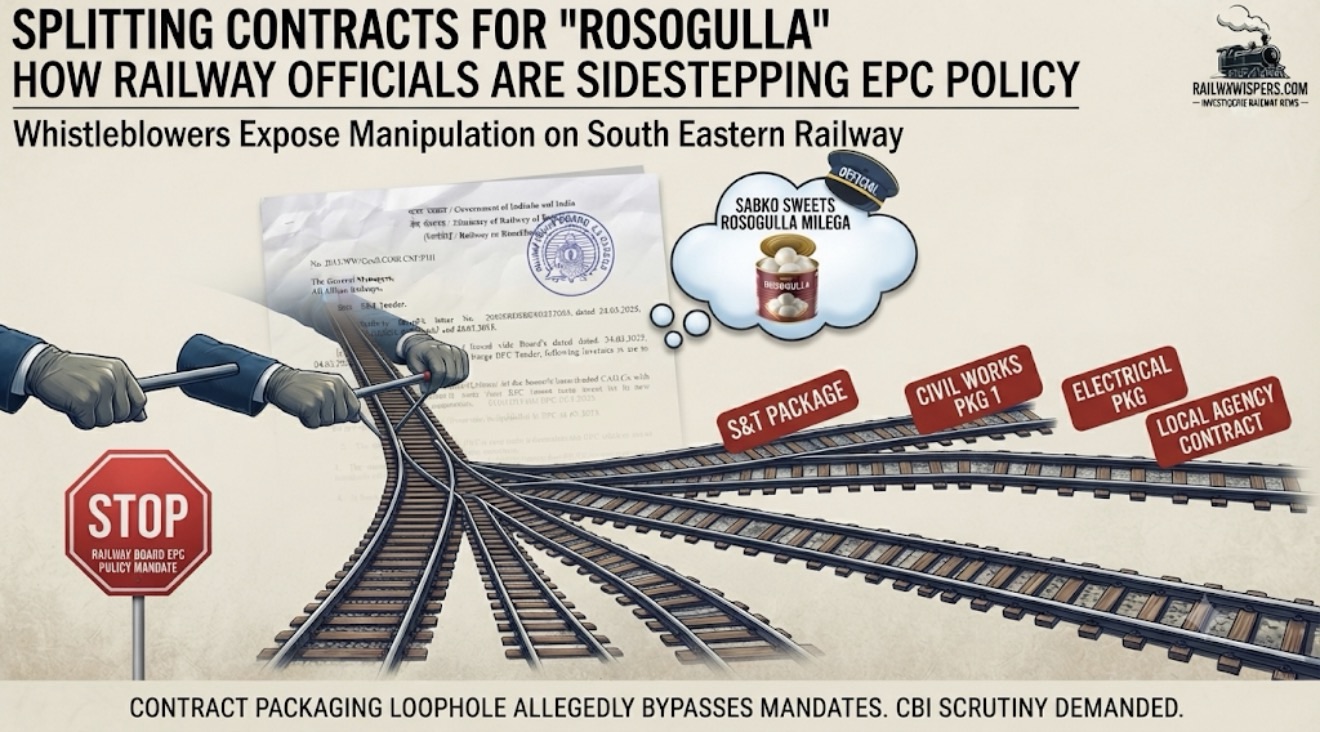
Splitting Contracts for “Rosogulla”: How Railway Officials Are Sidestepping EPC Policy
A serious controversy has erupted over the implementation of the Railway Board’s policy letter regarding Engineering, Procurement, and Construction (#EPC) tenders, with whistleblower inputs and e-office records pointing toward alleged procedural subversion to favor preferred local agencies.
The core of the dispute centers around Railway Board letter No. 2015/W-I/Genl./CORR.GM/Pt.III dated 24.03.2025, issued under the signature of Vivek Kumar, Executive Director/GS/Civil-II, which supersedes earlier instructions from 2018, 2022, and May 2024. The policy explicitly mandates that tenders for New Lines, Gauge Conversion, Doubling, large colonies, workshops, and important bridges must be executed via EPC contracts irrespective of value, while non-EPC tenders exceeding ₹100 crore require explicit prior approval from the Railway Board with proper justification.
However, leaked internal e-office movements from the South Eastern Railway (#SER) network—summarized by whistleblowers with the cryptic remark that a file was moved for “gandhiji”—suggest that administrative loopholes are being actively exploited.
According to the whistleblower disclosures, officials are allegedly attempting to keep high-value infrastructure projects out of the comprehensive EPC framework by deliberately separating Signalling and Telecommunication (S&T) or other departmental packages to reduce individual tender values below scrutiny thresholds.
The internal notes cynically note that separating S&T works keeps tender values lower compared to integrated modes, ensuring that pre-determined favored agencies can secure the bids under the pretext of decentralized execution, accompanied by local assertions that “sabko sweets rosogulla milega”.
This blatant circumvention directly challenges clause 4 of the March 2025 Board directive, which stipulates that splitting works to bypass the ₹100 crore ceiling or avoiding EPC mandates without recorded exceptional circumstances and Board sanction violates procurement propriety.
Industry observers and internal critics argue that such systemic packaging manipulation undermines fair competition, defeats the policy objective of attracting capable contractors who invest in modern construction technology, and calls for urgent vigilance by investigative bodies like the Central Bureau of Investigation (#CBI) to audit these administrative maneuvers.