

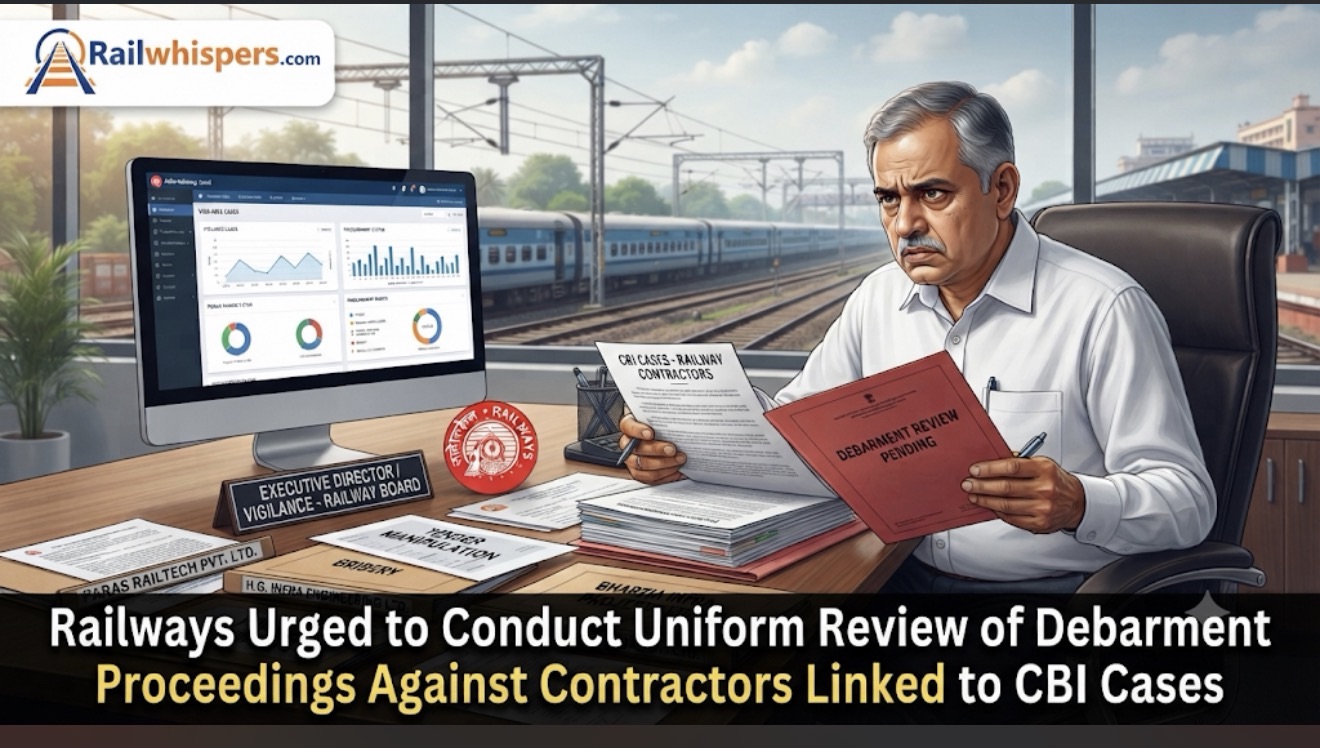
Railways Urged to Conduct Uniform Review of Debarment Proceedings Against Contractors Linked to CBI Cases
Railway Board Faces Calls for Comprehensive and Uniform Review of Debarment Proceedings Against Contractors Linked to CBI Investigations
A formal appeal to the Chairman and CEO of the Railway Board, alongside the Chief Vigilance Commissioner, demanding a thorough, case-wise examination of all contractors, directors, and associated entities named in Central Bureau of Investigation (CBI) cases related to Indian Railways and infrastructure projects. The central issue raised is why banning and debarment proceedings appear to face intense scrutiny or remain inactive in certain instances, while the precise status and justifications for procurement actions in other severe cases are left ambiguous. The primary goal of this proposed examination is to establish whether existing rules have been implemented consistently, transparently, and without discrimination, and to identify any situations where necessary action warranted by available evidence was omitted.
A prominent example highlighted in the communication involves a CBI case reported on February 21, 2025, concerning Paras Railtech Private Limited, three of its directors, and a railway project official. This case centers on allegations of criminal conspiracy and corruption linked to pending bills and revisions to estimates for the removal of tunnel muck on the Katra-Dharam section of the Udhampur-Srinagar-Baramulla Rail Link project. The Railway Board is urged to transparently disclose whether a show-cause notice was formally issued, whether the company’s eligibility to participate in future tenders was reviewed, whether any debarment proposals were actively considered, and what reasoned decisions were ultimately recorded. The communication explicitly notes that the mere registration of a case should not be automatically represented as a final proof of guilt.
Another critical matter involves H.G. Infra Engineering Limited, where media reports from January 2026 detailed a CBI case involving alleged bribery connected to railway construction projects. This investigation led to the arrest of four company officials, including its managing director, alongside railway personnel and other accused individuals, accompanied by the reported seizure of ₹45 lakh in cash. In light of the severity of these allegations, the Railway Board has been asked to clarify the status of any departmental proceedings, the applicable eligibility conditions governing ongoing and future tenders, and the specific reasons behind any decisions to initiate or withhold debarment proceedings. Any resulting administrative action must rely strictly on documented evidence, the established role of the company, and relevant rules rather than relying solely on the fact of an arrest.
The review further encompasses the CBI cases involving Bhartia Infra Projects Limited, following reports from January 2024 that the agency had booked seven railway employees and the company itself in an alleged ₹60-crore bribery case spanning the North East Frontier Railway zone between 2016 and 2023. This case involves complex allegations connected to contract awards and alleged bribery. The Railway Board is expected to disclose whether a formal banning proposal was ever initiated, whether the company’s active contracts and related financial payments were thoroughly examined, and what final decisions were executed under applicable procurement rules.
An additional case focuses on C.N.R. Projects India Private Limited, where reports from July 2024 indicated that the CBI arrested a company director and a middleman alongside railway officials in connection with an alleged ₹11-lakh bribery case involving tender awards and bill processing within the Guntakal Division of South Central Railway. Competent authorities are urged to clarify subsequent departmental actions and whether the firm’s eligibility to secure railway contracts faced formal review.
Similarly, the Board has been asked to examine Sandhya Constructions, following reports from February 2026 regarding CBI cases involving alleged false provident fund claims, forged documents, and railway personnel in track-maintenance work near Kazipet, which named the firm’s managing partner and manager. This review should verify whether claimed expenses matched actual worker deployment, attendance records, EPF documentation, and direct payments.
Track-maintenance irregularities also extend to contractor J. Rathnakar, whose case was reported in May 2025 concerning allegations of inflated manpower claims and forged EPF-related records within South Central Railway. The Railway Board is requested to disclose the ongoing status of this investigation and any measures taken under contract terms and debarment rules without treating unproven allegations as a final verdict of guilt.
Furthermore, the communication points to a historical 2018 CBI case involving Mangalmurty Constructions of Pune, where a private contractor and three Central Railway officials were booked over alleged manipulation of a tender for staff-quarter repairs. Reports at the time alleged that lower bidders were wrongly disqualified to award the contract at inflated rates, necessitating clarification on the final case status, departmental outcomes, and whether any actions were ever ordered.
The scope of concern extends beyond major construction contractors to include electrical work and material supply firms. In February 2024, the CBI reported two separate bribery cases involving railway personnel and private suppliers regarding pending bills, including one tender valued at approximately ₹2.56 crore where officials were allegedly caught accepting bribes. The Railway Board has been called upon to identify these specific firms from official case records and clarify whether procurement-integrity reviews followed. Under the framework of the Indian Railways Vigilance Manual, proposals to ban business dealings can be processed based on vigilance or CBI reports through structured procedures involving show-cause notices, reply considerations, and final administrative orders.
To streamline oversight, the appeal recommends that the Railway Board compile a comprehensive, zone-wise register of all contractors and firms named in CBI cases involving railway contracts. This register should meticulously record FIR numbers, alleged misconduct, current case statuses, contractual exposure levels, show-cause notice statuses, debarment proposals, final decisions, and the explicit rationale behind every decision across categories such as bribery, tender rigging, forged credentials, fraudulent EPF claims, inflated bills, and irregular contract variations.
Finally, the communication suggests comparing these scrutinized cases with contractors who have already been banned or debarred to identify any unexplained disparities in treatment, with apparent inconsistencies referred for independent vigilance examination. The review must also determine whether internal railway officials who approved questionable bills, measurements, or tender decisions were investigated alongside private parties. The core question remains why contractors facing comparable, substantiated allegations should be treated differently from those already banned, reinforcing that future measures must stem from documented evidence and transparent rules rather than selective enforcement or outside influence.
The cases mentioned above are only a few examples, whereas there are numerous other similar CBI cases against some other big contractors firms, who were involved in bribery to the railway officials, which are yet to be officially taken cognizance of. The Railway Board is expected to formulate a comprehensive and integrated policy addressing all such cases to initiate business-banning or debarment proceedings against them.