

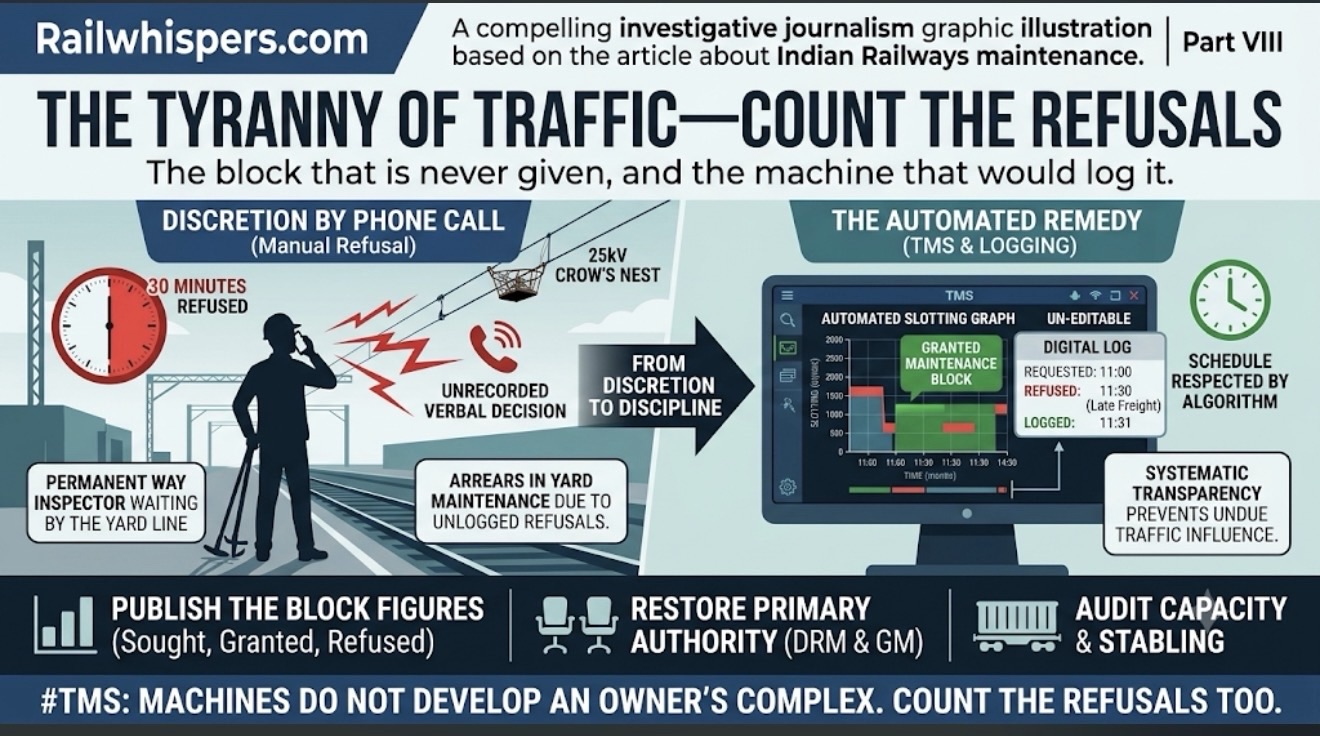
Part VIII: The Tyranny of Traffic—Count the Refusals
The block that is never given, and the machine that would log it. Seven parts of this series asked who holds the power. This one asks what would take it away
Editor’s Note: Much of this part rests on accounts from serving supervisors rather than on documents, and the text says so wherever that is the case. One allegation about a closed meeting is printed as an allegation. Rebuttal and clarifications from the Railway Board is invited and will be printed.
A permanent way inspector (#PWI) or today’s Senior Section Engineer/P-Way (#SSE/PWay) sent this publication a question, and asked us to put it to the Railway Board on his behalf, which is a thing men in his position do only when they have stopped expecting an answer through the channel they are supposed to use. Here it is, in his own shape.
The monthly drives for #points & #crossings can only be done in yards. So how many times in a month is a block inside a yard actually permitted?
He already knows. He wanted somebody to answer and write it down.
Thirty minutes
Start with what is already on paper, because it is easy to miss how strange this is.
A “corridor block” is not a favour anybody grants. It is printed in the Working Time Table (#WTT), which is the operating department’s own document, and the time is set aside there for maintenance. The #block exists. It has a slot. Somebody wrote it in.
Now consider what it means that the Railway Board had to issue an order telling the railways to reserve those blocks for the purpose the timetable already reserves them for.
An order is only necessary when the time is going somewhere else.
That order was issued by the only officer from outside the traffic service ever to have held the chair of Member, Operations and Business Development (#MOBD).
The point is that the chair had to pass to an outsider before anybody wrote the order.
Readers in the field report that outside a few zonal railways the corridor blocks are still not given.
A senior section engineer of traction distribution tells us that a short block for a ladder gang to clear crows’ nests is difficult to obtain.
Crows’ nests. On overhead equipment carrying 25,000 volts.
Because the yard blocks are not given, the civil engineering directorate has fallen back on manual maintenance of yard lines, and those lines are now in deep arrears across the country. That is not a failure of the permanent way organisation, whatever the inspection notes say about it. It is what any organisation does when the only tool left to it is the one it can use without asking somebody else for permission first.
Thirty minutes of block. That is what is being refused.
A chain that does not pass through the General Manager
It is alleged that a conference of Principal Chief Operations Managers (#PCOMs) reviewed, in closed session, every challenge that had reached the department from the political leadership and from General Managers (#GMs) and Divisional Railway Managers (#DRMs) who are not traffic officers.
#Ep246: S&T और Civil Engg में पोस्टिंग की तिकड़म: अगला कोई ‘बालासोर’ देश सह नहीं पाएगा!
This publication can observe something that needs no conference at all.
A chain runs from the Railway Board through the zonal headquarters down to the division, and it arrives there without ever passing through the General Manager, which is why a General Manager is sometimes the last officer on his own railway to learn what his railway has decided. Every serving officer reading this knows that chain exists. Most have watched a Divisional Railway Manager discover a decision only after the division had acted on it.
It does not require a plot, only that nobody stops it.
Ask the question this series has asked since Part I. Not who is to blame. Who was in a position to prevent this?
What the refusal costs
Disconnection, reconnection and testing all take time. Every one of those operations is the moment when interlocking is most vulnerable, and every one of them is a moment the operating department must release the line for.
The time belongs to traffic. It is not given.
Hold that beside the two parts this publication ran on Bondamunda.
Aug 24, 2026: “Balasore, Again | Part I: The Letter Sixty Days Before”
Aug 25, 2026: “Balasore, Again | Part II: Curse of Secrecy—The Demonstration Nobody Was Allowed to Read”
On 3 April 2023 the Member (Infrastructure) wrote to every Zonal General Manager listing five cases of point and signal inconsistency inside three months, and marked the letter to the Director General, Safety. Not one of the five was an equipment failure. Every one was a disconnection, a reconnection or a testing failure. One of them, at Kharkopar on 28 February 2023, is the Balasore mechanism arriving ninety four days early. Balasore itself came sixty days after the letter.
The Board filed those five under a heading that named the conduct of the staff. Short cut methods, it said, adopted by men at the bottom of the organisation.
It could equally have asked how much block time those men had been given, and by whom, and how often the answer had been no.
Nor did the drive that followed Balasore settle it. At the Board’s own #Safety review of 3 November 2023, months into a national campaign to correct wiring and drawings, the figures put up in that room still showed Engineering Scale Plans that did not match the yards they described. A drawing that does not match the yard is corrected by taking the yard out of service and walking it. That is block time again.
Everything in this argument comes back to the same thirty minutes.
Take the discretion out of the room
There is a remedy for this, and it is not a circular.
Every one of these refusals happens in the same place. A supervisor asks the control office for a block. A section controller weighs it against the trains on hand and says no, or says yes and then withdraws it. No file is opened. No reason is recorded. Nothing is countable afterwards, which is precisely why the practice has survived every instruction issued against it.
Discretion exercised in a phone call is the instrument of the tyranny. Remove the instrument.
The Indian Railways already knows how. Centralised Traffic Control with electronic interlocking and automatic signalling is working on the Ghaziabad to Kanpur section, one of the busiest on the system, controlled from a centre at Tundla. A Train Management System (#TMS) runs the Mumbai suburban sections on Western Railway and is being extended on Central Railway. Signals are set remotely. The technology is not a proposal and it is not foreign.
Now note how it is deployed, because that is the whole argument.
These systems aid the human controller. They do not decide, and they cannot overrule him. Every installation so far has put a better screen in front of the same man and left the discretion exactly where it was, which is why the block is still granted or refused by a person, on a telephone, with no file opened at either end.
That is a choice. It is not a limit of the technology.
So invert it. Enter the maintenance requirement as a constraint and let the machine plan around it, because a constraint is what a scheduling algorithm is built to respect. The Working Time Table already sets the block aside, as this piece began by saying. What a machine adds is that it cannot be talked out of the slot at eleven in the morning by a controller with a late freight on his hands. Every request, every grant and every refusal writes itself into a log that a Divisional Railway Manager can read without asking the operating department’s permission to read it.
This will be resisted, and it is worth being honest about why. Some of the resistance will be about safety, and some of that will be sincere. Automation on a mixed traffic network carrying freight, mail, express and suburban services over the same pair of rails is genuinely hard, and no honest reader of this publication should pretend otherwise.
The rest of the resistance will not announce itself.
A department whose authority rests on granting and refusing does not surrender the granting willingly. So watch which arguments are made, and by whom. Then check whether the officer making the safety case has ever, once, asked for the block figures to be published.
Machines do not develop an owner’s complex. That is their most useful property here. #TMS
Give the two chairs their railway back
Not the section engineer who cannot get twenty minutes to clear a nest. Not the permanent way inspector with his question.
The General Manager and the Divisional Railway Manager were in a position to prevent all of this, and both have been steadily emptied of that position. One department reaches past them through a parallel chain. Another, as the companion to this piece set out in Part 11 of The Cockroaches of Railways, now sends them a daily photograph quota. Between the two, the office that is supposed to run a railway is left arbitrating group chats.
Restore the primacy of those two chairs. Let them hold safety first and punctuality a close second, and judge them on nothing else.
Two audits
- #One. The capacity that is not there. Section capacity has been declared on the strength of freight trains run inside corridor margins. Audit that arithmetic. Then audit the parallel chain of the traffic department and establish how a division receives direction that its own Divisional Railway Manager has not seen. Publish the block figures, sought, granted and refused, by zone and by month. And publish the plan, with dates, for extending centralised traffic control and the Train Management System beyond the sections that already have them.
- #Two. The wagons and the stabling. It is alleged that the mechanical and traffic departments have together produced wagon requirements the network cannot hold, and that record stabling has followed. If that is right, it is among the reasons freight average speeds remain what they are. Audit the demand, the induction and the stabling together, because no one of the three explains itself alone.
Neither audit needs a committee. The first one needs a spreadsheet that already exists somewhere in every divisional control office. #IndianRailways #RailSafety
The permanent way inspector asked how many yard blocks are given in a month.
Count the refusals too. Then publish both numbers, and nobody will have to ask again.
Further reads on this site
Aug 25, 2026: Balasore, Again | Part II: Curse of Secrecy—The Demonstration Nobody Was Allowed to Read
Aug 24, 2026: Balasore, Again | Part I: The Letter Sixty Days Before
Aug 21, 2026: The Cockroaches of Railways | Part 10: Minister Must Urgently Review Conduct, Character & Competence Across Key Railway Bodies
Aug 18, 2026: The Cockroaches of Rail Bhawan | Part 7: Who Does the Railway Ask?
Aug 17, 2026: The Cockroaches of Rail Bhawan | Part 6: Read the Passenger List
Aug 12, 2026: The Cockroaches of Rail Bhawan | Hand the Machine to the Man Who Sold It
Jul 22, 2026: Part VII: The Tyranny of Traffic—The Absentee Landlord
Jul 21, 2026 Part VI: The Tyranny of Traffic—Keep the man waiting at the gate
Jul 20, 2026: Part V: The Tyranny of Traffic—Take the key from the gate
Jul 19, 2026: Part IV: The Tyranny of Traffic—Send the bill to the gate
Jul 17, 2026: Part-III: The Tyranny of Traffic—The key to the gate!
Jul 16, 2026: Part-II: The Tyranny of Traffic—वर्चस्व की कवायद! (The men who did not win the bread)
Jul 15, 2026: Tomfoolery of Prayagraj Division