

Part-II: The Tyranny of Traffic—वर्चस्व की कवायद!
Part II: The men who did not win the bread
Editorial Comment: We began with one division and one malpractice. In Part-I “Tomfoolery of Prayagraj Division” this newspaper webportal showed how the operating department books locomotive failures it caused against the technical men who did not, turning a safety record into a weapon and Integrated Coaching Management System (#ICMS) into a courtroom where one party is complainant, judge and clerk at once. That was not the sin of a single division. It was a symptom. Across this four-part series we set out the disease in full: the myth that the #traffic cadre alone earns (#claims) the Indian Railways its bread, the machinery of gatekeeping by which it holds every other department to ransom, and the accountability for art-1sinking speeds, lost freight and a feudal culture on the platform that the same #cadre has spent decades disowning. We publish it in the plain belief that an organisation cannot #reform what it refuses to name.
Part II, III and IV of the series is by a distinguished superannuated officer who agreed to start to write for us on condition of anonymity.
The Tyranny of Traffic
Part II — The men who did not win the bread
Part III — The key to the gate
Part IV — Send the bill to the gate
(Part I being “Tomfoolery of Prayagraj Division” which was written by a different contributor).
There is a claim you will hear in every office of the Indian Railways, sooner or later, usually after the second cup of tea. The traffic men, the operating and commercial officers, will tell you they are the breadwinners. The rest of the organisation, in this telling, is overhead. Engineers who lay track, mechanical men who build the wagons, electrical officers who string the wires, all of them are cast as expensive dependents living off the money that the traffic department alone brings home.
It is a good line. It has served the cadre well for decades. It is also, when you hold it up to the light, very close to nonsense.
What actually earns the money
Start with a simple question. What actually earns the Railways its money? The answer is not a mystery. Freight is about 65 per cent of the earnings of Indian Railways, and it is freight that quietly subsidises every passenger ticket sold below cost. Within that freight basket, a single commodity, coal, contributes close to half. Add iron ore, cement, foodgrain, fertiliser, petroleum and steel, and you have described almost the entire revenue base. This is a low value, high volume, bulk haulage business. It always has been.
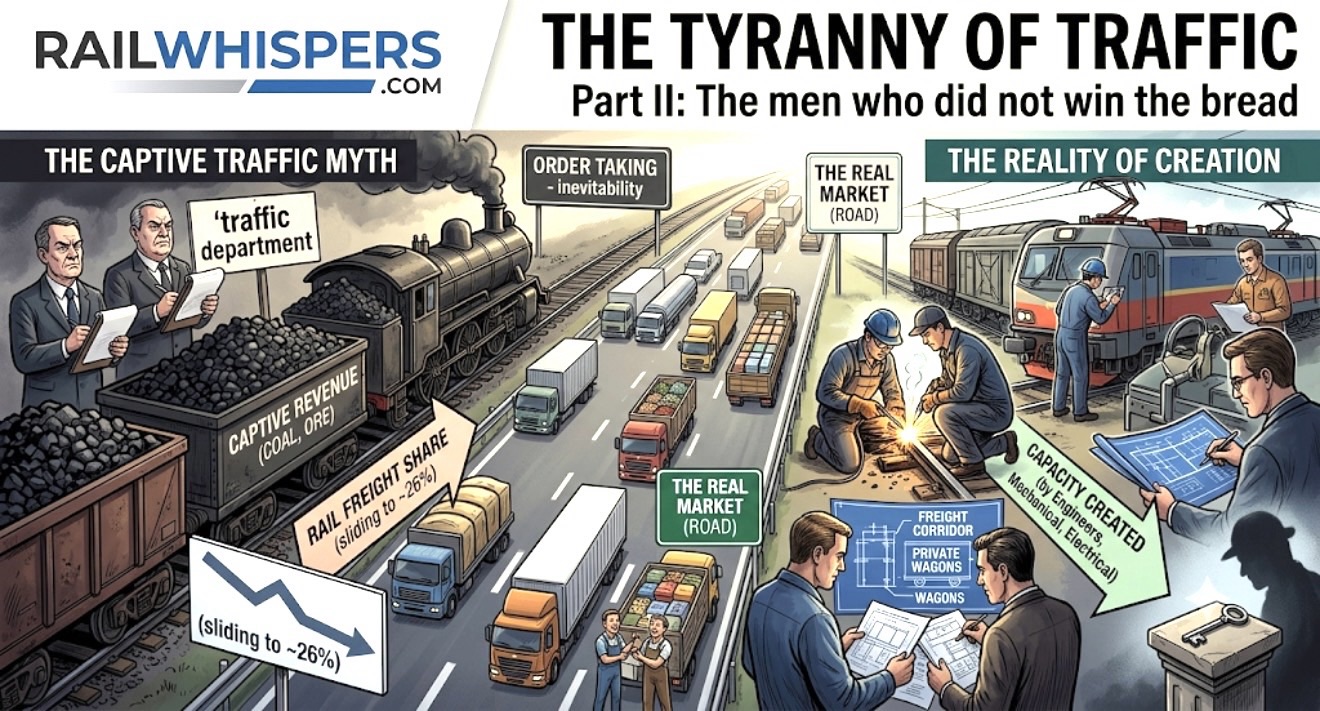
Now ask the next question, the one nobody in the mess wants to answer. Where does this bulk come from? It comes from mines and from a handful of large public sector loading points. Coal comes from the collieries. Ore comes from the ore fields. The Railways does not own these mines. It did not discover the coal. It does not run the washeries or sink the shafts. It shows up with wagons because the coal has to move, and there is no serious competitor over the distances and tonnages involved. A road fleet cannot haul a rake of coal from Korba to a power plant at anything like the cost of a train. So the traffic is captive. It was captive when the cadre’s grandfathers wore the uniform, and it is captive today.
Here is the uncomfortable part. If your revenue is captive bulk that arrives whether you canvass for it or not, then loading it is not salesmanship. It is order taking. A booking clerk with a rake to spare and a power plant screaming for coal is not a rainmaker. He is a facilitator of the inevitable. There is honour in doing that job well, in keeping the wagons turning and the sidings clear. But it is not the honour the cadre claims for itself.
Show me the market you made
So let us put the real test to the breadwinners. Show me the high value business the traffic department invented. Show me the trajectory bending contract, the new market conjured out of nothing, the container revolution that a traffic officer dreamed up and delivered against the road lobby. Show me the premium logistics product that pulled cargo off the highway and onto the rail because a commercial officer out-thought the competition. I have looked. Most honest men in the service, if you catch them off duty, will admit the cupboard is thin. The genuinely new ideas in Indian rail freight, dedicated corridors, private wagons, automobile and container traffic, were largely forced on the system by policy and by outside pressure, not incubated by the cadre that now takes the bow.
Meanwhile look at what has happened to the very market the breadwinners were supposed to be winning. Rail’s share of India’s freight has slid to around a quarter, roughly 26 per cent, while road now carries close to two thirds of the nation’s goods. A railway that once moved the overwhelming majority of India’s freight has been reduced, decade by decade, to a bulk carrier of coal and ore, watching everything with a deadline and a margin drive past on a truck. If the traffic department is the marketing arm, this is the record of that marketing. You cannot claim the crown for revenue and disown the collapse in share. Both belong to the same office.
I want to be fair, because the point is sharper when it is precise. The bleeding of freight share to road is not the fault of any one cadre alone. Roads got longer and better. GST erased the old checkpost delays that once made rail look quick by comparison. The economics of first and last mile went against the train. All true. But every one of those pressures was visible for twenty years, and the department whose entire reason for existing is to market and operate transportation is the department that was paid to answer them. It did not.
Who built the thing
And it is worth remembering who built the thing that generates the money in the first place. The capacity to haul that captive coal, the line capacity, the loops, the yards, the terminals, the bridges strong enough for a loaded rake, the traction to move it, the wagons to carry it, all of that is the work of the engineering and mechanical and electrical services. The traffic officer inherits a built railway and books traffic onto it. To then turn to the men who built it and call them overhead is not just ungracious. It is a category error. The engineer creates the capacity. The traffic man sells the capacity, or fails to. On the present numbers, the selling has not gone well.
None of this is an argument that the operating and commercial function does not matter. It matters enormously. Running a dense network safely, keeping paths clear, clearing yards, honouring commitments to a shipper, these are hard skills and the good operators are very good. The argument is narrower and it is this. A function that lives off captive bulk, that has not created a single market of its own worth naming, and that has presided over the steady loss of everything except the captive traffic, has not earned the right to look down the table at everyone else and call itself the sole breadwinner.
The bread, such as it is, was baked by the mines of India and the engineers of the Railways. The traffic department carried it to the table. That is a useful job. It is not the same job as winning it.
In the next piece I will turn from the myth to the machinery. Because the real power of the #operating department was never the #revenue it claims to bring. It is something quieter and far more useful to hold. It is the key to the gate.