

The Cockroaches of Rail Bhawan | Hand the Machine to the Man Who Sold It
The pantry car cockroach is exterminated on a schedule but the one in Rail Bhawan holds a post no order created and outlasts every campaign!
A government that cannot identify its own transformation experts, cannot verify what their grand ideas produced, and cannot stop promoting the people who embarrassed it, has not been let down by the system!
A leadership serious about national capability would have started somewhere unglamorous. It would have driven down unit cost, and it would have protected the depot engineer who argues with a vendor over the price of a spare part!
The railway acquired ownership without command, contracts without capability, and 35 years of somebody else’s expertise on tap!
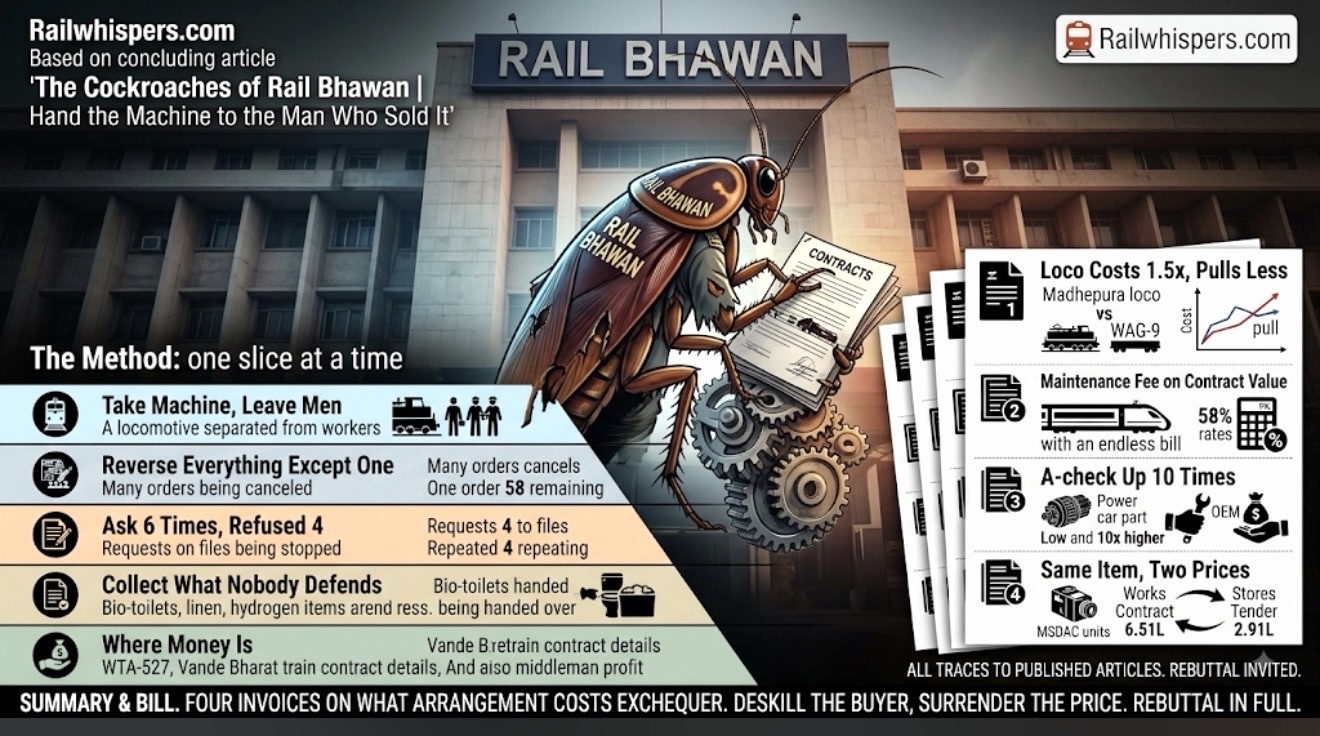
The method: one slice at a time !
Editorial Note: Between 6 and 10 August 2026 this site published, “The Cockroaches of Rail Bhawan” in five parts, a reading of eleven years of Railway Board office orders on who maintains the railway’s rolling stock. This essay is the summary and the bill. It restates the method in five slices, one for each part, and then presents four invoices on what the arrangement costs the exchequer. Every claim traces to a published article, cited in the text by date, title and web link. Rebuttal is invited. Any officer, department or firm that holds a different account of any document or figure cited here may write to this publication. A substantive rebuttal will be printed in full, with the same prominence as the charge it answers.
Nobody in Rail Bhawan ever proposed an empire.
That is the point. An empire proposed is an empire debated, costed and refused. So nobody proposed one. What happened instead was a decade of small, lawful, separately defensible decisions, each of which a reasonable officer could sign on a Tuesday afternoon without reading the file below it, and not one of which would have survived being put up as a single proposal.
“Salami Slicing” has a technical definition. You take a thing nobody would surrender whole by taking pieces nobody will fight over. The five parts of this series are five slices.
Slice one. Take the machine, leave the men
Office Order No. 58 of 2016 moved the electric passenger fleet, the sheds, the crew and the workshops to the mechanical department. Clause 3 left the officers and the staff under the department they came from. [6 August 2026, “The Cockroaches of Rail Bhawan | Part-1: Read the Last Column”]
Read that twice. One department owns the asset. Another commands the people who understand it. That is not an oversight, and it is not a conspiracy either, and what matters is that this first slice created a ten year argument inside the organisation which nobody since has been willing to settle.
Slice two. Reverse everything except the one that matters
This Board reverses itself readily. 14 (Fourteen) decisions of the transformation era were reversed, withdrawn, or quietly never implemented. Seven gazette notifications were spent on the service structure alone. Cabinet decisions among them. [7 August 2026, “The Cockroaches of Rail Bhawan | Part-2: Fourteen Reversals and One Survivor”]
Office Order 58 has never been amended.
Fourteen reopened. One left alone. Ask which of the fifteen touched a vendor’s revenue.
Slice three. Ask six times, until nobody is counting
Five zones and the Board itself asked for the staff to follow the asset, six requests in four years, and four of them were stopped. North Eastern Railway was refused in 2022, and East Central Railway and South Western Railway were reversed in 2023 by a Board Member writing to every General Manager. The all India order of 25 July 2025 lasted twenty days before the Board stayed it. [8 August 2026, “The Cockroaches of Rail Bhawan | Part 3: Six Times Asked, Four Times Refused”]
The two that were not stopped are still running.
That is the method. A refused request does not die. It returns at another zone, under another file number. The asking side has to win once. The refusal has to win every time.
Ask where the sequence points.
At maintenance run under the flag of the department that owns the asset, with the work itself done on contract and administered from the same office. The trainsets are there already. The agreement in slice five is what the arrangement looks like finished.
And ask what each round spends. Not posts. Talent, skill and institutional knowledge. Office Order 58 moved the machines on paper. The understanding of them stayed with the crews, and every file since has tried either to move the crews or to price what they know into a contract.
Slice four. Collect what nobody defends
While that argument ran, the collecting continued. Bio-toilets. Coach watering. Linen. Pest control. Hydrogen traction. Each transfer is trivial. Each is signed by somebody competent. [9 August 2026, “The Cockroaches of Rail Bhawan | Part 4: Feeding the Cockroaches”]
In the process, as if in a theatre of the absurd, hydrogen propulsion, bio-toilets and linen now answer to the same team.
Nobody defends a lavatory, and that is exactly why it appears as the fifteenth item on a list whose first fourteen you did not read, in an order you were never going to open.
Slice five. Where the money is
The maintenance agreement behind tender WTA-527, for 200 sleeper Vande Bharat trains, obliges the Government at clause 6.1.2(c) to provide the manpower. Clause 17.2 fixes the maintenance period at thirty five years. Clause 22.8.1 lets the technology partner charge the railway a daily rate to train railway staff. [10 August 2026, “The Cockroaches of Rail Bhawan | Part 5: Who Pays, Who Runs It”]
The #State buys the train. The state builds the depot. The state supplies the track, the power, the water and the men. The #Vendor supplies the knowledge, and bills for teaching it.
Now the bill, in four invoices
Each of these has been reported before, on this site or by a journalist we have cited for years. Read separately they are four grievances. Read together they are one accounting method.
Invoice one. The locomotive that costs half as much again and pulls less
In 2007-08, European consultants persuaded Rail Bhawan to buy eight axle permanently coupled locomotives. The order that followed was for 800 to 1000 machines of 12,000 horsepower from Madhepura. [12 February 2023, “Competence Poverty of #KMG – Machinations Exposed! Part-II”]
The arithmetic in that report has never been answered. A #Madhepura locomotive gives about 710 kilo Newtons of pull for about 32 crore rupees. Two coupled WAG-9 locomotives, built in our own factories, give 1020 kilo Newtons for about 21 crore.
More money. Thirty per cent less pull. Then a price variation clause, so the unit price climbs every year while our own factories were bringing theirs down. The same reporting puts the assured business to the supplier at about ₹25,000 crore, with long term maintenance charges on top of it. [28 September 2022, “The team of Minister is manipulating 360 degree and resulted in a round loss of morale”]
Invoice two. The maintenance fee, as a rate
On the Vande Bharat trainsets, the annual maintenance fee runs at a rate ranging from 3.5 to 10.5% of the total contract value, for 35 years. That is not our description. It is the tender, reported at the time. [2 November 2022, “Indian Railways to award three Vande Bharat EMU contracts”]
Note what that rate is charged on. Not on work done. On contract value. A percentage of the purchase price, every year, for longer than most of the officers who signed it will live in service.
Invoice three. The A-check that went up ten times
The simplest scheduled examination of a power car is called an A-check. This has been contract work for years, and it is worth being exact about what changed, because the change was not from departmental hands to contract hands, which is the version most people assume. The contracts used to be open. Then they were narrowed to the original equipment manufacturer (#OEM) alone.
The “A-check” went from a few hundred rupees to five thousand. [15 April 2025, “The OEM vis-vis Third Party Maintenance Conundrum”]
Now ask who actually turns the spanner
The manufacturers sublet. The same article records a case where “the order was on OEM while work was done by subletting”, and our reporting a week earlier found these contracts “rampantly #sublet”. [8 April 2025, “CRB-on-Contract – By the OEMs, of the OEMs and For the OEMs”]
So the men on the depot floor did not change, and the #Contractor who held the work before now holds it again one rung down, as somebody else’s #subcontractor, doing the same job for a principal who was inserted above him by a policy. What was inserted was a layer, and the layer bills.
Nothing about the job changed. Same shed, same check, same hands. Only the invoice changed, and it changed by a multiple.
And follow the rupee. The men below are paid what they were always paid. The multiple is billed to the railway, the old #rate settles the #subcontract, and the balance stays with the layer. Ask what the balance bought. Nothing that touches the train.
That single subject took five Railway Board letters in five years, three of them inside six months, and the panel that survived the churn is three firms.
Three suppliers, one buyer, and a rule that nobody else may bid. There is a word for that market, and we do not need to use it, because the price already said it.
Invoice four. The same item, two prices, one contractor
This is the cleanest evidence in ten years of our reporting on Policy Corruption and Manipulation, and it needs no interpretation at all.
A multi section digital axle counter (#MSDAC). The same contractor. Sold to Indian Railways at ₹6,51,504 through a works contract in 2020, and at ₹2,91,000 through a #Stores tender in 2022. Same item, same description, no value addition. [29 November 2022, “AXLE COUNTER FRAUD, SCAM AND LOOT IN RAILWAYS CONTINE”]
Why does the route change the price? Because a manufacturer (#OEM) cannot bid for a works contract. So a trader buys from the manufacturer and sells to the railway, and the margin is the whole story. On electronic interlocking the same reporting puts it at ₹80 lakh from the maker and ₹5.5 crore from the middleman.
Buy it as #Stores and there is a reverse auction (#RA). Buy it inside a #Works contract and there is a conversation.
What the four invoices have in common
In every one of them, over a decade and across four unrelated categories of equipment, the railway has arranged to be a worse buyer than it needs to be. Longer contracts. Fewer bidders. Prices fixed as a percentage rather than as a rate for work done. Commitments that outlive the signatory.
And in every one of them, the officer who could have argued has been moved further from the machine.
Ask the simple commercial question. Who is comfortable in a depot where a Senior Section Engineer (#SSE) can strip a converter and price an A-check? Nobody selling one. A railway that cannot smoke out a bluff is a railway that pays whatever it is quoted, for as long as the contract runs.
That is where the high skill job goes. Not in a retrenchment order, which somebody would resist. It goes when the work is contracted out, when the panel shrinks to three, and when the young engineer who would have learned the machine is given an invoice to check instead. Deskill the buyer and you have not saved a salary. You have surrendered the price.
The question nobody in Rail Bhawan will ask out loud
More than a dozen #transformation-reforms have been walked back. Eight services merged into one, and then unmerged. Every General Manager raised to the apex grade, then not. The post of Member Staff surrendered, then refilled.
That is not a partisan claim. It is a count, and the gazette notifications are public.
So who guided them? Who seeded them? Who briefed the Cabinet?
Not one of those people has been asked to explain the bill. Several were promoted while the reversals were still being notified.
Here is the failure that would belong to the political leadership, and not to the railway. A government that cannot identify its own transformation experts, cannot verify what their grand ideas produced, and cannot stop promoting the people who embarrassed it, has not been let down by the system. It has been outmanoeuvred by it, and it keeps signing the recommendation.
A leadership serious about national capability would have started somewhere unglamorous. It would have driven down unit cost, and it would have protected the depot engineer who argues with a vendor over the price of a spare part, because that officer is worth more to the exchequer over 35 years than any consultant’s slide deck.
Instead the railway acquired ownership without command, contracts without capability, and 35 years of somebody else’s expertise on tap.
The pantry car cockroach is exterminated on a schedule. The one in Rail Bhawan holds a post no order created and outlasts every campaign.
Indian Railways is being run by cowboys who are afraid of horses.
Who commands the man with the spanner?