

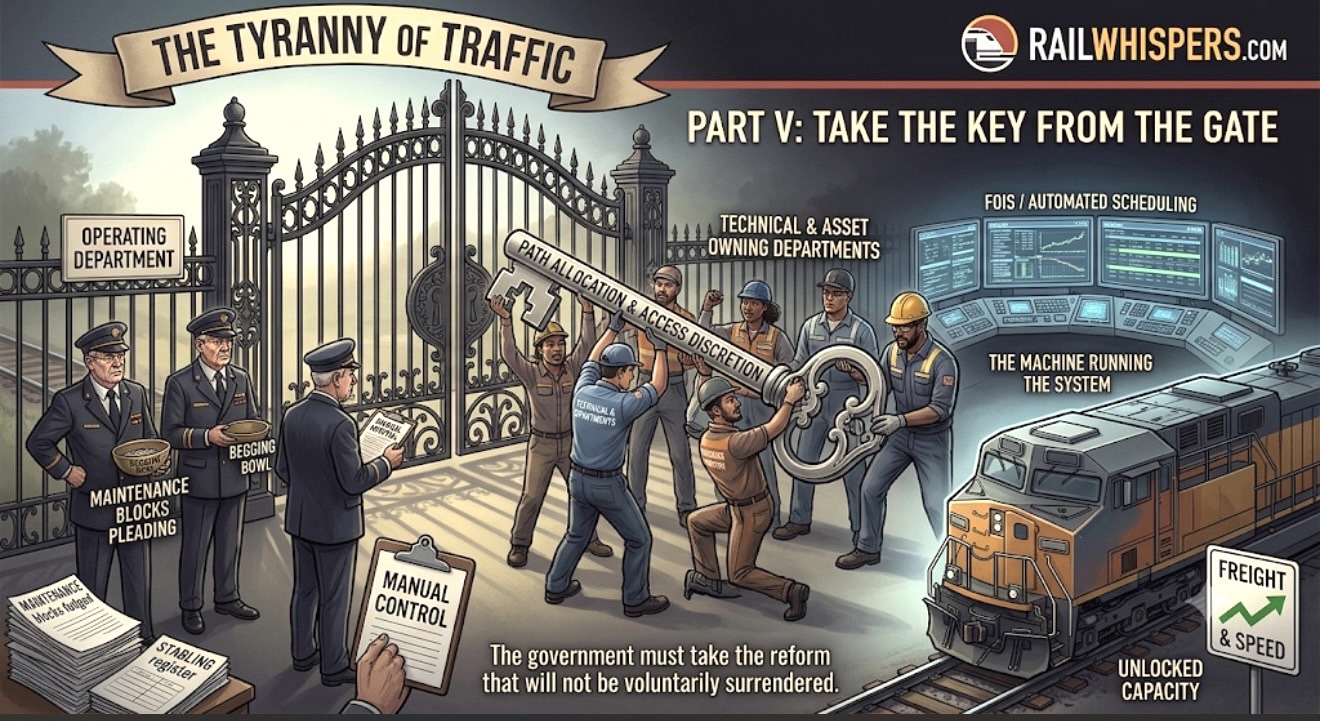
Part V: The Tyranny of Traffic—Take the key from the gate
Can the operating department be trusted to take this decision about itself?
Editorial Comment: When we began this series with one division and one malpractice in “Tomfoolery of Prayagraj Division”, we did not expect the postbag it would bring. Over four parts we set out the disease in full: the myth that the #traffic-cadre alone earns the Railways its bread in “Part-II: वर्चस्व की कवायद!” the machinery of #gatekeeping by which it holds every other department to ransom in “Part-III: The key to the gate!”, and the accountability for sinking #Speeds, lost #Freight and a feudal culture on the platform in “Part IV: Send the bill to the gate”. Then the messages came. Serving and superannuated officers alike wrote in, many of them from the very cadre this series has arraigned. They did not write to deny the charge. They wrote to say it was worse than we had put it, and to tell us what to do about it. That is a rarer thing in this organisation than criticism. We publish it in the same belief that carried the first four parts: “an organisation cannot #reform what it refuses to name, and it cannot mend what nobody will tell it how to fix. Part V belongs to them.”
What FOIS proved, and what it cost
Start with the one thing that worked.
The Freight Operations Information System (#FOIS) is a powerful instrument, and its power lies in a single property. It makes the operating floor visible. Practices that had run for decades on the strength of nobody being able to see them went onto a screen, timestamped and retrievable, and they have stayed there.
The first FOIS did not fail on its engineering. It was killed by poor adoption and by open hostility. That is worth stating flatly, because it is the tell. Systems that only add work get ignored. Systems that remove discretion get fought.
It took a second generation, and a handful of sane operating officers who pushed it through, to democratise the interface and restore a measure of that transparency. Grant them the credit. And grant the larger point they were making, which the department has never conceded in principle even while using the tool in practice. A network of this size cannot be run out of a man’s head. Divisional and zonal interchanges, crew beats, yard limitations, passenger traffic sharing the same rails, rolling stock of a dozen different speed classes. That is not a planning problem. That is a computation problem, and it has been one for years.
The corridor that is promised and never given
Now to the grievance that filled our postbag.
The asset owning departments, loosely called technical, are on a war path with operating, and the ground of the war is the maintenance block. Corridors are marked in the Working Time Tables. In most divisions they are not fully made available.
Consider what that does. The engineer needs the block to keep the asset safe. He is not given it. He cannot report the asset as unmaintained without inviting a proceeding on himself. So the record gets fudged. The pressure produces the falsification, and then the falsification is treated as the offence.
Look next at who is made to ask. Headquarters officers of the technical departments push the business of obtaining blocks down to their branch officers in the divisions. Those men then plead, daily, for what the timetable already promised them. Many describe it as demeaning, and they are right.
The most damaging testimony on this came not from the technical side but from traffic officers themselves. Several told us plainly that colleagues of theirs derive pleasure from making the entire system approach them with a begging bowl. We reported the same word in Part IV, from supervisors at #AgraCantt. It has now been said to us by the men who hold the key.
That is the machinery. A monolithic department, a common refrain about being the #breadwinners which this series has already busted, and the leverage to press #DRMs and #GMs into line.
What GMs and DRMs should do
The officers who wrote to us were not content with diagnosis. They were specific, and their prescriptions cost nothing.
First, call for stabling information daily. The country is facing poor mobility. Heavy stabling is not a symptom of it, it is a driver of it, and the mechanism is worth spelling out because it is routinely waved away.
Not every station has a platform on the main line. Where it does not, the loop is the road to the platform and the loop has to be kept clear. So the stabled rake goes on the main line instead. That is not an aberration. In a great many cases it is the only place left to put it.
Follow what that does to a train that was not going to stop at all. The main line ahead of it is occupied, so it is taken through the loop. It slows to enter, crawls through, and accelerates out. Minutes go at every such station, and they are the most expensive minutes on the railway because they are spent by a train that had no business stopping. The stock takes the punishment of the repeated braking and acceleration. So does the loco pilot, and he takes it shift after shift.
Do this often enough across a division and the train has lost its path. Trains out of path then run through the very corridors that had been marked for maintenance. The stabling register and the maintenance block are the same problem wearing two hats.
Second, review #punctuality honestly. Do that and most zonal delay resolves not into failures of the machine but into failures of network management. It is a settled ritual at #RailwayBoard for the operating side to blame mechanical for wagon procurement, having first signed away the forecast that fed the tender. If the forecasts are to be the basis of mega purchases, then let the forecaster answer for them. It is pertinent to ask whether the present Member Oprations & Business Development (#MOBD) is reviewing loading against the forecast he himself gave while at #NITIAayog.
Third, and simplest, take the list of daily corridors into the meeting. Ask, for each one, whether it was made available and whether it was used. Two columns. The accidents in Eastern Railway (#ER) and South Eastern Railway (#SER) have shown repeatedly what accumulates behind those two columns when nobody fills them in.
What the Railway Board must settle
One question sits underneath all of this, and the Railway Board has never answered it in writing. How is section capacity calculated?
Experts put it simply. Capacity is a function of signalling, of the state of the track, and of the rolling stock that runs on it. #Signalling and #track are what they are. But the stock is no longer uniform. With new generation locomotives and wagons, no two trains run alike. Once a forecast exists, paths can be remapped around what the stock can actually do, and more trains fit into the same span of hours. Run older stock and poorer locomotives on the same section and the capacity falls away.
These are dynamic calculations. They cannot be demanded of a controller working off a master control chart. Zero base timetabling has been attempted often and has never really taken, for exactly this reason. The arithmetic was beyond the man doing it.
It is not beyond the machine.
Give the timetable to the computer
So we come to the recommendation that our correspondents made most insistently, and we endorse it.
Train running and scheduling should pass from human controllers to computers.
The case is not ideological, it is arithmetic. Poor decisions in the control office cost paths, and lost paths are lost capacity that no budget head can buy back. Today’s Working Time Tables reduce a locomotive’s haulage to little more than its ability to start a train, and discard the other half of the calculation, its section clearing capacity. Once forecasts exist and the order of dispatch is agreed, there is no reason a machine cannot run the system, with dynamic corrections applied as conditions change. Weather forecasting does this. Power grid management does this. Stock market trading does this, at a speed no controller could survive.
And here we arrive at the reason it will not happen easily.
Automate the path and the operating department stops being the gate. It loses the discretion, and with the discretion it loses the ability to weaponise it. Every begging bowl in this article exists because one man can say yes or no to a block, a path, a dispatch. A scheduler cannot be pleaded with.
Can the operating department be trusted to take this decision about itself? We doubt it, and the doubt is not a slur on the men. It is a statement about the position they are placed in. No department has ever been asked to draft the order that strips it of its own leverage and produced a good one. When this government brought in faceless assessment, the loudest resistance came from the revenue officers whose discretion it removed, and those were not dishonest men either. The pattern is old and it is human. Nobody surrenders a gate voluntarily.
Which is why this reform is not a departmental matter at all. It is a government one.
The men who keep the gate will not hand over the key. It has to be taken.