

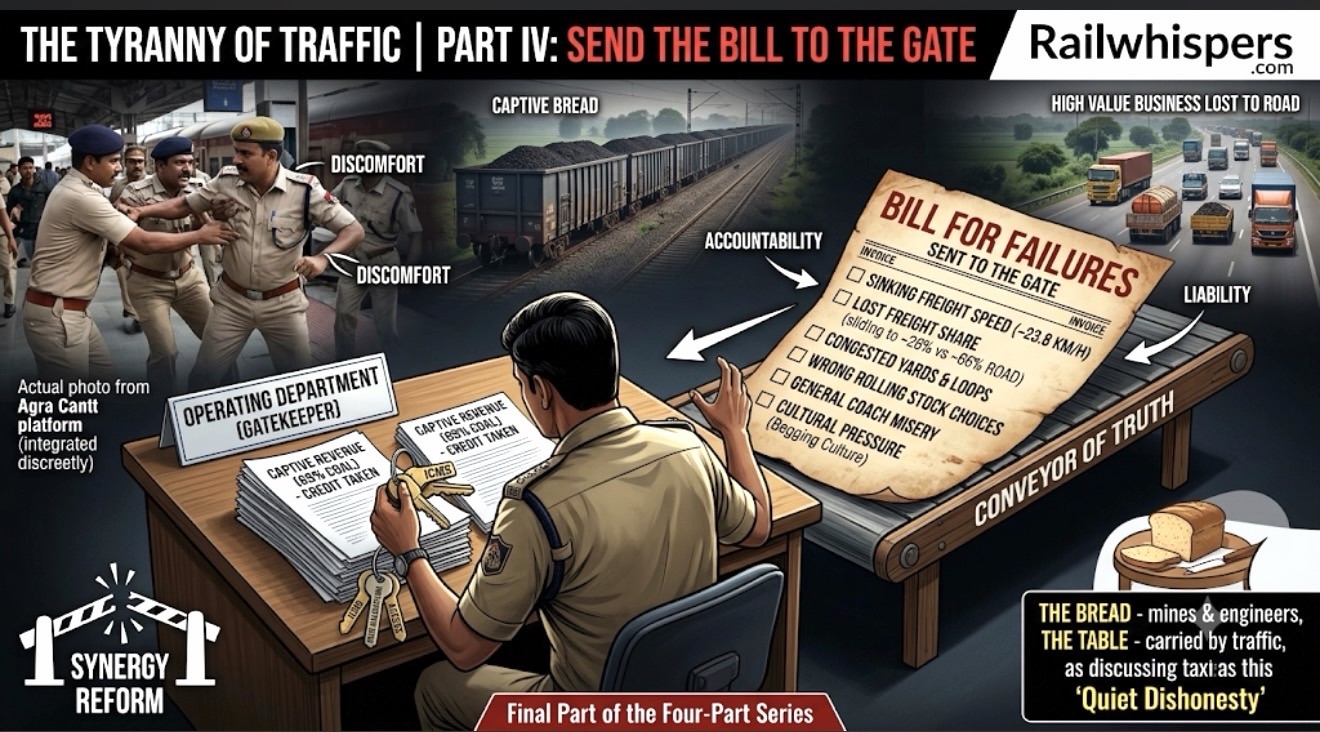
Part IV: The Tyranny of Traffic—Send the bill to the gate
Editorial Comment: We began with one division and one malpractice. In “Tomfoolery of Prayagraj Division”, this newspaper showed how the operating department books locomotive failures it caused against the technical men who did not, turning a safety record into a weapon and Integrated Coaching Management System (#ICMS) into a courtroom where one party is complainant, judge and clerk at once. That was not the sin of a single division. It was a symptom. Across this four-part series we set out the disease in full: “the myth that the #traffic-cadre alone earns the Railways its #bread, the machinery of #gatekeeping by which it holds every other department to ransom, and the accountability for sinking speeds, lost #Freight and a feudal culture on the platform that the same #cadre has spent decades disowning. We publish it in the plain belief that an organisation cannot #reform what it refuses to name”.
Part II, III and IV of the series is by a distinguished superannuated officer who agreed to start to write for us on condition of anonymity.
The Tyranny of Traffic
- Part II — The men who did not win the bread
- Part III — The key to the gate
- Part IV — Send the bill to the gate
- (Part I being “Tomfoolery of Prayagraj Division” which was written by a different contributor.
July 16, 2026: “Part-II: The Tyranny of Traffic—वर्चस्व की कवायद!” (Part-II: The men who did not win the bread).
July 17, 2026: “Part-III: The Tyranny of Traffic—The key to the gate!” (Part III — The key to the gate).
On 13 July, at #AgraCantt, a video did the rounds that no railwayman should be able to watch without discomfort. Personnel of the Railway Protection Force (#RPF) were filmed dragging and beating a #DySS (Deputy Station Superintendent) on the platform while the Hirakund Express stood at the halt. Four RPF men were suspended, two of them assistant sub-inspectors, and North Central Railway (#NCR) ordered a three-member inquiry. The #IRTS Association and the Railwaymen’s Federation demanded strict action. As of this writing the official cause of the quarrel has not been stated.
The instinct is to read this as a discipline problem in the RPF, and perhaps in part it is. But listen to the supervisors, and a second reading emerges that is harder to dismiss. Several of them, speaking of their own experience and not of this case alone, describe a station environment in which the operating staff treat everyone else as contractors. The word that keeps coming up is begging. Supervisors say they have to plead for routine maintenance, that station masters can be openly bossy, that the men in the operating chair behave as though the platform is their estate and everyone on it is there by their leave. If even part of that culture is real, then #Agra is not only a story about four policemen who lost their heads. It is the story of a pressure that had been building for a long time, in a system where one department holds the gate and the others are made to knock.
I do not offer that as a defence of anyone who raised a hand. Assault is assault, and the inquiry should run its course. I offer it as a symptom. When a workplace runs on gatekeeping and supplication, the surprising thing is not that tempers finally broke. The surprising thing is that they did not break sooner.
The accounting they never do
Now let us do the accounting the #breadwinners never do for themselves. If you claim the credit for the #revenue, you inherit the #liability for the results. So let us look at the results.
Average speed first. The average speed of a freight train on Indian Railways was 23.8 km/h in 2024-25. A bullock in no particular hurry manages something not far off that. This is the headline output of a transportation business, and it has by many accounts been drifting down rather than up even as thousands of crore of rupees went into the network. #Speed is the product that the operating department exists to deliver. It is not delivering it.
Market share next. Rail now carries around a quarter of India’s freight, close to 26 per cent, while road carries about two thirds. The department that markets and operates transportation has watched the market walk out of the door and onto the highway, and has kept only the captive bulk that could not leave. That is the scoreboard of the marketing arm.
Then the money that was supposed to fix all this. Two plan heads carry the burden of the two things a railway is meant to produce, capacity and passenger experience. Plan Head-16 funds traffic facilities, the yard remodelling, the loops, the terminals, the works that create line capacity and let more trains move faster. Plan Head-53 funds passenger amenities, the station upgrades that decide whether a journey is bearable. Lakhs of crore have flowed through these heads over the years. And still the yards are congested, still the average speed sinks, still the passenger in the general coach travels in a way that would shame a self-respecting railway. Where did the capacity go? Who signed off on the works, the priorities, the sequencing? The traffic department’s concurrence and participation sit on all of it.
Rolling stock too. Every major rolling stock plan bears the approval and the participation of the operating and commercial side. So when the wrong stock is chosen, when the coaching mix does not match demand, when the general-coach traveller is left standing because someone misjudged the composition, that decision does not belong to the mechanical engineer alone. It was concurred in by the department that claims to know the customer.
Put it plainly. Poor speeds, lost market share, congested yards, wrong stock, misery in the unreserved coach. On every one of these the fingerprints of the #operating and #commercial department are on the file, often on the very first page.
A fair charge is a heavier charge
I promised precision in Part-II and I will keep the promise here, because a fair charge is a heavier charge. Average speed is not the traffic department’s fault alone. It depends on track quality, on signalling, on saturation, on the maintenance blocks that engineers need and often cannot get. Freight share did not bleed to road because of one cadre. Roads improved, GST removed the old delays, the economics of the short haul turned against rail. All of that is true and it must be said. But here is the thing that cannot be waved away. Every one of those factors was known and forecast for two decades, and the function whose entire purpose is to design mobility, plan the network, sequence the trains and sell the capacity is the function that was paid to respond to exactly these pressures. Network design, yard planning and mobility design are the sole preserve of the traffic service. The technical departments have virtually no say in how the network is designed to move. So when mobility stagnates, the responsibility cannot be spread thinly across everyone. It concentrates, and it concentrates at the gate.
This is the quiet dishonesty at the centre of the breadwinner pose. The cadre takes sole credit for the revenue, which is captive and would arrive without it, and it disclaims responsibility for the performance, which is genuinely within its control and which is poor. That is precisely backwards. The honest accounting is the reverse of the boast. Modest credit for the earnings, which the mines and the engineers largely made possible. Major ownership of the failures, which flow from decisions the department actually took.
The reform that is owed
So what is to be done. The reform instinct of recent years was not wrong in diagnosis, only in execution. The silos did need to fall. The answer now is not to hand the strongest silo the master key and hope it plays fair. It is to build genuine cross-cadre accountability into the places where the damage is done. Network and mobility design should not be the private property of one service, closed to the engineers who build the very capacity being designed. The control and monitoring systems should answer to the whole organisation, not serve as a stick in one department’s hand. And the culture that turns station platforms into little fiefdoms, where supervisors beg and the RPF is treated as hired help, has to be named for what it is and broken, before more videos like the one from Agra teach the public what the service already knows.
The men who keep the gate have spent a long time telling the Railways that they win its bread. The numbers say otherwise. It is time the organisation stopped believing the story, and started sending the bill for the failures to the office that actually holds the key.