

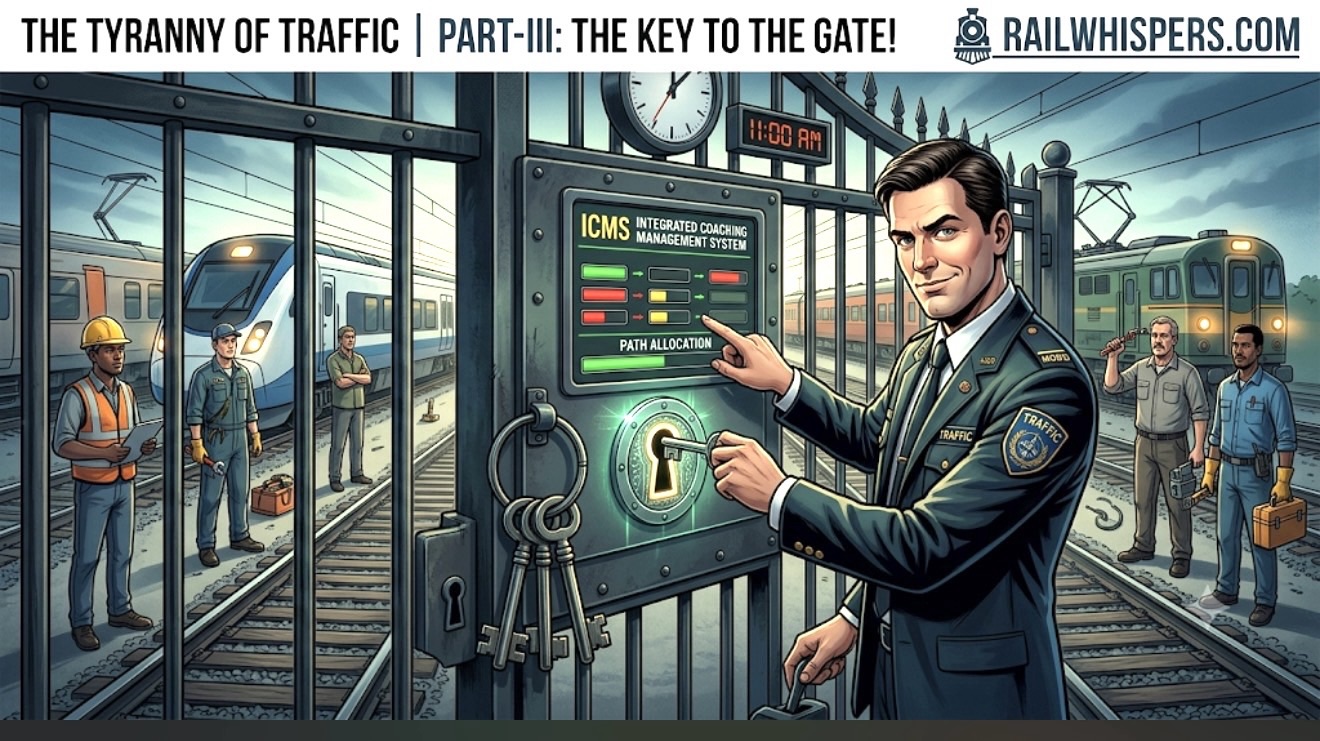
Part-III: The Tyranny of Traffic—The key to the gate!
Editorial Comment: We began with one division and one malpractice. In “Tomfoolery of Prayagraj Division”, this newspaper webportal showed how the operating department books locomotive failures it caused against the technical men who did not, turning a safety record into a weapon and Integrated Coaching Management System (#ICMS) into a courtroom where one party is complainant, judge and clerk at once. That was not the sin of a single division. It was a symptom. Across this four-part series we set out the disease in full: the myth that the traffic cadre alone earns the Railways its bread, the machinery of gatekeeping by which it holds every other department to ransom, and the accountability for sinking speeds, lost freight and a feudal culture on the platform that the same cadre has spent decades disowning. We publish it in the plain belief that an organisation cannot reform what it refuses to name.
Part II, III and IV of the series is by a distinguished superannuated officer who agreed to start to write for us on condition of anonymity.
The Tyranny of Traffic
- Part-II — The men who did not win the bread
- Part III — The key to the gate
- Part IV — Send the bill to the gate
July 15, 2026: “Part I: Tomfoolery of Prayagraj Division” which was written by a different contributor.
July 16, 2026: “Part-II: The Tyranny of Traffic—वर्चस्व की कवायद!” (Part-II: The men who did not win the bread).
Every large organisation has one function that everyone else must pass through. In the Railways, that function is not glamorous and it does not show up on a plaque. It is the allocation of paths. Who gets a slot on a saturated section, whose rake moves and whose waits in the loop, which yard is cleared first, which train is given priority when two want the same block at the same minute. This is the #operating department’s daily #bread, and it is the most valuable thing anyone in Indian Railways controls. Not because it earns money. Because it decides who else can.
Understand this and you understand the department. The #traffic-service is powerful not for the revenue it claims but for the gate it keeps. A station master can hold a maintenance block that an engineer needs. A control office can decide that the permanent way gang gets its four hours at two in the morning instead of eleven at night, or does not get them at all this week. A commercial officer can be helpful, or he can be slow. Multiply these small discretions across a network of thousands of stations and you have the real currency of the organisation. It is access. And access, when it is scarce and someone controls the tap, is power.
There is nothing sinister about a railway needing a traffic control function. Someone has to sequence the trains. The problem is not the function. The problem is what a #cadre does when it realises that the function is a chokepoint, and that whoever holds the chokepoint holds everyone else. At that point a coordinating role quietly becomes a #gatekeeping role, and gatekeeping, in any bureaucracy on earth, curdles into leverage.
The terror of ICMS
Now layer the technology on top. The Integrated Coaching Management System (#ICMS) and the family of control and monitoring tools that sit around it were sold as instruments of efficiency, and in principle they are. But talk to supervisors and to officers of the other services and you hear a different word used about these systems. #Terror. Not because a dashboard is frightening, but because the dashboard is pointed. It records, it flags, it escalates, and the finger on it belongs to the operating side. A tool that could have been a neutral referee has become, in too many divisions, a stick. When the same department both sets the exam and grades it and decides who gets caught cheating, the tool stops being about efficiency and starts being about control.
If all of this were merely cultural, an old habit of a proud cadre, it might correct itself over time. What makes the present moment different is that the machinery of the Railways was recently redesigned, and the redesign handed the gatekeepers the one prize they most wanted.
A reform turned on its head
Recall what the 2019 restructuring was meant to do. The government looked at a Railway Board split into eight departmental fiefs, each with its own Member, each defending its turf, and decided the silos had to go. Eight separate services were to be merged into a single Indian Railway Management Service (#IRMS), so that an officer’s cadre would no longer be his tribe. The Board itself was collapsed from eight departmental Members into four functional ones, reporting to a Chairman who would finally be a genuine chief executive. The whole point, stated openly, was to end the department culture.
Watch what happened to one of those four functional posts. Member, Operations and Business Development (#MOBD). On paper it is a clean functional label. In substance it carries the entire old Traffic domain, transportation, coaching, commercial, catering, tourism and the information technology that runs it all. It is, in other words, the #gate, elevated to the Board and given a modern name. And it is widely believed within the service, and stated by many serving officers in private, that the traffic cadre worked hard, canvassing politicians and the bureaucracy, to make sure that this particular chair would in practice remain theirs. I cannot document that lobbying campaign from the public record and I will not pretend the record proves it. But I can report that it is the settled belief of a great many people who wear the same uniform, and that belief is itself a fact about the institution.
Here is the irony worth sitting with. A reform designed to dissolve departmental identity ended by delivering, to the most departmental of all the departments, custody of the function that lets it stand over every other department. The #silos were supposed to come down. Instead the one wall that mattered was reinforced and given a corner office.
And the behaviour since tells the story better than any organisation chart. Senior officers of the technical services will tell you, if you ask them quietly, that they have watched the traffic cadre grow more combative, not less, since the operating and business development post was secured. The moral certainty has hardened. The sense of ownership over the Railways, the assumption that the operating officer is the Railways and everyone else is a supplier to it, has if anything deepened. A restructuring that was meant to humble the tribes has emboldened the strongest one.
A monopoly dressed as service
This is why the #breadwinner myth from Part-II matters so much to the cadre, and why it is defended so fiercely. The myth is the moral cover for the machinery. If you can convince the organisation and the government that you alone bring in the money, then your grip on the gate looks like stewardship rather than what it often is, which is leverage. Take away the myth, as the numbers do, and the grip is exposed for what it is. A monopoly on access, dressed up as service.
None of this makes the operating officer a villain. Most are decent professionals doing a hard job under real pressure. The danger is structural, and structural problems do not need villains. Give any group exclusive control of the one resource everyone else depends on, tell that group it is also the sole earner and therefore the natural aristocracy of the place, and remove the check that a balanced Board once provided, and you will get exactly what the Railways is now getting. A gatekeeper that has forgotten it is a servant of the network and has started to behave as its owner.
There is a cost to all this, and it is not paid by the gatekeepers. It is paid by the network, by the shipper who leaves for the road, by the supervisor kept waiting, and in the end by the passenger in the general coach. In the final piece I will send the bill to the address where it belongs.