

Part VII: The Tyranny of Traffic—The Absentee Landlord
“The leadership must know who owns which cadre!”
Editorial Comment: Part-VI — “Keep the man waiting at the gate!” — set out how this organisation manufactures the fatigue it then calls #humanerror, and left one question standing. If the #operating department will not answer for a loco pilot’s duty hours, his detention or his wasted runs, on what footing does it deal with him at all? It has one. It is in writing, it is precise, and it is produced in exactly one situation. This part sets out what the #establishment manual says, what the department does with it, and what the same silence costs the #stationmaster, who is nobody’s disputed property at all. “An organisation cannot #reform what it refuses to name.”
The series so far—
- July 15, 2026: “Part I: Tomfoolery of Prayagraj Division”
- July 16, 2026: “Part-II: The Tyranny of Traffic—वर्चस्व की कवायद!” (The men who did not win the bread)
- July 17, 2026: “Part-III: The Tyranny of Traffic—The key to the gate!”
- July 19, 2026: “Part IV: The Tyranny of Traffic—Send the bill to the gate!”
- July 20, 2026: “Part V: The Tyranny of Traffic—Take the key from the gate!”
- July 21, 2026: “Part VI: The Tyranny of Traffic—Keep the man waiting at the gate!”
Parts VI & VII are built on feedback from retired officers and serving supervisors belonging to the #traffic, #electrical and #mechanical departments.
Who owns which cadre?
Part-VI put that question and took the half of it that costs lives. A loco pilot called out on a forecast only the operating department holds, wasted in a lobby the operating department filled, running a duty the operating department planned, with the explanation for all of it demanded from an electrical officer who planned none of it.
This part takes the other half. Not what the arrangement does to the man, but what the department gets out of it.
Because the department’s position is not that the loco pilot is somebody else’s. Its position, stated in writing and acted on, is that the loco pilot is its own.
It states it once.
What the manual actually says
Begin with the document, and produce the awkward part of it first.
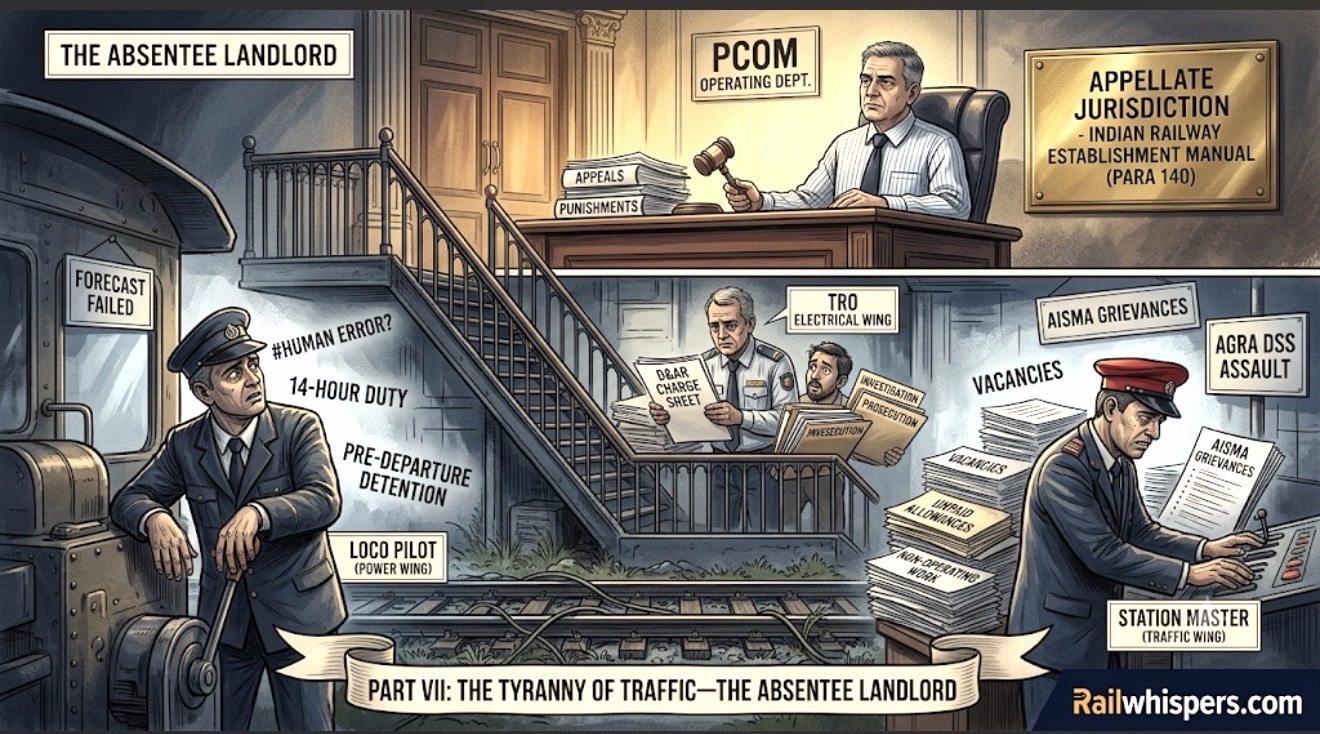
The Indian Railway Establishment Manual (#IREM), Volume I, Chapter I, Section B, Sub-Section III, deals with Drivers and Loco Running Supervisors at paragraph 140. It files them under the heading Transportation (Power) Department. Guards are dealt with sixteen paragraphs earlier, at 124, under a different heading, Transportation (Traffic) Department.
A reader looking for a way out of this argument will stop at that difference and say the manual separates the driver from the traffic men.
Look at the two headings again.
Transportation is this organisation’s other name for what everybody now calls #Operating. Both headings are transportation headings. The #manual divides the operating department into a traffic wing and a power wing, and it puts the loco pilot in the second. What it does not do, anywhere in that sub-section, is put him in the electrical department. There is no heading there for an electrical cadre of drivers, because the manual never contemplated one.
So the loco pilot is, on the establishment, an operating man. That is not an inference. It is a heading and a paragraph number.
The organisation nevertheless administers him through traction rolling stock operation (#TRO), a wing sitting under electrical engineering. Call the gap between the manual and the practice administrative untidiness if you like. The rest of this part is about what the gap is worth, and to whom.
Land is ours, the dirty work is somebody else’s
Now follow a mistake through the system and watch where it travels.
Say the driver errs. Proceedings under the Discipline and Appeal Rules (D&AR) are initiated by the TRO. The electrical wing runs the case, frames the charge, appoints the inquiry officer, carries it through.
And the final appeal?
It rests with the Principal Chief Operations Manager (#PCOM).
Not with an electrical officer. Not with the wing that prosecuted him. With the operating boss of the zone.
Ask why, because the answer is the whole of this piece. The appeal climbs to the #PCOM because on the establishment the loco pilot is a transportation man, which is to say an operating man, and paragraph 140 is where it says so. That is the ground of the jurisdiction. Not custom, not convenience. The classification.
So ownership is not in dispute at all. The department has settled it, in the one forum where settling it was worth something.
Now hold that beside everything in Part-VI. The man is theirs when there is a punishment to confirm. He is not theirs for the call book issued on a forecast that did not hold, nor for the hours in the lobby the railway pays for and does not use, nor for the duty that ran past fourteen, nor for the 10 kilometres in 12 hours, nor when the Board wants to know why the detention figures look the way they do. For all of that he is an electrical officer’s problem, and that officer had no say in a single element of it.
Read the chain once more, slowly. The department that made the plan does not answer for the plan. The wing that had no hand in the plan prosecutes the man who suffered it. And the department that made the plan sits in final appeal over that prosecution, by right of an ownership it exercises nowhere else in the man’s working life.
This is absentee landlordism in its textbook form. The land is ours. So are the proceeds. The title deed is produced when there is rent to be collected or a tenant to be put off. Somebody else lives on the land, works it, and stands at the door taking the abuse.
Part-I “Tomfoolery of Prayagraj Division” described a department contriving to be prosecutor, witness and court of appeal in the matter of a single booking. This part describes the same department declining even to prosecute its own men, while keeping the appellate chair.
The station master’s list
It would be convenient for the department if all this turned on a disputed cadre. It does not.
The station master is nobody’s disputed property. He is operating, he has always been operating, and no manual, wing or heading says otherwise. So look at what the undisputed ownership has bought him.
The station masters have a body of their own, the All India Station Masters’ Association (#AISMA), alongside the federations. Read its grievances as a list, because a list is the form in which they arrive.
Vacancies. An unusually heavy incidence of D&AR penalties. Non-operating work: station cleanliness, ticket sales, and accountal of sales at smaller stations. Allowances unpaid for months, in some cases for years.
Then ask the same question as before. Who plans this cadre? Who sanctions its posts, sets its duties, moves its files?
The operating department. All of it, and here there is not even a divided establishment to hide behind.
Part-IV “Send the bill to the gate”, reported the assault on a Deputy Station Superintendent (#DySS) at Agra Cantt, and the word supervisors kept reaching for when they described the station environment. Begging. It is worth noticing that the man standing on that platform was the operating department’s own. The culture the gate has built does not stop at the gate. It works inward, and the man standing in it is the Station Master.
The two most volatile associations in the organisation
#AILRSA and #AISMA are the two bodies in this organisation most capable of bringing an agitation to the boil. Between them they represent the men who drive the trains and the men who signal them, which is to say the men who between them make the railway run at all.
Trace every substantive grievance either of them holds. The hours. The wasted crew. The detention. The vacancies. The penalties. The unpaid allowances. The work that was never theirs to do.
Every one of them arrives at the same door, that of the Operating Department.
What the Minister should ask for
Part-III “The key to the gate!”, set out how the Member Operations and Business Development (#MOBD) chair carries the whole of the old traffic domain to the Board under a functional name, and how it is believed within the service that the cadre worked to keep it there.
Part-V “Take the key from the gate”, asked whether the department can be trusted to draft the order that removes its own leverage, and answered no, on the plain ground that no department in the Government of India ever has.
This part adds a charge that has not yet been laid.
The Hon’ble Minister for Railways should call for results against that chair. Not only the results this series has already put on the record, the speeds, the freight share, the yards, the paths, set out in Part-II “वर्चस्व की कवायद!”, and Part-IV “Send the bill to the gate”. Those are the operating results. Ask for the staff results as well.
- Ask for pre departure detention, division by division, set against the forecast that produced the call book. Ask what those hours cost in wages paid for time the railway did not use.
- Ask why the explanation for it is signed by an electrical officer when paragraph 140 says the man is not his.
- Ask how many D&AR cases against loco pilots were initiated by a wing with no control over the plan and confirmed on final appeal by the department that made it.
- Ask the operating department to state, in writing, the provision under which the PCOM hears those appeals. Then ask it to explain why the identical provision generates no engagement or action at any other hour of the pilot’s day.
- Ask for station master vacancies against sanction, and for the age of the oldest unpaid allowance on the zone.
And when the next inquiry into the next signal passed at danger comes back with the words human error, ask again the question the Minister has already asked once, and go on asking it until somebody answers in writing.
For all the canvassing that is believed to have gone into securing the chair of MOBD, the department has to be held to more than its operating performance. It must answer for the men it owns and does not administer, and for the men it administers and will not defend.
None of which is possible until one thing is settled — “The leadership must know who owns which cadre!”