

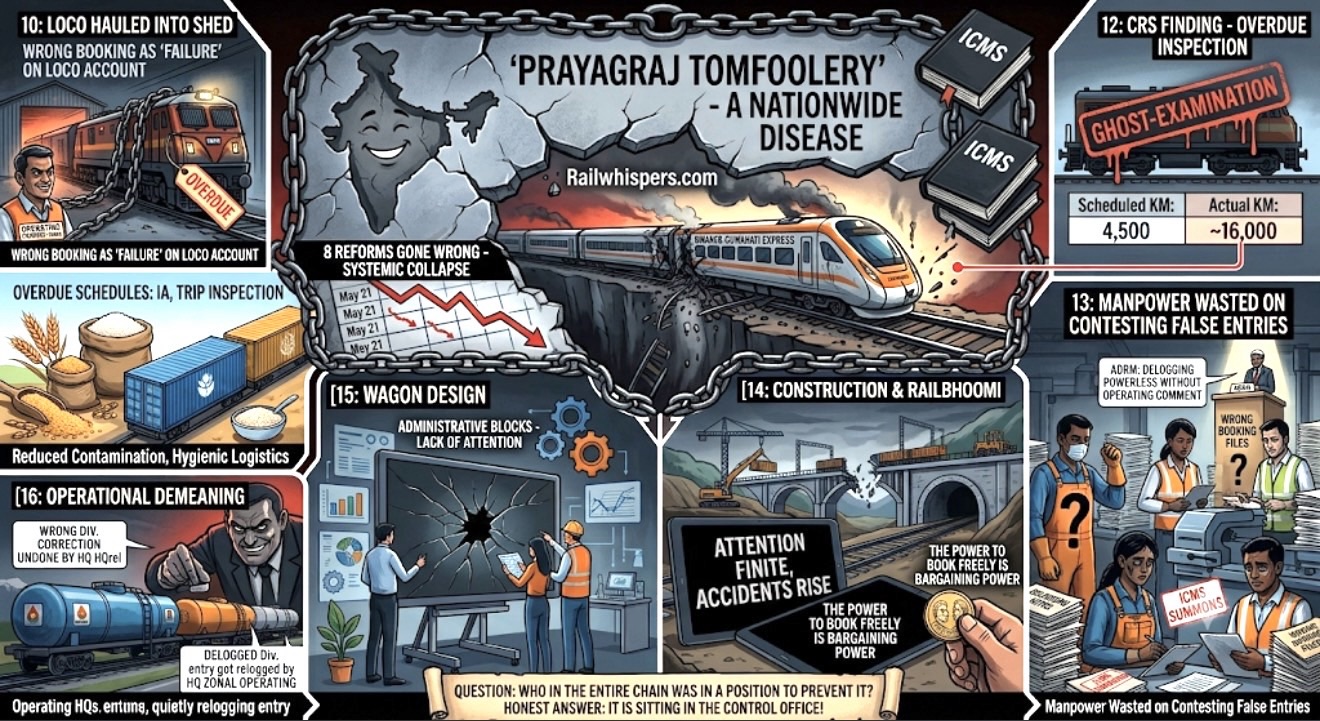
Tomfoolery of Prayagraj Division
How the operating department demeans and harasses every technical department. And yes, Prayagraj Division (#PRYJ) is not alone. It is a nationwide disease.
If the history of this railway is ever written honestly, the #operating department of #Prayagraj division of North Central Railway (#NCR) will find a place in it. Not for punctuality. For invention.
Look at the divisional abnormality board of 14 July. Three locomotives hauled into Prayagraj shed. Loco No. 30482 of #Royapuram, off train 14114. Loco No. 33281 of #Saharanpur, off 04116. Loco No. 37236 of #Ghaziabad, off 20434. Against each one, the same four words. Trip inspection overdue.
One was carrying an IA schedule undone since 21 May. Read that date again. May. The machine kept working.
The locos were cut and sent to shed, on the demand of the Traction Loco Controller (#TLC). Correct. That is what should have happened.
Then the operating department logged the withdrawal in #ICMS. As a failure. On the loco account.
Who moves a locomotive?
A shed cannot fetch an engine it never sees. A Royapuram loco may be anywhere between Chennai and Chhapra on a given morning. Somebody has to trace it, turn it, and work it home for a major schedule or to the nearest shed for a minor one.
The man who traces it is the Traction Loco Controller. He is a #loco man. He sits in the control office, finds the machine wherever in the country it has wandered, and asks for it to be turned towards a shed.
Asks—That is the whole word
The TLC cannot order a train. He cannot decide which engine goes on which load. That decision belongs to operating. The loco side requests. Operating disposes.
Now read the entry again. Those three locomotives were demanded by TLC Prayagraj. The loco side asked for them. And the loco side was then booked for the fact that they had gone overdue.
A fine arrangement. The man at the wheel writes the #accident report and names the passenger.
The loco is not the story. The booking is
An ICMS entry is not a line of text. It is a summons. Every entry has to be defended. The logs go up to Railway Board. The Chairman picks samples. So no reply can be casual.
Booking takes a minute. Removing a wrong booking does not. It is worth setting out how.
The department that has been wrongly booked raises a delogging note. The note goes to operating for comments. That is, to the department that made the booking. It then goes to the #ADRM, who alone can delog. On paper the whole thing should close in twenty four hours.
On paper.
In practice operating sits on the comment. No comment, no delogging. The ADRM cannot act on an incomplete file. The entry stays live. The department carrying the wrong booking on its chest goes on defending it.
Say the comment finally comes. Say the ADRM is convinced. Say he delogs. It still does not end. The entry is quietly got relogged through the operating department of the zonal headquarters.
Read that chain again. The department that books the failure also comments on whether the booking was wrong. And when a divisional officer rules against it, it goes over his head and has the correction undone.
Prosecutor, witness, and court of appeal.
What it costs
Not paperwork. Manpower.
Every hour a technical department spends contesting a false entry is an hour not spent on an asset. Supervisors who should be on the machine sit drafting defences. Attention is finite, and this railway has a long file of accidents to show what happens when it is spent in the wrong place.
And it is demeaning. That is not a side effect. That is the function. Asset owning departments are made to stand and explain themselves for doing their job correctly. Do that often enough and men stop doing the job correctly.
The charge is not that one entry will derail a train tomorrow. The charge is what the entry teaches. That pulling an overdue loco off a train earns you a black mark and weeks of files. That the career-safe course is to let the machine run one more trip.
Not a Prayagraj disease
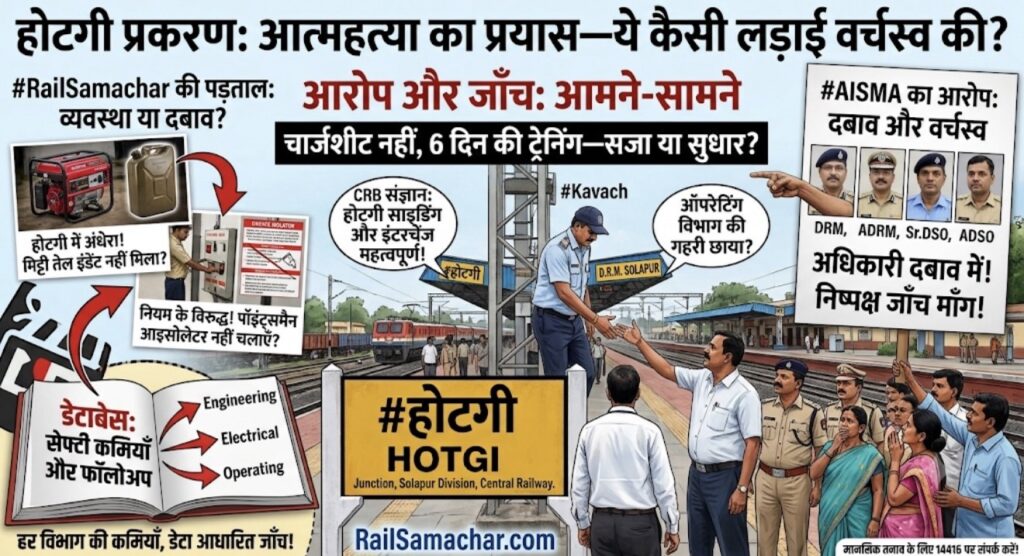
Look at Solapur. #RailSamachar reported this month that operating there was furious with safety inspections, that the officer who kept finding lapses was called in and scolded for finding them, and that technical officers bend before operating while their departmental heads stay silent at headquarters. “होटगी प्रकरण: आत्महत्या का प्रयास—ये कैसी लड़ाई वर्चस्व की?”
Different zone. Same reflex
The power to book freely, at no cost to yourself, is bargaining power. The traffic side holds it across this country and knows what it is worth. That is my judgment, and I state it plainly.
13 January 2022
Twelve coaches of the Bikaner-Guwahati Express came off the road near Domohani, in Jalpaiguri, on Alipurduar division. Nine people died.
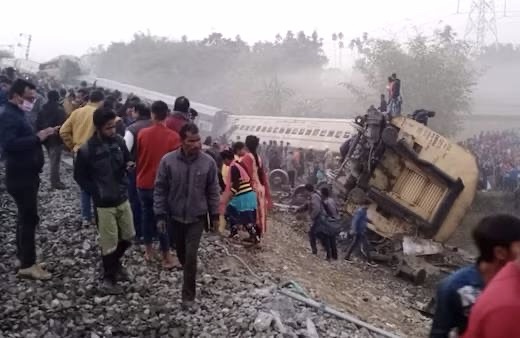
A traction motor had come off the locomotive. The Commission of Railway Safety (#CRS) found that the WAP-4 required a #trip-inspection every 4,500 kilometres, that it last had one on 6 December 2021, and that it then ran roughly 16,000 kilometres before it came off the road.
The Commission used two phrases that ought to hang in every control office in this country. #Ghost-examinations. And #missing-link-loco.
An engine that had fallen out of the net. Nobody’s problem, until it was everybody’s.
The question
Prayagraj has not learnt that lesson. It has found a way to punish the men who did.
So put one question to the operating department, and let it answer in writing for once. Not who is to blame for a locomotive going overdue. Who, in the entire chain, was in a position to prevent it?
There is one honest answer. It is sitting in the control office!