

Maximum Government at Rail Bhawan—Damn What the Prime Minister Said
An authority takes a function—it does not take the accountability that comes with the function!
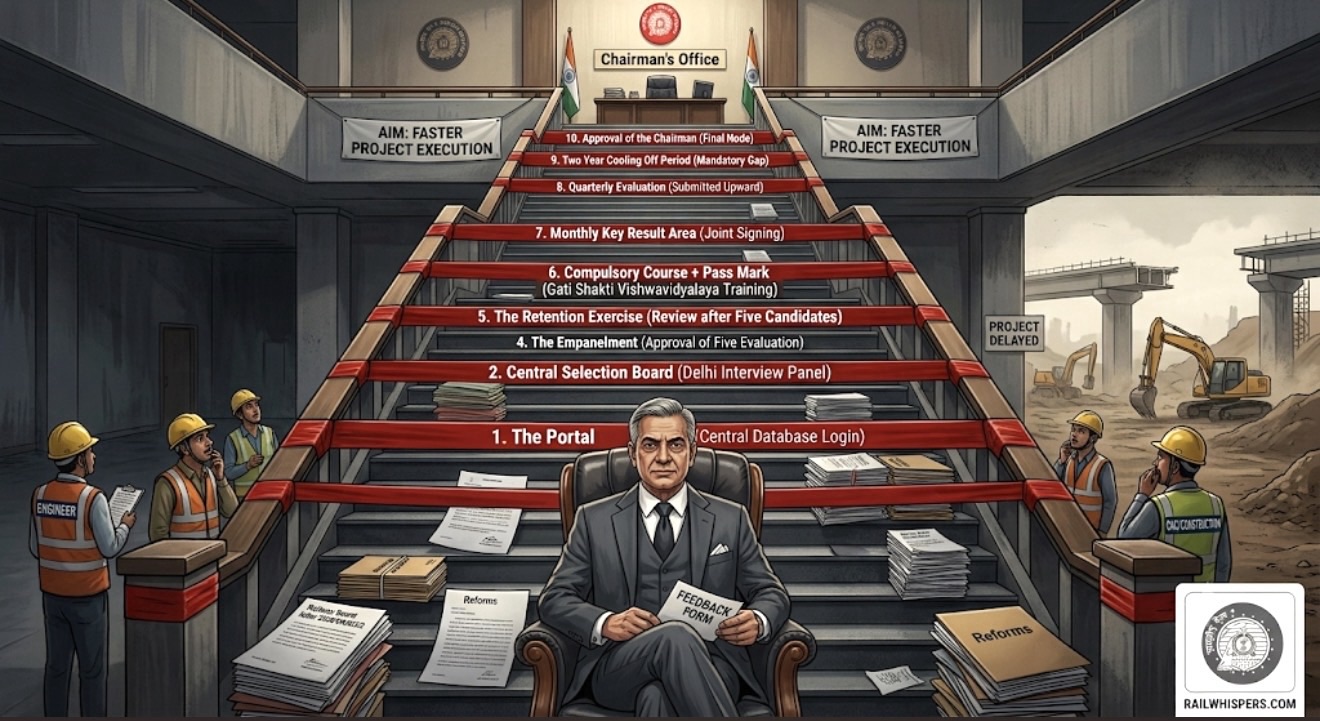
Ten new layers between an officer and a worksite, and the Zone that answers for the work is left to send feedback!
A letter that reads well
Railway Board letter no. 2026/O&M/3/2 of 28 July 2026 is one page long. Three pages of annexure follow it. It #Reforms the Construction organisation.
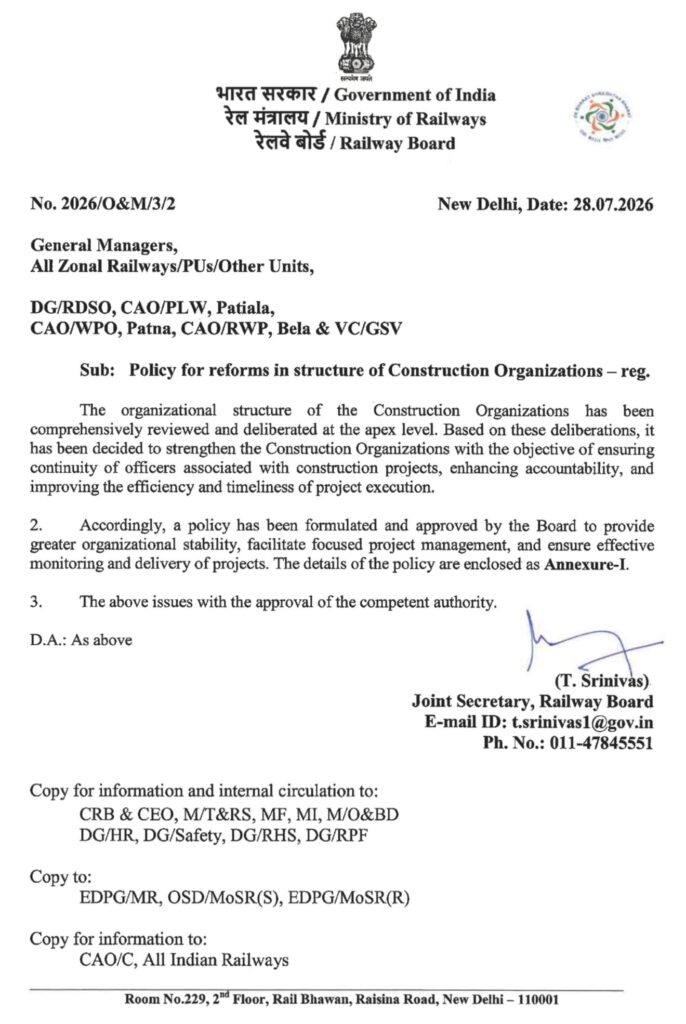
It went to every #GeneralManager. It went to #RDSO, to the #ProductionUnits, to #GatiShakti Vishwavidyalaya. Copies went to the Chairman and to four Members.
The objective is stated plainly. Continuity of officers on #Construction projects. Higher accountability. Better and faster execution.
Concede the problem first, because it is real. Officers move too often. An engineer who arrives after the alignment is fixed, and leaves before the bridge is built, owns nothing. Continuity is a genuine need. The Board is right to name it.
Now read what the letter does about it.
What is new
Six things are new.
Selection moves to Delhi. Central Selection Boards of two Additional Members, Principal Executive Directors or Executive Directors will select officers of all departments for construction. The levels run from Junior Scale to NFHAG.
Officers apply through a portal. Biodata, courses, experience and “exceptional works done” go to a central committee.
Selection is by interview. The committee calls the senior most officers to five times the requirement, and interacts with them.
Retention moves to Delhi too. Clause 2, item v, gives the same committee the retention of officers who have already served more than five years.
Training becomes a gate. Two to three weeks at Gati Shakti Vishwavidyalaya or a centralised institute, and passing the course is essential for working in construction.
Tenure is fixed. Five years, extendable to seven.
None of this existed before. All of it now sits above the zonal railway.
Where the General Manager went
So ask the plain question. What does the policy leave to the General Manager?
Clause 4, item v, answers it. “ZR will provide feedback of officer for perusal of concerning Member.”
That is the zonal railway’s part in the whole document. Feedback.
This deserves more than a raised eyebrow. The General Manager is not one senior officer among many. The post is an institution. The Railways Act recognises the General Manager as the railway administration of a government railway. The zone is not the legal person. The General Manager is.
Everything in that zone is finally answerable to that office. A works contract. A land acquisition. A bridge. A death at a construction site. A question in Parliament. The General Manager answers.
The General Manager will not choose the officers who do the work.
Set that against what the same General Manager does on every other day of the week. Inside the zonal railway, the posting of every officer up to Junior Administrative Grade (#JAG) is the General Manager’s decision. So is the transfer of most Heads of Department (#HOD), barring the few posts the Railway Board controls.
So a General Manager may move a Head of Department, and may not pick a Junior Scale officer for a construction post in the same zone.
The General Manager may send feedback about them.
And be content with that.
The Member and the cadre
The second casualty sits in Rail Bhawan.
The practice has been settled for years. Up to Senior Administrative Grade (#SAG), transfer and posting of an officer is the competence of the Board Member who controls that cadre. The cadre belongs to that Member, who answers for its depth, its succession and its balance.
Read clause 5, item i. Transfers of CAO/Construction, NFHAG and SAG officers now need the approval of the Chairman and Chief Executive Officer. The Member Infrastructure (#MInfra) is left with JAG and below.
The Member Infrastructure keeps the bottom of the cadre. The Member loses the top of it.
Cadre control is not a courtesy. An officer held in construction for seven years is an officer the parent department cannot count for a Chief Engineer’s chair, a divisional post or a specialist assignment. Those chairs must still be filled. The Member Infrastructure will now fill them from a cadre whose senior end is allotted elsewhere.
And then clause 8
Then the policy cancels itself.
“Notwithstanding the above guidelines, #CRB shall have full powers for retention/posting in administrative interest.”
Read that twice. Everything above it binds the General Manager, the Member, the committee and the officer. Nothing above it binds the authority at the top.
A policy that ends in an override is not a policy but it’s a policy corruption. It is an upward delegation with paperwork attached.
Accountability is the stated objective of the letter. Name the accountability that clause 8 leaves with anybody below the Chairman.
More layers, not fewer
One declaration has been in circulation for more than a decade. Minimum government, maximum governance. Fewer layers between the decision and the person who executes it.
This letter travels the other way, and it does so on paper that anyone can count.
Count the layers this letter adds—
- The portal.
- The Central Selection Board, in three variants by level.
- The interaction.
- The empanelment.
- The retention exercise.
- The compulsory course with a pass mark.
- The monthly Key Result Area, signed jointly.
- The quarterly evaluation to the next higher officer.
- The two year cooling off.
- The approval of the Chairman.
Ten steps stand where one posting order stood.
That is more government, and all ten steps of it sit in Rail Bhawan. The governance was meant to happen at the worksite.
The so-called aim is to execute projects faster. The instrument is ten procedural gates before an officer reaches the site.
Seven years in one place
The tenure provision needs its own look.
Five years, extendable to seven. In construction. Which is to say in the part of the railway that acquires land, awards works contracts and certifies payment against them.
Administrative practice has long run the other way, and it runs that way for a reason. The senior most executive posts in Indian Railways, the Divisional Railway Manager (#DRM) and the General Manager (#GM), turn over far more often than this. The #Policy proposes to hold a construction officer in one organisation for longer than the railway holds the officers who supervise the work.
Continuity is a real good. So is #rotation. This letter takes one and does not say what it did with the other.
There is a quieter problem in the same section. Clause 5, item iii, preserves natural transfers on promotion to Divisional Railway Manager, Principal Head of Department, General Manager and Additional Member.
So the seven year tenure holds only the officer who is not promoted.
The able ones leave on promotion, as they always did. The tenure binds the rest. That is not continuity. That is the opposite of it.
The shape of it
Regular readers of these pages will know the shape.
An authority takes a function. It does not take the accountability that comes with the function. The office that keeps the accountability is left to send feedback.
The construction policy is department neutral on its face. It names no service. That is what makes it worth reading closely. This is not one department taking work from another. This is the centre taking a function from the one office the law recognises.
Ask the useful question. Not who is to blame.
Who was in a position to prevent this?
The letter says the structure was “comprehensively reviewed and deliberated at the apex level”. It does not say who was consulted. It went to every General Manager on 28 July 2026, as a decision already taken.
Three questions for the Board
- When a construction project fails in a zone, who answers. The General Manager who did not select the officer, or the committee that did?
- If accountability is the objective, name the accountability that clause 8 leaves with anyone below the Chairman.
- Was any General Manager consulted before 28 July 2026? If the answer is yes, publish the record of it.
The Railway Act gives the zone a Master.
This letter gives the Master a feedback form.
#IndianRailways #RailwayBoard #ConstructionOrganisation #FeedbackForm #GeneralManager #CadreControl #MinimumGovernmentMaximumGovernance