

Twin CBI FIRs Expose Multi-Zone Bribery Racket in Railway Bill Clearances: MRT Signals Under Lens Across SER & NWR
From Chakradharpur to Bikaner: How CBI Unmasked an Organized Pay-for-Bills Syndicate Inside Indian Railways
Price Variations to RA Bills: Twin FIRs Lay Bare Systemic Kickback Network Between Railway Officials and MRT Signals
Railway S&T Bill Clearance Racket: CBI Books Dy. CSTE, Sr. Accounts Officer, and MRT Signals in Successive Bribery Cases
Cash for Approvals: CBI Raids and Dual FIRs Reveal Entrenched Tollgate System for Railway Contractor Bills
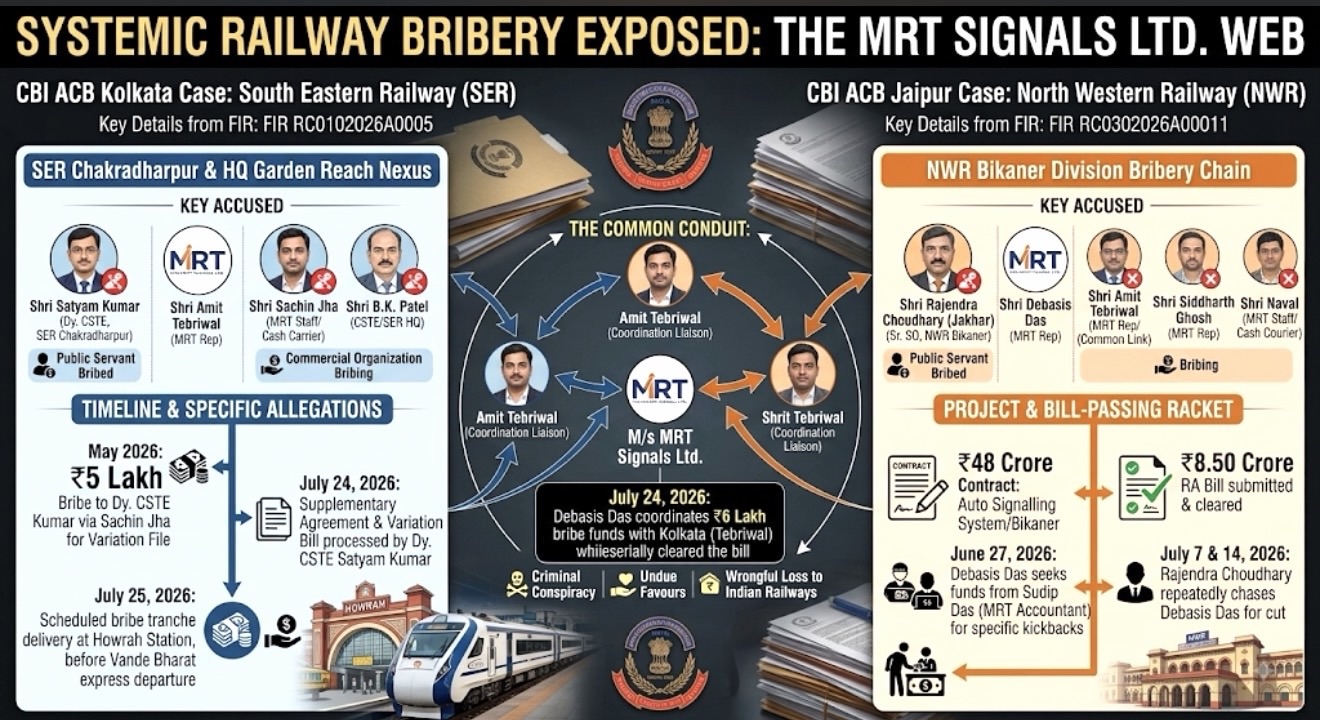
BIKANER: Two consecutive First Information Reports (FIR) registered by the Central Bureau of Investigation (#CBI) have blown the lid off an organized #Corruption network governing the clearance of bills, price variations, and supplementary contract approvals inside Indian Railways, with Kolkata-based contractor M/s #MRTSignals Limited emerging as the common conduit across multiple railway zones.
The systemic racket first unraveled in Kolkata, where the CBI’s Anti-Corruption Branch registered a regular case, RC0102026A0005, on July 24, 2026, under Section 61(2) of the BNS, 2023, along with Sections 7, 8, 9, 10, and 12 of the PC Act, 1988. The case named #SatyamKumar, Deputy Chief Signal and Telecommunication Engineer (#DyCSTE) of South Eastern Railway (#SER) posted at Chakradharpur; #AmitTebrewal, employee and representative of M/s MRT Signals Ltd; #AnkitAnchalia, Director of the company; the corporate entity M/s MRT Signals Ltd itself, having its registered office at 2, Raja Woodmunt Street, Kolkata; and other unknown railway officials and individuals.
According to the Kolkata FIR, reliable intelligence revealed that Dy. CSTE Satyam Kumar, in collusion with officials at the SER Headquarters in Garden Reach, Kolkata, engaged in corrupt practices by seeking illegal gratification from MRT Signals Ltd in exchange for clearing Running Account bills, Price Variation Clause (#PVC) bills, and High Utilization Network (#HUN) variation files for projects under Chakradharpur Division.
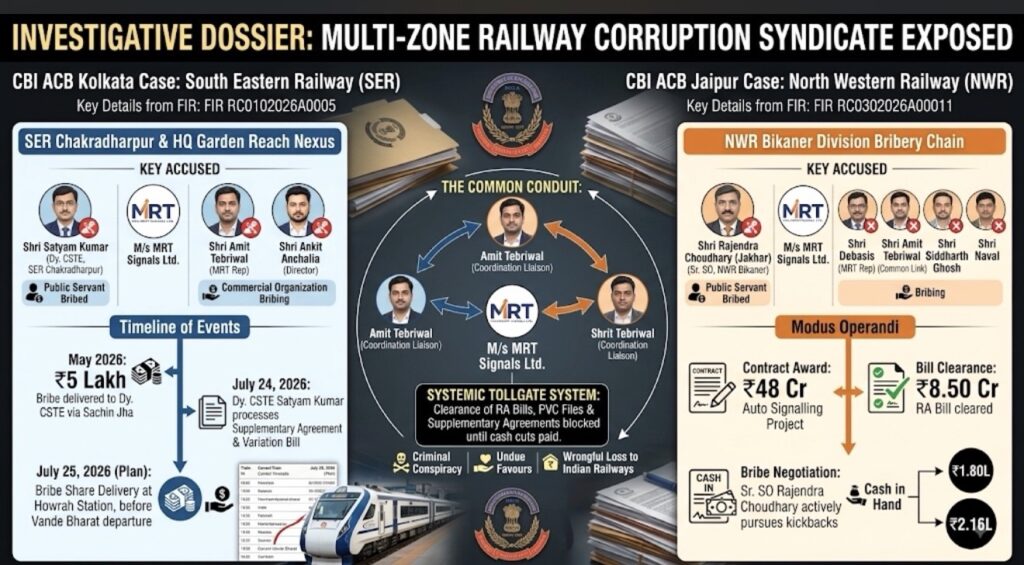
The probe detailed that an initial bribe installment of five lakh rupees had already been paid to Satyam Kumar in May 2026 through company staff Sachin Jha. The file was further escalated by company director Ankit Anchalia and Amit Tibrewal to Chief Signal and Telecommunication Engineer #BKPatel at SER Headquarters. On July 24, 2026, Satyam Kumar informed Tibrewal that he was processing the supplementary agreement and variation bill, demanding the pending bribe tranche be delivered to him early the next morning at Howrah Railway Station before his departure on the Howrah-Rourkela Vande Bharat Express, prompting the registration of the FIR and an investigation led by Addl Superintendent of Police Tarun Kumar Sinha.
Barely three weeks after the Kolkata action, an identical bribery pattern surfaced in Rajasthan, leading CBI ACB Jaipur to register another regular case, RC0302026A00011, on August 13, 2026, against #Rajendra Choudhary (Jakhar), Senior Section Officer in North Western Railway at Bikaner, alongside MRT Signals employees Debasis Das, Amit Tibrewal, Siddharth Ghosh, Naval, and the company itself. This case was registered under Section 61(2) of the BNS and Sections 7, 7A, 8, 9, 10, and 12 of the PC Act, entrusted to Deputy Superintendent of Police Ashish Rastogi.
The Jaipur FIR details that MRT Signals Ltd, which also operates a field office at Sufal Apartment, Bani Park, Jaipur, had secured a railway contract worth approximately forty-eight crore rupees for the construction and commissioning of an Electronic Interlocking based Automatic Signalling System in NWR’s Bikaner Division. During project execution, Debasis Das submitted bills amounting to roughly 8.50 crore rupees to the Office of the Dy. CSTE (Construction) at Bikaner, which were favorably cleared. To secure these sanctions, on June 27, 2026, Das requested bribe funds from company accountant #SudipDas amounting to 1.80 lakh rupees and 2.16 lakh rupees for Dy. CSTE (Construction) office personnel.
The investigation revealed that on July 7 and July 14, 2026, Senior Section Officer Rajendra Choudhary persistently pursued Debasis Das to demand his cut. Remarkably, on July 24, 2026—the very day the Kolkata FIR was being drawn up—Debasis Das reached out to the same Kolkata operative, Amit Tibrewal, to arrange a six-lakh-rupee bribe fund for Bikaner railway staff. On August 12, 2026, instructions were passed through Siddharth Ghosh to alert Rajendra Choudhary and another official that company courier Naval would hand over the bribe amounts of 1.80 lakh rupees and 2.16 lakh rupees in Bikaner on August 13, 2026, triggering immediate registration of the Jaipur case.
Together, the twin FIRs establish a continuous, well-oiled bribery machinery where M/s MRT Signals Ltd systematically utilized central liaison personnel like Amit Tebriwal to coordinate cash pay-offs across executive engineers and accounts scrutiny desks alike, turning routine statutory variations, price escalations, and running contract payments into calculated extortion points within the Indian Railways infrastructure network.