

Back to Basics | Part 3: “Fourteen Reversals and Nobody Watching the Wire”
Editorial Note: This part reads the Railway Board’s own gazettes and office orders, every one of which is on the public record or held by this publication. No serving officer is named. Any clarification or counter will be printed in full.
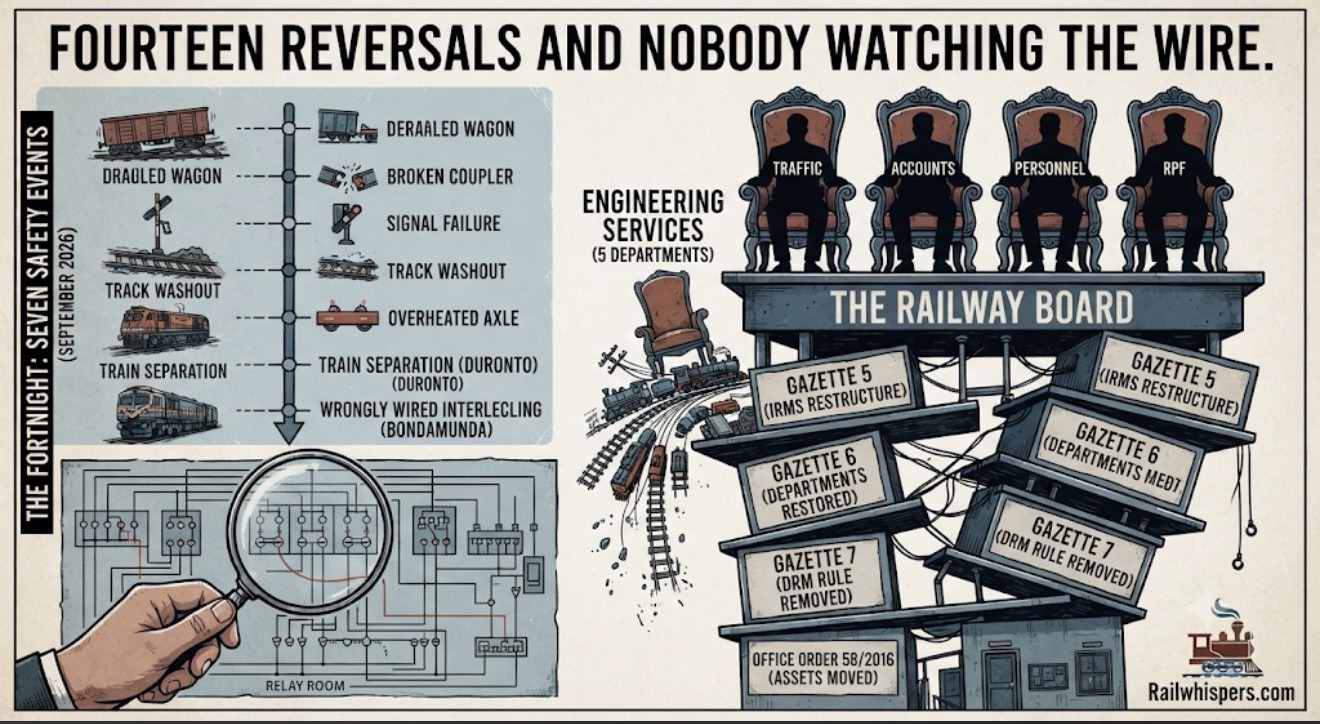
How good is a decision? One test is whether it survives. Since 2016 the Railway Board has taken at least fourteen decisions on how the railway is run and then reversed them, and this publication printed the full list in August. This part reads five rows of it beside the fortnight of seven safety events, and asks a plain question. A Board that spends its years undoing its own orders: what is left over for the wire on the wrong terminal?
First, the reversal that was right
Not every reversal is a fault.
In December 2019 the Cabinet merged the railway’s eight officer services into one, the Indian Railway Management Service (#IRMS), and stopped taking engineers through the Engineering Services Examination. In October 2024 the sixth gazette on the subject took the railway back to eight departments, and from 2025 engineers are recruited through the engineering examination again, about 225 posts a year.
That reversal was correct. The Government looked at five years of a merged service, and a spate of devastating accidents made it conclude that engineering needs engineers. Give the Board its due for the one it got right. Now read the other thirteen.
The half of that reversal that did not happen
The 2024 gazette restored the eight departments. It left the Railway Board itself alone. The apex chairs at the top of the railway still sit where the 2019 reform put them.
Read that order. Four Members. Infrastructure. Traction and Rolling Stock. Operations and Business Development. Finance.
Now count the services behind each chair. Traffic has a Member to itself. Accounts has a Member to itself. Personnel has a Director General. The Railway Protection Force, the RPF, has a Director General. A Director General post is Level 17, the same level as a Member, and it is reserved for its own cadre. Four services enter through the Civil Services Examination, and each of the four holds a Level 17 chair of its own.
Five services enter through the Engineering Services Examination. Civil engineering, Signal and Telecommunication, Mechanical, Electrical and Stores. They hold two chairs between them. Civil engineering shares with signalling. Mechanical shares with electrical and with stores.
Four of the five services own the assets. The track, the overhead wire, the interlocking, the locomotive, the wagon.
Now put the money beside the chairs. About 20 lakh crore rupees of capital spending in twelve years has gone into the railway, and it has gone into track, electrification, signalling, new lines and rolling stock. Every rupee of it became an asset that one of those four services must inspect, test and maintain for the next forty years. The spending went to the asset owning branches. The chairs did not.
One specialist service on Indian Railways is recruited through the Civil Services Examination. It is the RPF, and it was not asked to share its Level 17 post. #Level17
So put the question plainly. The 2024 gazette agreed that engineering needs engineers. Why did it stop at the recruitment and leave the chairs where the merger put them?
Five of the fourteen, for a lay reader
This publication printed all fourteen on 7 August 2026, in “The Cockroaches of Rail Bhawan | Part-2: Fourteen Reversals and One Survivor”. Five rows are enough here.
- One. In December 2019 every General Manager was raised to the grade of a Secretary to the Government of India. Rail Bhawan itself asked for that to be withdrawn, and it was. #Level17.
- Two. The same reform surrendered the post of Member Staff on the Board. It was never given up. The post was filled again by 2021.
- Three. The Central Organisation for Railway Electrification at Prayagraj was closed with effect from 31 December 2023. In January 2024 a General Manager was posted to it. Closed for one month.
- Four. The rule that an officer must have served as a Divisional Railway Manager before becoming a General Manager or a Member was removed by the seventh gazette in November 2025. That is the one field posting in which an officer learns what a wire on the wrong terminal costs. The Board took the requirement away.
- Five. In December 2023 the Board handed the assets of the National Academy of Indian Railways (#NAIR) at Vadodara to a new university and put its training calendar under that university’s permission. Part 4 of this thread, “A Service Needs Its Own College”, is about that one. And the survivor. Office Order 58 of 2016 moved the ownership of electric locomotives, sheds, crews and running rooms from one department to another and left the officers who run them behind. It also left one desk answering for the modern electronics of a train set, chamber A of a bio toilet, high voltage power electronics and the hydrogen fuel cell, all at once. This publication set that out on 23 August 2026, in “The Cockroaches of Railways | Part 10: Minister Must Urgently Review Conduct, Character & Competence Across Key Railway Bodies”. Empire building cannot hold the nuance that engineering demands. Ten years on it has never been amended. Every attempt to close the gap it opened was stopped. It is the one decision of that era nobody reversed, and it is the one that most needed reversing. The file is Railway Board Office Order No. 58 of 2016, file number 2016/O and M/8/1, dated 3 August 2016, signed by the Secretary, Railway Board. It redesignated Member Mechanical as Member Rolling Stock and Member Electrical as Member Traction, moved diesel locomotives with their sheds, crew and running rooms to one, and moved electrical multiple units, main line electrical multiple units, train sets and coach electrical maintenance to the other. Any reset of the departments starts there. Restore eight departments above and leave that order below, and the officers still work to a map drawn in 2016.
What a reversal costs
Each of the fourteen is a file. Each file is a round of representations, a gazette, a counter gazette, a court case or two, and a set of officers who did not know for a year which service they belonged to. Nobody has counted what the fourteen cost in senior attention. That is itself the answer. Now put the fortnight beside it.
The interlocking at Bondamunda was commissioned on 2 May 2023 with one wire on the wrong terminal. It stayed wrong through Balasore, through a national drive, and through three inspections in 2026. In the same three years the Board issued the fifth, sixth and seventh gazettes on the structure of its own officer cadre.
Which of those got the Board’s afternoon? #WhoWatchedTheWire.
The block order an outsider had to write
One more, from a different list.
The Working Time Table (#WTT) on every division prints a corridor. A corridor is a fixed hour in which no train runs and the track, the wire and the signals can be handed over for repair. Part VIII of The Tyranny of Traffic, published on 27 August 2026, told how those corridors came to be given to trains instead, and how the order that reserved them had to come from outside the operating department that gives them away.
South Eastern Railway’s own report after Bondamunda says its fix needs 5,608 testing shifts, each with the line handed over for 45 minutes. The report does not mention the department that hands it over. A Board that could write seven gazettes on its own cadre could not write one order that made the corridor real, and the men who would have used it wrote to this site instead.
Empire, and what it displaces
This publication has argued across two series, in the nine articles listed at the foot of this part, that a department which gains power without accountability builds an empire, and that a department which builds an empire neglects its core. The proof of the second half came on 3 September 2026. On the morning the Minister told every General Manager to look after couplers, the Howrah to Pune Duronto had already come apart at Gidhni. The department that owns the coupler had, that same year, taken on hydrogen trains, mega depots, foreign study tours, and the dustbin. The coupler was clearly not in focus.
An empire is not a cost to the treasury alone. It is a cost in afternoons. Every subject added to an office order is an officer’s afternoon taken from the depot, and every reversal is a Member’s year taken from the wire.
Getting the basics right, in the Board’s own words
This site printed, on 25 October 2025, in “What is the role of a Division, Zone and Railway Board: Getting Basics correct, Part-I”, what it called the settled wisdom of the railway: that the architecture of a Division is never interfered with, because the Division is the unit that runs trains and the Zone and the Board exist to let it. That is the basic.
Fourteen reversals later, the Division still has its wire on the wrong terminal, its corridor given to a train, and its coupler unwatched. The Board has a new gazette.
Who was in a position to prevent this
Not the wireman. He is, in South Eastern Railway’s own phrase, the last rung in the hierarchy, and nobody asked him. The Members of the Railway Board, who chose, fourteen times, to spend the railway’s attention on how the railway is organised rather than on how it is wired.
The ask
- One. For every decision since 2016 that was later reversed or never implemented, publish in one table the date of the decision, the date of the reversal, the reason, and the level at which the original decision was taken. That table exists in pieces, in gazettes and office orders that this publication had to assemble by hand. Put it in one place. Then the reader can do what the Board has not done, which is to ask what each reversal cost and who paid it.
- Two. Publish which Member speaks for each of the eight departments, and the cadre to which every Level 17 post on the Board is reserved. Publish the capital spending of the last twelve years by year, and the share of it that became a fixed asset. Then set the count of chairs beside the count of assets.
Count the reversals. Then count the wires nobody checked while they were being written.
On empire building, across two series, newest first
Jun 8, 2026: A Coach Broke in Two—The Real Crack Is in Rail Bhavan
Aug 15, 2025: The रायता ! Part-II
Jul 27, 2025: The रायता !
Apr 15, 2025: The OEM vis-vis Third Party Maintenance Conundrum
Mar 15, 2025: The Gazetteers
Feb 23, 2025: EnHM – A Biggest Fraud in Indian Railways
Oct 31, 2022: Newsdrum, Vande Bharat: The good and the bad. Reprinted at Railwhispers
Jul 5, 2024: EnHM: Mechanical Engineers have to do cleaning, so why become engineers?
Jan 23, 2021: Cadre Control/Manpower Management of Mechanical & Electrical Staff
In this series
Part 1 counted the seven events, “Back to Basics | Part 1: Seventeen Days—Seven Events—Three Reached a Portal”. Part 2 found the social calendar, “Back to Basics | Part 2: The Safety Inquiry and the Birthday Party”. Part 4 asks where the officers who take these decisions are trained, and finds that since December 2023 the answer is nowhere.
Further reads on this site:
Sep 14, 2026: Back to Basics | Part 2: The Safety Inquiry and the Birthday Party
Sep 6, 2026: Back to Basics | Part 1: Seventeen Days—Seven Events—Three Reached a Portal
Aug 27, 2026: Part VIII: The Tyranny of Traffic—Count the Refusals
Aug 21, 2026: The Cockroaches of Rail Bhawan | Part 8: Quietly Built to Fail, and Against the Prime Minister’s Advice
Aug 11, 2026: Maximum Government at Rail Bhawan—Damn What the Prime Minister Said
Aug 8, 2026: The Cockroaches of Rail Bhawan | Part 3: Six Times Asked, Four Times Refused
Aug 7, 2026: The Cockroaches of Rail Bhawan | Part-2: Fourteen Reversals and One Survivor
Oct 25, 2025: What is the role of a Division, Zone and Railway Board: Getting Basics correct, Part-I