

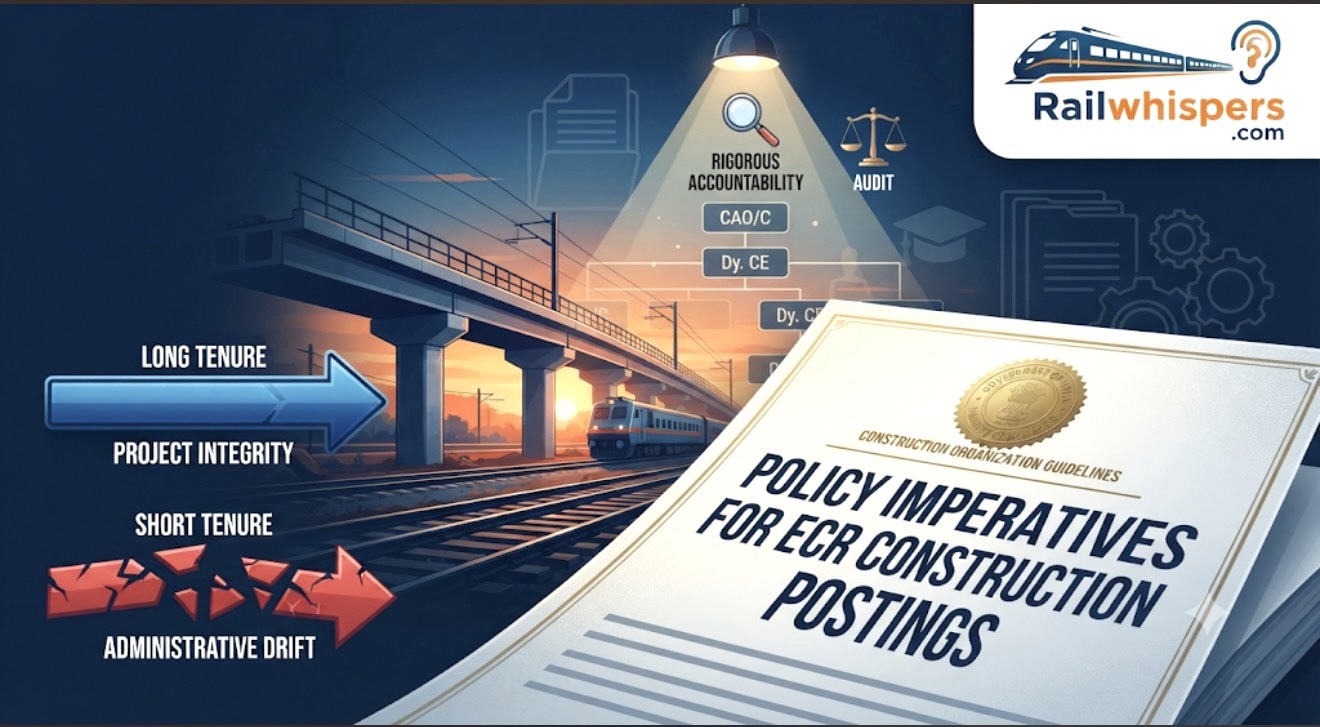
Strengthening Governance & Accountability: Policy Imperatives for Construction Organization Postings
Recent directives from the Railway Board underscore a clear strategic focus: “enhancing the efficiency of construction organizations through assured officer continuity, rigorous accountability, and timely infrastructure delivery”. However, structural challenges within the East Central Railway (#ECR) construction organization highlight a critical gap between these policy objectives and ground-level execution.
The Tenure Dilemma & Administrative Continuity
A foundational concern is the tenure profile of key leadership. With multiple CAO/Con (Chief Administrative Officer/Construction) incumbents nearing superannuation and possessing remaining service windows of only 6 to 14 months, the core principle of long-term administrative continuity is compromised. Short tenures frequently result in fragmented project oversight, where complex technical hurdles are passed down to successor officers while initial project milestones are rushed without fully realizing long-term operational benefits.
Governance, Delegation, and Procurement Oversight
While financial powers are delegated to expedite critical infrastructure, reports from internal personnel suggest that these provisions require tighter re-examining and monitoring. Concerns center around several systemic governance vulnerabilities:
Unreasonable targets, Operational Pressures and Contractor Dynamics
Subordinate officers frequently report working under intense pressure to accelerate workflows. While urgency is necessary for infrastructure growth, critics argue that procedural shortcuts can inadvertently skew benefits toward external contractors rather than public utility. Ensuring that operational speed aligns strictly with established procurement guidelines remains a vital check against administrative drift.
A CAO for his own benefit and to please the top bosses of Railway, gives unreasonable targets. In turn he created undue pressure on junior field officers to adopt shortcut methods and procedural bypasses. The unreasonable target dates communicated to top management are being used as a tool to harass junior officers in the field as well as to extort contractors. Threats to replace and displace the officers are very common. Railway Board instructions are given the least importance.
- Jurisdictional Boundaries: Instances where administrative adjustments—such as modifying deputy chief engineer jurisdictions outside standard competence frameworks—risk altering project scopes without adequate procedural checks.
- Resource Allocation: Questions surrounding the administrative deployment of Railway Protection Force (RPF) personnel for non-core duties highlight the need for stricter resource audits.
The system of posting agreed list or secret list officers as Secretary to CAOs should be stopped immediately. There is scarcity of field officers in JAG etc wasting JAG officers as secretary to CAOs should also discontinue. CAOs should refrain from empire building mentality.
Conclusion
Addressing the systemic challenges within the ECR construction organization requires moving beyond routine administrative adjustments toward structural governance reform. To safeguard public investments, enforce strict accountability, and uphold the integrity of Indian Railways’ infrastructure expansion, the Ministry of Railways would benefit from reevaluating its posting and financial protocols.
Prioritizing leadership assignments with substantial remaining tenure will ensure that officers are fully equipped to oversee projects seamlessly from inception to completion.
CAOs are not posted for being acting like front office for contractors to chase tenders, variations and bills rather they should provide enabling environment that there should be no delay in procedures and should facilitate smooth functioning of the system in overall interest of Railways and public. They should support their junior field officers and should act as guide and mentors.