

The Cockroaches of Railways | Part 15: “Send Them Home. Then Look at Who Built the House”
Editorial Note: This part is this publication’s reasoning, built on the railway’s own report on Bondamunda and on the public record of recruitment and postings. Where a fact rests on inside information it is said so. We urge the Minister for Railways and the Chairman, Railway Board, to get the matter examined, and any counter will be printed in full.
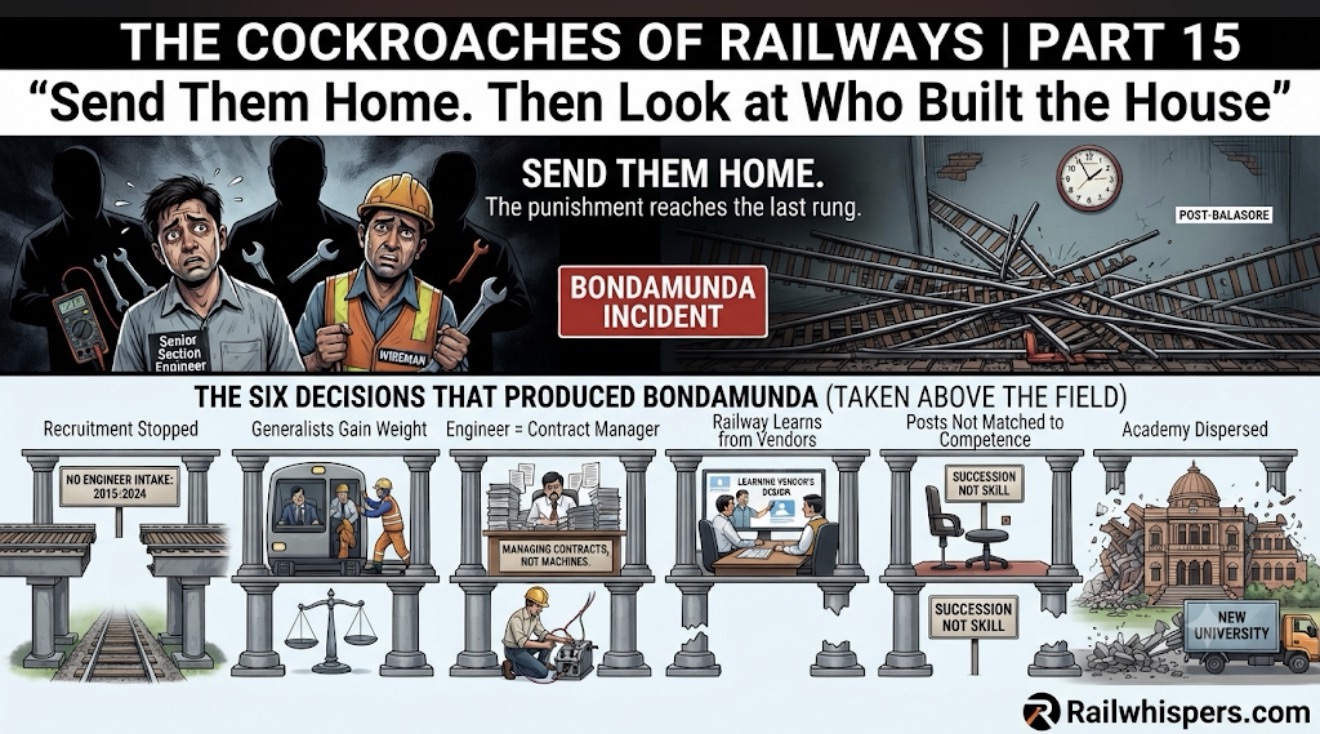
The Minister will send officers home. The six decisions that produced Bondamunda were taken above the field. Recruitment stopped, the generalist gained weight, the engineer became a contract manager, the railway learnt from vendors, posts stopped matching competence, the academy was dispersed. None of those was taken by a Senior Section Engineer, a wireman, or anyone else at the level the punishment reaches.
Fair is fair
Grant the Minister his point first.
An officer who signs for a machine he has not tested should go. An officer who inspects a station three times and traces no wire should go. Compulsory retirement exists for that, and it has been used too little for too long.
But a wireman does not design a railway, and if you send him home the next wireman will wire the next machine the same way, because the house he works in has not changed and nobody in the house has been asked to change it.
Now look at the house.
Six decisions, none of them taken at Bondamunda
- One. The railway stopped taking in engineers. For years there was no fresh intake of engineers into the service that runs signalling, track, traction and rolling stock, and recruitment through the Engineering Services Examination has resumed only from 2025, at about 225 posts. A gap of that kind never closes. The officers who should be Senior Divisional engineers today were never recruited. Their chairs are filled by whoever is left.
- Two. Weight shifted to the generalist. The railway told itself that an engineering post is a post anybody can hold, and signalled intention to fill engineering chairs with officers picked through the civil services examination. The Government reversed that when it reopened engineering recruitment, because a spate of devastating accidents made it conclude that engineering needs engineers. It did not move the chairs. The Board that came out of that reform has four Members. Traffic has a Member to itself. Accounts has a Member to itself. Personnel and the Railway Protection Force each have a Director General, a Level 17 post reserved for that cadre. The five engineering services share the two Members that are left, and those five own the track, the wire, the interlocking and the locomotive. About 20 lakh crore rupees of capital spending in twelve years went into assets those five look after. The Protection Force is the one specialist service recruited through the Civil Services Examination, and it was not asked to share. #Level17
- Three. The engineers who remain were turned into contract managers. Read South Eastern Railway’s report again. Vital wiring is done by the wireman, “last rung in our hierarchy”. The bell test that would catch a wrong wire was “not in practice”. The engineer above them was not testing the machine. He was managing the contract for it. The trade skills left the hands and went to the file.
- Four. The railway began to learn its own machines from the people who sell them. The report asks the point machine makers to design the wiring so that nobody in the field has to understand it. It holds a webinar with the alarm maker to teach supervisors what the alarm means. A locomotive crew now needs two courses for two makes of brake, and every traction maker ships its own wiring diagram. A railway that must ask the vendor how its own equipment works has lost the argument on price, on quality and on safety, all at once. The insulator story in Approved by RDSO showed the price (Part I, 30 August 2026, “Crisis Looms Over Railway Electrification: Two-Supplier Dominance in OHE Insulators, Soaring Prices, and Stalled Projects”, and Part II, 1 September 2026, “Approved by RDSO | Part II: The Insulator That Does Not Tell You It Has Failed”). Bondamunda shows the safety.
- Five. Posts were not matched to competence. This publication has shown, in Approved by RDSO Part III, how the chair for traction installation at RDSO was filled by succession rather than by skill. It has shown how 50 officers were moved out of the Railway Board and then came back. A source reports the Senior Divisional Signal Engineer at the division that owns Bondamunda has held the post for more than four years. We have not verified that. The Establishment Officer’s records can. Publish them.
- Six. The place where the railway once thought about all this is gone. The National Academy of Indian Railways at Vadodara, once the Railway Staff College, trained the senior leadership, studied the culture of the organisation, and gave officers of every department one room in which to argue about problems too large for any one of them to solve alone. In December 2023 the Railway Board ordered its assets handed to a new university, and its training calendar now needs that university’s permission. There is today no place on the railway whose job is to think about the railway.
Turn the question round
The Minister asked how basic mistakes could happen after Balasore.
Here is the question this publication puts back. If a Minister has to take a daily position on the wiring of point machines, what does that say about the six decisions above?
A railway is meant to run like a clock, as disciplined as the armed forces, and an army does not ask the Minister to count its rifles, because it recruits soldiers, trains them, promotes the good ones and posts them where their skill is needed, and so it counts its own rifles. Take away recruitment, training, the trade and the posting rule. You get an army where the Minister counts rifles.
That is not a failure of officers. It is a failure of the system that makes officers. Sending men home does not repair a system. It empties it faster.
The ask
Three things, to the Minister and the Prime Minister’s Office.
Publish the intake of engineers into the railway, by year, since 2015. Let the gap be seen.
Publish the tenure of every Senior Divisional Signal, Electrical and Civil Engineer, and of every officer who signed a commissioning certificate for an interlocking since 2020. Let the pattern be seen.
Map every safety post to a competence, and publish the map. Then post to it.
Send home whoever must go. But first say who built the house.
In this series
Part 14 counted the blocks. Part 16 adds up the bill nobody has added up, and asks the Prime Minister’s Office to demand it.
Further reads on this site:
Sep 13, 2026: Playing with Fire: How Rail Bhavan’s Crony Postings Breed Disaster
Sep 8, 2026: The Cockroaches of Railways | Part 14: Five Thousand Six Hundred Blocks
Sep 7, 2026: The Cockroaches of Railways | Part 13: The Last Rung Wires the Interlocking
Sep 4, 2026: The Cockroaches of Railways | Part 12: The Minister Counted the Point Machines. That Is the Failure
Sep 1, 2026: Approved by RDSO | Part III: The Chair Was Filled. The Job Was Not
Aug 23, 2026: The Cockroaches of Railways | Part 10: Minister Must Urgently Review Conduct, Character & Competence Across Key Railway Bodies
Jul 22, 2026: Part VII: The Tyranny of Traffic—The Absentee Landlord