

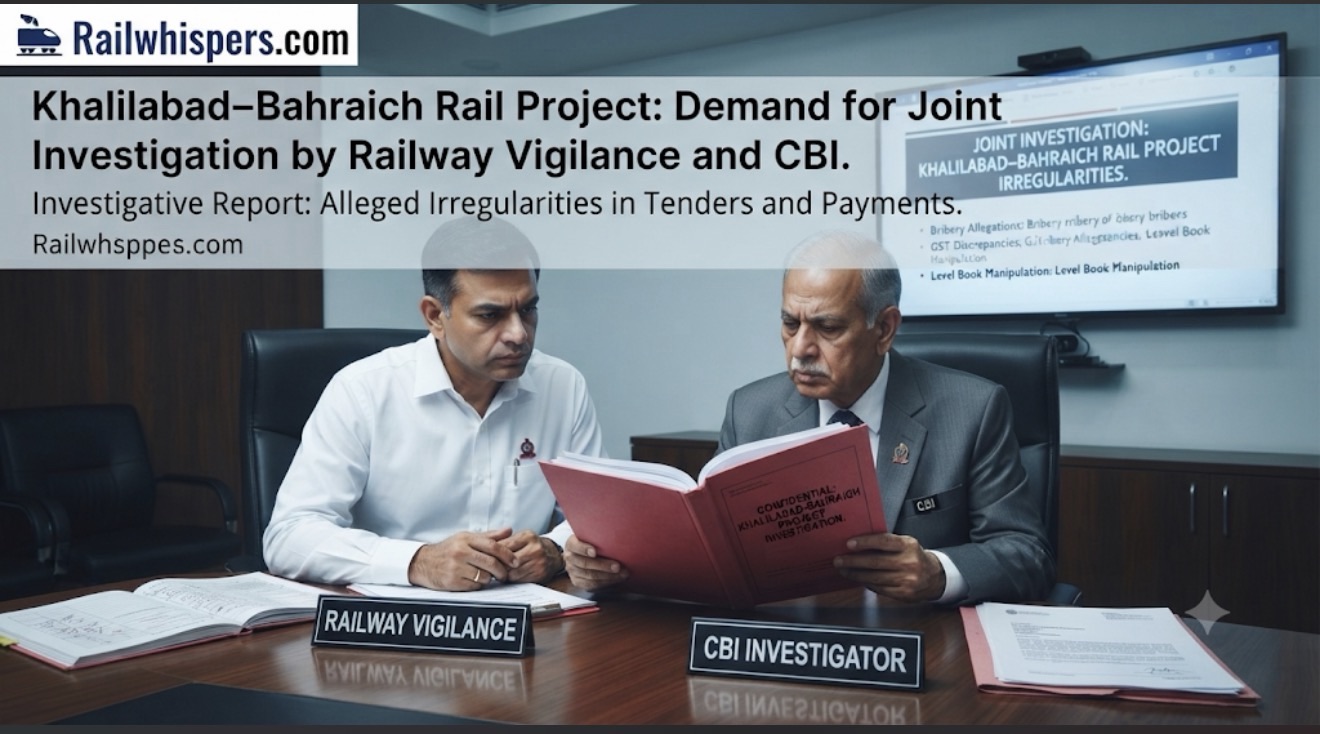
Khalilabad–Bahraich Rail Project: Demand for Joint Investigation by Railway Vigilance and CBI
Expenditure of Over ₹235 Crore on Balance Work Tenders, Demand for Investigation from Level Book to GST and Bribery
Serious Allegations Regarding Construction Quality, Measurement Books, and Payment Process in NER Construction
Was There Any Foul Play in the Original Contracts, and Did Balance Work Tenders Create a Path for New Financial Benefits?
The Khalilabad–Bahraich new broad gauge rail line project has raised several serious questions following the issuance of three “Balance Work Tenders” after two original tenders. In 2024, tender no. DYCE-CON-G-GKP-11-2024 was invited for ₹65.38 crore and tender no. DYCE-CON-G-GKP-12-2024 for ₹98.22 crore. Subsequently, in 2026, tender no. DYCE-CON-G-GKP-02-2026 was issued for ₹58.92 crore, tender no. DYCE-CON-G-GKP-07-2026 for ₹81.38 crore, and a Special Limited Tender (#SLT) no. DYCE-CON-G-GKP-09-2026 for ₹94.91 crore. Thus, the total advertised value of the three balance work tenders is approximately ₹235.21 crore.
#Ep272 | NER: बैलेंस वर्क टेंडर में बड़ा घालमेल!
Not only the tender allotment, but allegations of heavy irregularities during the execution of original works should also come under the scanner of investigation. It is alleged that irregularities such as tampering with level books, showing changes in actual ground levels, discrepancies in initial and final level records, and obtaining payments by inflating the quantity of earthwork may have occurred. The question is: Was an independent cross-verification conducted between the original survey levels and the subsequently prepared level books? Were the original ground levels, cross-sections, chainage-wise measurements, and the paid quantities matched? If the quantity of earthwork was increased by showing changes in levels, which officer and contractor will be held responsible?
The most serious allegations are also being raised regarding bribery and collusion. Were Measurement Books (MB), bills, quality inspections, and payments influenced through improper transactions between certain officials and contractors? Was a quantity higher than the actual work executed certified? Is there a discrepancy between the work executed on-site and the quantity recorded in the MB? Independent investigation of these allegations, financial transactions involving related officers and contractors, and available digital records are essential. However, bribery or collusion is not yet a proven fact. This can only be confirmed through investigation.
Serious questions are also raised regarding quality. Were payments made according to the actual quality of soil, blanketing material, compaction, CBR test, RCC, steel, and cement? Did the laboratory reports match the material used on-site? Were test reports prepared only on paper, or were inspections actually conducted at every critical location? Was full payment made by approving substandard materials? Railways should cross-verify MTCs, test reports, lab registers, and site inspection reports with all bills.
Potential manipulation in quantity is also a crucial subject of investigation. Actual execution in earthwork, blanketing, boulder backing, RCC, and other items should be compared with the approved BOQ, level book, cross-sections, and running bills. In particular, it should be investigated whether works for which payments were already made were re-included in the balance work BOQ. Did a situation arise where double payments were made for the same work? Was a new tender created without properly deducting the quantity executed in the original contract?
An independent financial audit should also be conducted regarding GST. Was GST levied at the correct rate? Was there any discrepancy in the classification of supply and works contracts? Do the records of invoices, GSTIN, e-way bills, GSTR-1, and GSTR-3B match actual supplies and payments? Was improper GST benefit claimed on any item, or was undue extra payment obtained from the Railways? Cross-verification of records related to GST and income tax should also be carried out.
Now a major question is also this: When there are such serious allegations regarding level books, quantity, quality, and payment in the execution of original works, what independent technical audit did the Railways conduct before issuing balance work tenders for those same work areas? Was the actual remaining quantity certified by any independent agency? Was the accountability of the original contractors fixed? Were risk and cost, penalties, and other contractual actions taken?
Railway Vigilance should identify all contractors, Joint Venture (JV) members, L-1, and L-2 companies across these five tenders to investigate whether the same business groups repeatedly appeared in both original and balance work tenders. Comparative statements of all tenders, reverse auction records, LOAs, original contracts, MBs, level books, and payment details should be made public.
Direct questions to the Railway Board, CAO/C/North Eastern Railway, and Railway Vigilance now are:
- Will a forensic audit of all level books be conducted?
- Will there be an independent cross-verification of original and final ground levels?
- Will a chainage-wise audit of the actual quantities of earthwork and blanketing be conducted?
- Will an independent laboratory be appointed for quality testing?
- Will a departmental audit of GST records be conducted?
- Will there be an investigation into bribery and potential collusion between officials and contractors?
- Will all payments for original and balance work be reconciled?
This matter is not merely about issuing tenders. It is also an issue of public funds, engineering quality, and railway accountability. If the allegations are found to be true, accountability must be fixed not only for the concerned contractors but also for the engineers who certified measurements, the officials who cleared bills, and the responsible authorities who granted approvals.
A balance work tender may be a necessity for the Railways, but it must not become a medium to sweep alleged discrepancies in the measurement, quantity, quality, and payment of original works under the rug.
Independent investigations by the CBI and the GST department, as and when required, along with Railway Vigilance, are demanded. The investigation report and the names of responsible officials must be made public.