

Part XI: The Tyranny of Traffic | Six Trains That Were Not in the Section
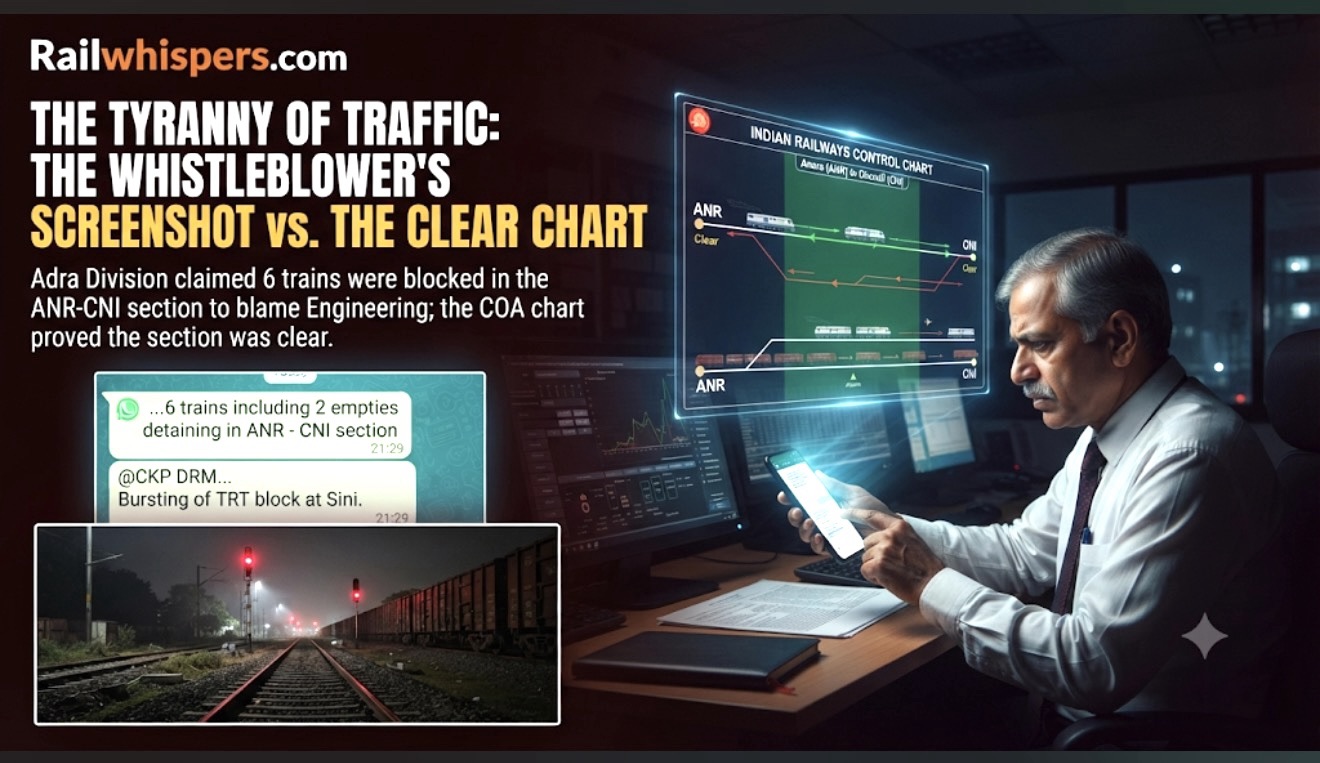
At 20:55 an operating officer called out the bursting of an engineering block and blamed it for congestion. By 21:29 zonal headquarters and a second division had told the group that the section was blocked and six trains were held. At 23:29 a Divisional Railway Manager posted the chart. The section was clear.
Editor’s Note: This article is based on screenshots of a WhatsApp group, received from a whistleblower. The site first reported the exchange on 17 September 2026. Rebuttal from the Zonal Railways is invited and will be printed.
A Track Relaying Train block at Sini yard, in Chakradharpur division of South Eastern Railway, was permitted from 16:40 to 19:40 and was still not cancelled at 20:55. The site reported the exchange that followed in the zone’s emergency control group (17 Sept. 2026, “Phantom Congestion & Group Optics: Inside SER’s Emergency Control WhatsApp Theatre”). Three facts from it carry this part.
Three offices reported a blockage
Between 20:55 and 21:29, four messages from Chakradharpur division, zonal headquarters and Adra division told the group that the section was blocked. The Adra Division message put a number on it: “6 trains including 2 empties detaining in ANR – CNI section”. None of the four messages carried the chart. This publication reads the sequence as the offices acting in concert. The screenshots show the order of the messages and their words. They do not show an agreement.
Bursting the Balloon
At 23:29 the Chakradharpur Divisional Railway Manager, in the control office since 9 pm on that officer’s own message, posted the control chart from Anara to Chandil: “Only 3 trains from Adra in Up direction on chart…” At 23:32 the Adra Senior Divisional Operations Manager replied: “Ordering was controlled for some time.” The six trains were not in the section. Adra had held them at Anara, which the site report places about 80 kilometres from Chandil. Holding trains while a yard ahead is blocked can be proper regulation. Reporting them as detained in the section is a different act. Nobody else in the group asked for the chart before the Divisional Railway Manager posted it.
The operating department holds the chart, and the others see only the claim
The chart sits in the control office, and the operating department runs the control office. Everyone else in the group saw the claim and not the chart. The site report says the messages were aimed at the General Manager and the Principal Heads of Departments. The author’s account, from service experience, is that this is the operating department’s default mode of working: it reports a crisis that nobody else can check, the panic does the work, and the pressure falls on the Divisional Railway Manager and on the officers of the asset owning branches.
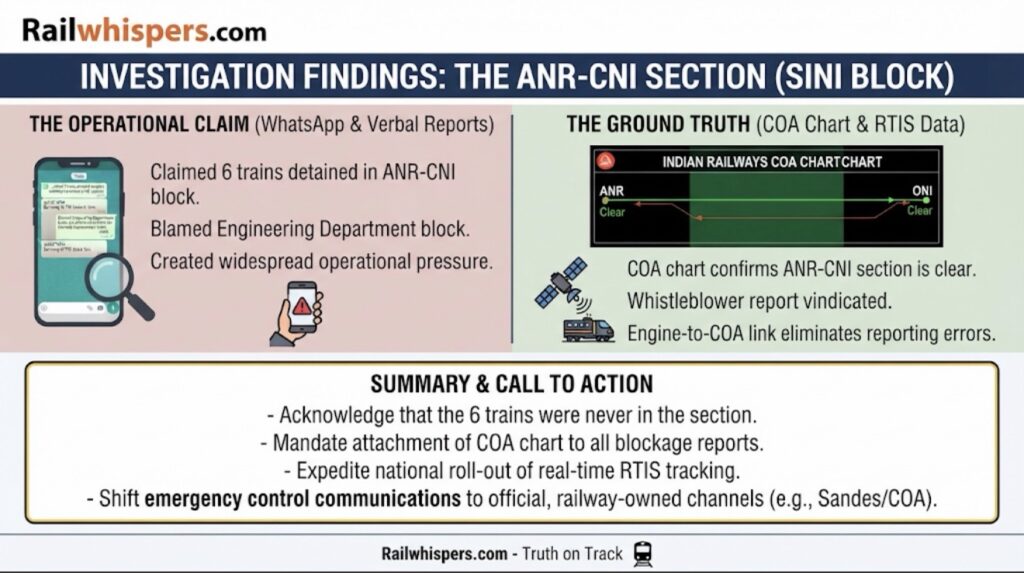
The screenshots show where the pressure went that evening. The message of 20:55 named the block of Chakradharpur’s civil engineers. The tag of 21:29 named the Divisional Railway Manager of Chakradharpur.
A detention blamed on an engineering block can be booked against the engineering department, and Part X showed how such losses drift to the asset departments after the day. Six trains that were not in the section are six detentions nobody should book.
The claim went to the group, and the fact stayed on the chart
Two records ran side by side that evening. The claim went to the group, while the fact sat in the Control Office Application, the computerised chart that the Centre for Railway Information Systems runs in every division (“CRIS, Control Office Application”).
The chart is computerised, but its entries are not automatic. #CRIS describes a system that “requires the controllers to enter data related to the train operations as they receive information from the control points or stations.” A section controller takes a time from a station on the telephone and keys it in, so the chart is only as current as the last call, and each controller keys in one section only.
The chart that the Chakradharpur DRM posted runs from Anara to Chandil. Its lower part, from Anara through Purulia, lies in Adra division, and Adra’s own controllers key it in. The claim of 21:23 was about a run that the claimant’s own division charts. What crossed the boundary between the two divisions was a WhatsApp message.
New Zones Create More Zonal Checkposts
Every zone and every division ends at a boundary, and at each boundary a train passes from one control office to another. The Indian Railways had nine zones until 2002, and seven more came into being in 2002 and 2003. Metro Railway, Kolkata, became the seventeenth in December 2010. South Coast Railway started work on 1 June 2026 as the eighteenth.
Take a train from New Delhi to Howrah through Dhanbad. Until 2002 it ran on two zones, Northern and Eastern, and crossed one zonal boundary. The Allahabad division then went to North Central Railway, and the Mughalsarai and Dhanbad divisions went to East Central Railway (“IRFCA, Railway Zones”). The same train now runs on four zones, Northern, North Central, East Central and Eastern, and crosses three zonal boundaries.
The divisions on that route stayed at six, so the number of handovers stayed at five. Two of them moved up a level. The handover between Delhi and Allahabad, now Prayagraj, divisions was inside Northern Railway, and the one between Dhanbad and Asansol divisions was inside Eastern Railway. Each now runs between two zones, two headquarters and two Principal Chief Operations Managers, and between two emergency control groups wherever a zone runs one as South Eastern Railway does.
The Sini exchange happened inside one zone, between two divisions. A zonal boundary adds a second headquarters to the same exchange. Part X of this series asked why the senior traffic leadership put no note on the record while the network was being cut into more zones and divisions (“Part X: The Tyranny of Traffic—Cut the Generic Bullshit—Here Are the Specifics”). The question now applies to South Coast Railway as well.
The railway has started the fix, and it started at the interchange
Part of the fix already runs. The Ministry said in 2022 that trains hauled by locomotives fitted with the Real Time Train Information System, built with ISRO, “get automatically plotted on the control chart of those trains in the Control Office Application (COA) system” (PIB, 23 September 2022). “The Minister put the fitted fleet at about 8,700 locomotives in December 2023” (Business Standard, 13 December 2023).
In April 2025 Northeast Frontier Railway said it had linked the data loggers at its stations to the Control Office Application, at “all originating, destination, divisional interchange and zonal interchange stations” of the zone” (ETV Bharat, 14 April 2025, “Railways links data logger with control app to minimise manual errors boost efficiency”). A data logger records what the signalling does, so a train that clears a signal is timed by the signal and not by a telephone call.
Part V of this series made the general case. A network of this size “cannot be run out of a man’s head”, and running it “is a computation problem” (20 July 2026, “Part V: The Tyranny of Traffic—Take the key from the gate”). Part V also recorded why the first FOIS failed: “Systems that remove discretion get fought.” A chart that fills itself removes one more discretion, which is what goes on the chart and when.
The record lives on Meta’s servers
Part 11 of the sister series reported that a Railway Board letter put cleanliness monitoring on six WhatsApp communities, and not on Sandes, the messaging service the National Informatics Centre built for the Government (28 August 2026, “The Cockroaches of Railways | Part 11: A Rat Bit a Passenger in First AC. The Board Asked for Thirty Photographs a Day”). The emergency control group of a zone runs on the same application.
The Government’s communication advisory of January 2022, as ‘The Tribune’ reported it, told officials not to use WhatsApp or Telegram for confidential information, “as the servers of these Apps are controlled by the private companies abroad” (The Tribune, 21 January 2022, “No Important Documents On WhatsApp, No Use of Smartphones In Meetings On Classified Issues, Centres’ new Guidelines”).
Secrecy is the smaller fault. A message on a private application is not a record that the railway owns. Nobody can join it to the chart, check it against the chart, or produce it at an inquiry unless somebody kept a copy, and the Sini exchange exists today only because a whistleblower kept one.
Part VIII of this series showed that a block refused at the control office leaves no file (27 August 2026, “Part VIII: The Tyranny of Traffic—Count the Refusals”). The Sini exchange shows the other half of the same gap. A detention claimed in a group leaves no record that the railway holds.
Who was in a position to stop it
Four offices could have read the chart before they wrote—
- The Senior Divisional Operations Manager (#SrDOM) of Chakradharpur Division, whose control office charts Chandil.
- The Chief Passenger Transportation Manager, (#CPTM) of South Eastern Railway, who wrote from headquarters with no chart.
- The Senior Divisional Operations Manager of Adra, whose division held the trains at Anara.
- The Divisional Railway Manager (#DRM) of Adra Division, who passed the claim on.
The site’s report of 17 September read the pattern as divisions building an excuse in advance for later interchange failures and late running. The pattern also shows how one department uses such claims to put pressure on the DRM and on the asset-owning departments. DRMs and GMs are, as they should be, focused first on safety. The same cannot be said of GMs and DRMs from the Accounts, Stores and Personnel services, who, on the author’s account from service experience, typically go by the reports put up to them rather than going deeper into the issues.
The ask
To the Railway Board:
- Publish, zone by zone, how many divisional and zonal interchange stations have data loggers linked to the Control Office Application, how many do not, and the date for the rest. Start with South Eastern Railway.
- Publish how many locomotives carry RTIS today, and the date by which every locomotive will.
- Order that no report of a blockage or a detention goes to a control group without the chart of that section attached.
- Move emergency control off WhatsApp, to Sandes or to a channel inside the Control Office Application, so that the claim and the chart sit in one record the railway owns.
- Before any new zone or division, require a signed note from the operating department that counts the interchange points it adds. Publish that note for South Coast Railway, if one exists.
Then ask each zone how many of the detentions it reported last month were on the chart.
Earlier parts of this series:
Sep 6, 2026: “Part X: The Tyranny of Traffic—Cut the Generic Bullshit—Here Are the Specifics”
Sep 5, 2026: “Part IX: The Tyranny of Traffic—RBP & Corridors—The Biggest Jokes in Town”
Aug 27, 2026: “Part VIII: The Tyranny of Traffic—Count the Refusals”
Jul 22, 2026: “Part VII: The Tyranny of Traffic—The Absentee Landlord”
Jul 21, 2026: “Part VI: The Tyranny of Traffic—Keep the man waiting at the gate”
Jul 20, 2026: “Part V: The Tyranny of Traffic—Take the key from the gate”
Jul 19, 2026: “Part IV: The Tyranny of Traffic—Send the bill to the gate”
Jul 17, 2026: “Part-III: The Tyranny of Traffic—The key to the gate!”
Jul 16, 2026: “Part-II: The Tyranny of Traffic—वर्चस्व की कवायद!” (The men who did not win the bread)
Jul 15, 2026: “Tomfoolery of Prayagraj Division”
Also cited
Sep 17, 2026: “Phantom Congestion & Group Optics: Inside SER’s Emergency Control WhatsApp Theater”
Aug 28, 2026: “The Cockroaches of Railways | Part 11: A Rat Bit a Passenger in First AC. The Board Asked for Thirty Photographs a Day”