

An Open Letter to the Prime Minister: Focus on First Party not the Fourth—that’s where the problem lies
Hon’ble Prime Minister Modi ji,
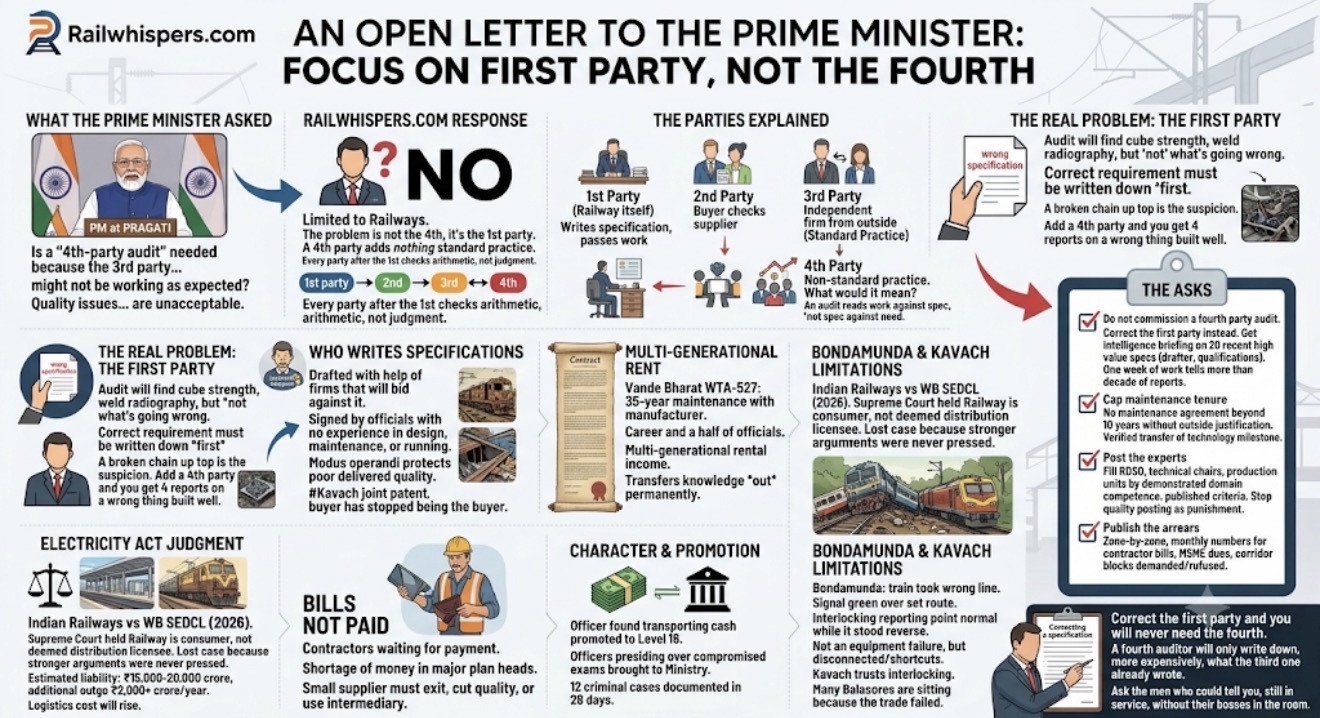
On 25 August you chaired the 53rd meeting of #PRAGATI at Seva Teerth. You reviewed six projects, in railways, roads and power, across nine states, at more than ₹30,000 crore. Then you asked the secretaries and the chief secretaries a question that has been reported since in these words: is a “4th-party audit” needed, because the 3rd party audit that is already standard practice “might not be working as expected”.
Quality issues in #construction, you said, are unacceptable, and the system will not work like this.
We will limit ourselves to the railways, as we always do.
The question deserves a straight answer and it is not a comfortable one.
Count the parties
Before adding a 4th, look at what the first three already are.
The 1st party is the railway auditing itself. Its own inspecting officer, its own quality organisation, and the man who writes the specification and later passes the work against it. The 2nd party is the buyer checking the supplier. The 3rd party is the independent firm brought in from outside, and that is the one you were told is standard practice.
A 4th party is not standard practice anywhere. Not even the reports of your question could say what it would mean.
Here is why the count matters.
An audit reads a work against a specification. It cannot read the #specification against the country’s need, because that is not what an auditor is engaged to do.
So the audit will find what it is pointed at. Cube strength. Weld radiography. Ballast gradation. A cracked plinth. All of it real, all of it worth finding, and none of it the thing that is going wrong.
Consider what has to be true before any auditor can help you. Somebody must have written down the correct requirement, in the correct quantity, at the correct place, and somebody must have had the standing inside the department to insist on it against a supplier who would rather sell something else.
That somebody is the first party.
Every party after him is checking his arithmetic and not his judgement. Your question suggests you already suspect the chain is broken further up, which is the more useful suspicion, and we would ask you to follow it all the way to the top of it.
Add a fourth party and you will have four reports on a wrong thing built well.
Who writes the specification
This publication has set out, over 10 published parts, how #procurement-authority inside the #IndianRailways has moved.
Read: 17 Aug 2026: “The Cockroaches of Rail Bhawan | Part 6: Read the Passenger List”
The purchase specification is now frequently drafted with the help of the very firms that will bid against it. The railway officer signing it has often never designed the equipment, never maintained it in a shed, and never run the division that will live with it. He is not dishonest. He is unequipped, and the #vendor in the room knows it. This publication has put it in one line: “An officer who has never opened the converter cannot write the specification for the next, and cannot argue about the price of servicing!” This modus operandi protects poor delivered quality as vendor insures himself well in the paragraphs of the purchase specification.
Read: 9 Aug 2026: “The Cockroaches of Rail Bhawan | Part 4: Feeding the Cockroaches”
Kavach is the plain example, and it is not an allegation. The Research Designs and Standards Organisation (#RDSO) holds the patent jointly with the three firms it approves as suppliers. The regulator and the supplier share the intellectual property. Ask what that does to a specification.
Read: 18 Aug 2026: “The Cockroaches of Rail Bhawan | Part 7: Who Does the Railway Ask?”
The consequence is that the buyer has stopped being the buyer.
The contract that outlives the government that signed it
Look next at what is being signed for how long.
The maintenance agreement for two hundred Vande Bharat rakes, tender WTA-527, fixes maintenance with the manufacturer at thirty five years. A bidder asked during the tender whether that could be reduced to fifteen. The Board’s recorded answer was that no change is envisaged. A further clause allows the vendor to charge the railway for training the railway’s own staff.
Thirty five years. Read that as a career and a half of every officer who will administer it.
We have called this a multi-generational rental income. A contract of that length converts a one-time purchase into an annuity paid by the taxpayer to a private party, and it does something worse than cost money, because it also transfers the knowledge of the machine out of the railway permanently. When the thirty five years end there will be nobody left in the department who knows how the train works.
Read: 12 Aug 2026: “The Cockroaches of Rail Bhawan | Hand the Machine to the Man Who Sold It”
Your own metaphor at PRAGATI was about power. Generation without transmission, you said, is building dams without laying canals.
The railway has been buying dams for a decade.
The same fault, in a courtroom
There is one more room where the government side of the table was unequipped, and this one has a judgment attached to it.
On 8 May 2026 the Supreme Court held that the Indian Railways is not a deemed distribution licensee under the Electricity Act, 2003. It is a consumer. Fifty nine pages, in Indian Railways vs. West Bengal State Electricity Distribution Company Limited, 2026 INSC 464.
The railway had already won this. The Central Electricity Regulatory Commission held it a deemed licensee on 5 November 2015. Eight state distribution companies appealed, and over the decade that followed the railway lost a case it had won.
Read how it was lost, because it is the argument of this letter with the parties changed.
The claim rested on a Ministry of Power letter of 6 May 2014, and the Appellate Tribunal held that a Ministry letter is an administrative direction and not binding. The stronger argument sat in section 173 of the Electricity Act, which provides that the Railways Act prevails on an inconsistency, and it was never pressed. The court’s own functionality test in Sesa Sterlite, decided in 2014, was binding precedent and went unanswered. Worst of all, the Board’s two attempts to amend the Act, in 2014 and again in 2018, both rejected by Parliament’s Standing Committee, were produced against the railway as its own admission that it knew it was not a licensee.
A decade on the file, and the file never left New Delhi.
The estimated liability already avoided is between ₹15,000 crore and ₹20,000 crore, and the estimated additional outgo is upwards of ₹2,000 crore every year. Both figures are projections and neither is a Board number.
Logistics cost was supposed to fall. It will now rise.
Read: 15 May 2026: “How Indian Railways Switched Off Its Own Power—When Incompetence Represents—The Current Goes Out, Part-1”
Read: 11 May 2026: “High-Voltage Shock: How the Supreme Court’s ‘Consumer’ Tag Derails the Indian Railways’ Cheap Power Dream”
Where the money went, and where the voter was
Put the railway’s capital outlay since 2014 against what the passenger actually received.
Lifts and escalators stand today at stations where the daily footfall does not justify a second staircase, let alone a machine with a maintenance contract attached to it. Station buildings have been rebuilt to a standard of finish that European railways do not attempt at comparable traffic. Meanwhile the general coach and the MEMU rake, which carry the people who have no alternative to the railway, have waited.
That is our charge, from a career in the service, and it is put here as such. The comparative figures are not in the public domain, which is itself part of the complaint.
You have said, and this publication has quoted you saying it, that governance means fewer layers between the decision and the person who executes it. Apply the same test to expenditure. Fewer hands between the rupee and the passenger.
Read: 11 Aug 2026: “Maximum Government at Rail Bhawan—Damn What the Prime Minister Said”
Wrong expenditure does not merely waste. It inflates, because the money enters the economy and no capacity comes out at the other end.
The bills that are not being paid
Now the part that will not appear in any review presentation.
Contractors are waiting for payment. Officers are hesitant to open new works because they do not know that the money will be there to finish them. The major plan heads are short of money.
Squeeze a small supplier long enough and one of three things happens. He exits the trade, or he cuts the quality of what he supplies, or he goes to an intermediary who can get his bill released.
Your auditors will find the second of those. They will never find the third.
Character, and the file that records it
Prime Minister, look at whom the Ministry of Railways has chosen to promote.
An officer found transporting bundles of cash has been promoted to Level 16, some one stepped in to own the cash—but just ask even a stone in the department and facts will tumble out. Officers who presided over departmental examinations that were compromised at scale have been brought into the Ministry. This publication has documented twelve criminal cases against railway officers in the twenty eight days between 23 July and 19 August 2026, and six of the seven trap cases attach to a stalled bill.
Read: 23 Aug 2026: “The Cockroaches of Railways | Part 10: Minister Must Urgently Review Conduct, Character & Competence Across Key Railway Bodies”
Ask three questions of the establishment file and you will not need a fourth auditor.
Why has #rotation stopped. Why do officers transferred out of Rail Bhawan return to it, and return specifically into safety chairs. Why is subject matter expertise absent from the chairs where technical decisions are actually taken, at RDSO, at the production units and in the Board.
The last of those is the whole of it. The government side of the table is now represented by people who need the vendor’s help to write down what the government wants to buy.
Nobody in that position can tell you the truth, because the pressure on him is to deliver, and the truth would stop the delivery.
Bondamunda, and why Kavach will not save you
On 21 August 2026 a passenger train at Bondamunda took the wrong line. A signal stood green over a set route while the train occupied the other line across the crossover. This publication read the panel photograph signal by signal and has published two parts of three.
Read: 24 Aug 2026: “Balasore, Again | Part I: The Letter Sixty Days Before”
Read: 25 Aug 2026: “Balasore, Again | Part II: Curse of Secrecy—The Demonstration Nobody Was Allowed to Read”
That is the #Balasore failure mode. At Bahanaga Bazar the crossover was 17A/B. At Bondamunda it is 104A/B.
Sixty days before Balasore, the Member (Infrastructure) had written to every Zonal General Manager listing five such cases in three months. Not one of the five was an equipment failure. Every one was a disconnection, a reconnection or a testing failure. The Board filed the letter under a heading that blamed shortcut methods adopted by staff.
Kavach sits on top of the interlocking. It trusts what the interlocking tells it. If the interlocking can be made to report a point normal while it stands reverse, then Kavach is being fed a lie at the speed of light, and it will enforce that lie correctly.
Indian Railways is sitting over many Balasores. Not because the technology failed. Because the trade did.
The asks
- Do not commission a fourth party audit. Correct the first party instead. Take twenty recent high value railway specifications and get an intelligence briefing on each. Who drafted it. What qualification and what demonstrated expertise the drafter and the signing officer held. And whether a better qualified expert was available inside the railway and was passed over. That last question is the one nobody in the department will volunteer. The exercise is one week of work and it will tell you more than a decade of third party reports.
- Cap the maintenance tenure. No maintenance agreement beyond ten years without a written justification cleared outside the buying department, and a transfer of technology milestone that is verified before payment, so that the buyer is never blackmailed and retains options.
- Post the experts. Fill RDSO, the production units and the technical chairs of the Railway Board by demonstrated domain competence, with pre-posting interviews, published criteria and enforced rotation. Stop treating a quality posting as a punishment.
- Publish the arrears. One number for pending contractor bills and one for micro and small enterprise dues, zone by zone, every month. Publish the count of corridor blocks demanded and the count refused, alongside them.
You asked whether the system will work like this. It will not, and you are right to say so.
But the fault is not in the third or fourth party. It is in the first, and a fourth auditor will only write down, more expensively, what the third one already wrote.
Place the first party correctly and you will never need the fourth.
The men who could tell you are still in service. Ask them without their bosses in the room.
Further reads on this site
- 24 Aug 2026: Balasore, Again | Part I: The Letter Sixty Days Before
- 25 Aug 2026: Balasore, Again | Part II: Curse of Secrecy—The Demonstration Nobody Was Allowed to Read
- 17 Aug 2026: The Cockroaches of Rail Bhawan | Part 6: Read the Passenger List
- 18 Aug 2026: The Cockroaches of Rail Bhawan | Part 7: Who Does the Railway Ask?
- 15 May 2026: How Indian Railways Switched Off Its Own Power—When Incompetence Represents—The Current Goes Out, Part-1
- 11 May 2026: High-Voltage Shock: How the Supreme Court’s ‘Consumer’ Tag Derails the Indian Railways’ Cheap Power Dream
- 12 Aug 2026: The Cockroaches of Rail Bhawan | Hand the Machine to the Man Who Sold It
- 9 Aug 2026: The Cockroaches of Rail Bhawan | Part 4: Feeding the Cockroaches
- 11 Aug 2026: Maximum Government at Rail Bhawan—Damn What the Prime Minister Said
- 26 Aug 2026: PM Modi flags ‘unacceptable’ quality issues in infra projects, questions need for ‘fourth-party audit’ Report The Mint
Yours Sincerely
Suresh Tripathi