

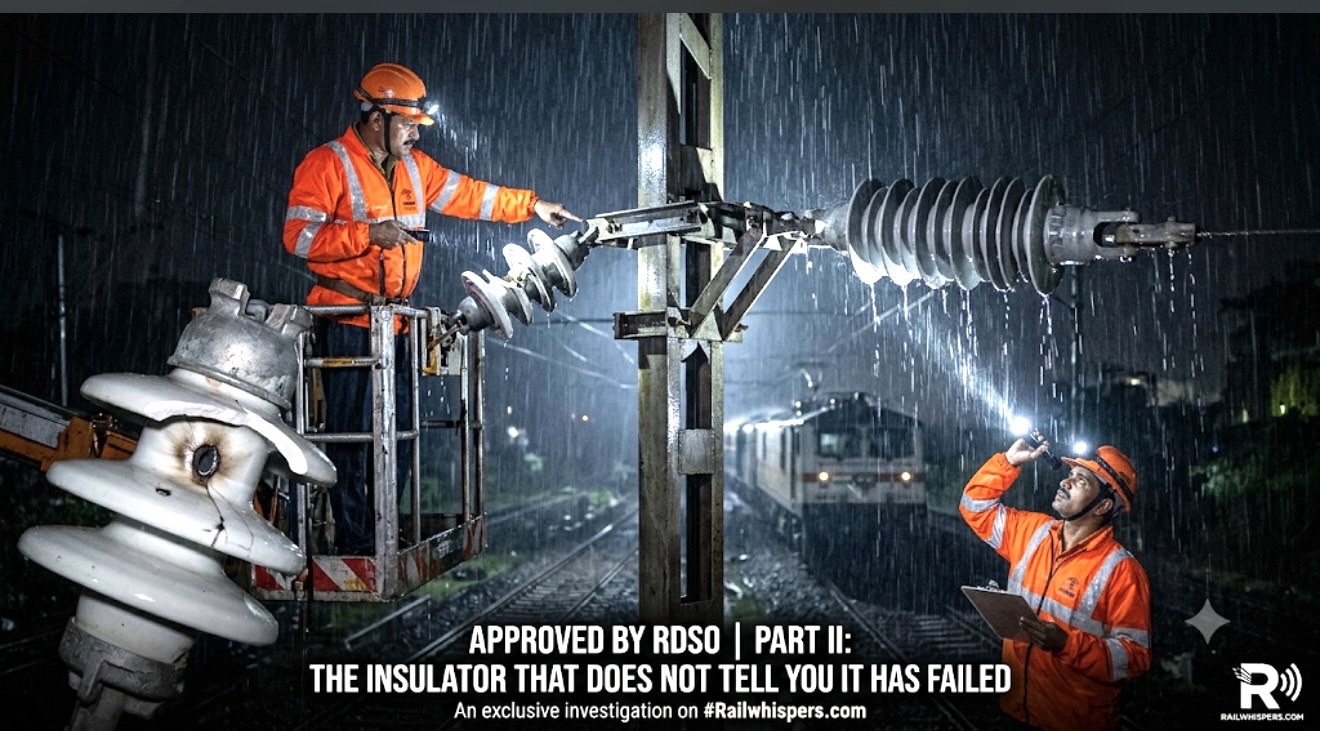
Approved by RDSO | Part II: The Insulator That Does Not Tell You It Has Failed
Part-I (30 August 2026, “Crisis Looms Over Railway Electrification: Two-Supplier Dominance in OHE Insulators, Soaring Prices, and Stalled Projects”) asked for technology neutral procurement of overhead equipment insulators. The ask is right. However, if granted in a hurry, as relief for a price problem, it would cost the network more than the price rise it is meant to cure. This part sets out what the choice actually involves, and who has never had to defend it in public.
Editor’s Note: This part rests on two grades of material and says which is which as it goes. The first is published technical literature on insulator failure. The second is the operational account of officers who have restored tripped sections at night, which is testimony and is printed as testimony. #RDSO and the #RailwayBoard are invited to reply, and any reply will be printed prominently. We express gratitude to a retired #TRD expert for his views. Part III follows. It asks why the #IndianRailways fails in matters of this kind, and how that failure frustrates the Government’s own drive to create quality employment through quality technical contracts.
Ep248: इंसुलेटर: दो कंपनियों के कार्टेलाइजेशन में शामिल #RDSO, #RailwayBoard?
Let us start with the part of Part-I that nobody disputes.
Four approved manufacturers of porcelain overhead equipment insulators became two. Rates on several items now stand at three to three and a half times the level at which contractors bid for the work. #Porcelain is not treated as a volatile commodity in the contract, so no price variation clause (#PVC) absorbs the rise, and the contractor carries all of it against bank guarantees that are already tied up. That is a real crisis, it belongs to firms that cannot wait for a committee, and it needs a commercial remedy quickly.
Part-I then asked for a strictly technology neutral procurement framework, so that qualified composite manufacturers can compete openly.
That ask is correct.
It is also the sentence that worries the officers who keep the wires up.
A technology neutral framework and an emergency substitution are not the same instrument. If the composite insulator enters the general network next month as the answer to a price problem, the railway will have settled a commercial failure by reversing an engineering decision it took with great difficulty.
Porcelain tells you where it broke
Consider what an insulator has to do besides insulate.
It has to fail in a way that a man standing on the ground at two in the morning can find.
A porcelain unit that has failed is usually visible. It is cracked, punctured or shattered, and there is a flash mark on it. Toughened glass is better still, because the shell has only two states, whole or completely shattered. When it shatters the glass falls away, and the metal cap, the pin and the cement stub stay on the string. The unit is then unmistakable from the ground, and the stub still holds about 80 per cent of the load the whole insulator was rated for. So the fault announces itself and the wire stays up. Neither material asks the man on the ground to guess.
The composite insulator does not
The published failure literature on composite insulators is consistent about where the danger sits. The failure modes that matter are internal. Moisture penetrates the polymer housing and reaches the glass fibre core, and what follows is stress corrosion cracking, known as brittle fracture, or flashunder, or destruction of the rod by discharge activity inside the housing.
Two findings in that literature matter more than the mechanisms do.
Failures cluster early, sometimes within two to five years of commissioning.
And many of the units that failed in service had passed the standard tests that were in force when they were manufactured.
Read those two together before widening any panel. A test regime that failed units have passed is not a test regime you can put a new set of suppliers behind and then go home.
Reference: “Overview of Failure Modes of Line Insulators” INMR, and “A comparative study on the failure analysis of field failed high voltage composite insulator core rods”, Engineering Failure Analysis, 2022.
A wet night, and a man walking
Now put all of that on a section of running line.
The section trips in heavy rain. Trains stand. The traction power controller isolates a patch, and staff go out on foot along the isolated length looking for what caused it: the flash mark, the broken shed, the nest on the bracket, the shattered disc. On porcelain there is usually something to see, and the patrol ends at the moment somebody sees it.
Where the failed unit is a composite one that has broken down inside its own housing, there may be nothing to see at all.
Officers who have run these restorations put the difficulty there, and not in the insulating performance of the material. Their complaint is about detection.
The grid’s experience does not transfer as it stands
There is a reason the transmission engineer’s confidence about composite insulators cannot simply be borrowed.
On a transmission line the insulator is usually a string of discs, and one failed disc in a string of ten does not drop the conductor. Overhead equipment is a different arrangement. The cantilever, the bracket insulator, the stay arm insulator, the section insulator and the nine tonne insulator each sit alone in their function, over a track, in a system where one breakdown earths the section and stops every train behind it.
The consequence of a hidden defect is therefore not the same in the two places, and neither is the value of a failure mode you can see from the ground.
The specification is not missing
Composite is not banned on Indian Railways, and an argument built on the idea that it is will be answered in a single line.
RDSO carries a specification for it. Specification No. TI/SPC/OHE/INSCOM/1071, Revision 01, covers 25 kV composite polymer insulators, and firms listing against it print two creepage distances, 1050 mm and 1600 mm, for polluted and highly polluted zones. Solid core porcelain has a specification of its own, TI/SPC/OHE/INS/0070.
So the rule in force is not a prohibition. It is a placement.
Composite goes where pollution and stone pelting defeat porcelain. It is kept off the rest of the network because of the way it fails, and not because of what it costs.
The question is no longer why a technology is blocked. The studies that placed it were done years ago, and they were open. The question is whether they still hold, or can be overlooked.
Tolerance is the product
There is a further reason to be careful about widening the panel in a hurry.
The composite insulator’s weak point is the seal between the housing and the core, and a seal is a manufacturing tolerance rather than a design feature. Loosen control there and water gets in, and the failure that follows is early and invisible, which puts the network straight back into the vulnerability described above.
So the two things now being demanded at the same time pull against each other. Break a duopoly by admitting more suppliers, and tighten manufacturing control on a product whose reliability is almost entirely manufacturing control.
Both ends of that have to be held by one office, and in the Indian Railways there is only one office that can hold them, the TI Directorate of RDSO.
Two technologies that nobody has put on the table
Ceramic and composite are not the only choices available, although the debate as it currently stands prints only those two.
Toughened glass is the standard suspension insulator across much of the world’s transmission plant, and its failure mode is the one the traction distribution officers keep asking for. The shell self shatters, the stub stays, the fault is visible from the ground.
Room temperature vulcanised silicone coating is the second. It puts a hydrophobic silicone layer onto a porcelain body, which buys the pollution performance while keeping porcelain underneath it, and utilities have taken that route precisely because it costs less than changing a technology wholesale.
Neither is a recommendation from this publication. Both are questions.
Has either been evaluated for 25 kV overhead equipment, and if it has, where is the report?
If the honest answer is that no evaluation exists, then the railway has spent forty years arguing porcelain against composite, and has never put a third material on the table.
Reference: “Coating Porcelain Line Insulators to Prevent Pollution Flashover”, INMR
Four became two, and somebody let it happen
Return now to the price, because the technology argument does not dispose of it.
A vendor panel is not a market. Approval, renewal, suspension and cancellation are administrative acts. RDSO performs them, and each one leaves a file. When a panel of four falls to a panel of two, the significant fact is not that two firms left. It is that in the whole of that interval nobody new was brought in.
Part I asks for a forensic cost audit of five to ten years. Ask for something cheaper first, because it can be answered out of one room in Lucknow in a fortnight.
How many firms applied for approval against the porcelain and composite specifications in the last ten years? How many were approved, how many were rejected, and on what ground? How long did each application take from receipt to decision? How many were still pending on the day the rates went to three times bid level?
That table is either very short or it is damning, and either way it is an answer.
Keeping the panel wide is not a courtesy RDSO extends to vendors. It is the greater part of the job. A monopoly that forms inside an approved panel is a regulatory outcome before it is ever a commercial one.
A reliability action plan is not a reliability measure
Meanwhile the traction distribution organisation fills returns.
Reliability action plans are written. Spreadsheets are shared, updated and reviewed. Officers who have to fill them describe several entries as laughable.
None of it widens a vendor panel. None of it qualifies a fourth technology, or shortens by one minute the time a man spends walking an isolated patch in the rain looking for a mark that a composite insulator does not leave.
The middle path costs somebody a view
There is a reason all of this sits unanswered, and it is not a shortage of paper.
Every question in this part requires an officer to take a view. Not to convene a committee, not to seek a reference, not to mark the file to the concerned person and discover that the concerned person is oneself. To read the specification with the attention that is routinely given to the General Conditions of Contract and the Special Conditions of Contract, and to sit across a table from a vendor without treating the vendor as an infection and without working as though on the vendor’s payroll, and then to write the conclusion down and sign it.
A view, once taken, can be questioned, audited, reviewed and, in the worst case, remembered. That is the whole difficulty, and this site set it out ten days before this article.
“The Art of Keeping Files Pending—or the benefits of timely transfers”, 30 August 2026.
The middle path is not a temperament. It is a capability. It comes from knowing the subject well enough that a view can be defended after the man who took it has been transferred. It holds only where the chain of decision makers has spine and character.
Which is a statement about who is sitting in the chair.
What to ask for
Three things, and none of them needs a new committee.
Publish the approval, rejection and pendency record of the insulator panel for ten years.
Say whether toughened glass and coated porcelain have ever been evaluated for overhead equipment, and if they have not, say when that will start.
Say what was done about the sudden throttling of supply and the spike in cost.
One chair in the Indian Railways is answerable for all three. It is the Executive Director, Traction Installation, at RDSO.
Part III asks who has been posted to it, and what it has cost.
Part I of this series: 30 August 2026, “Crisis Looms Over Railway Electrification: Two-Supplier Dominance in OHE Insulators, Soaring Prices, and Stalled Projects”