

Crisis Looms Over Railway Electrification: Two-Supplier Dominance in OHE Insulators, Soaring Prices, and Stalled Projects
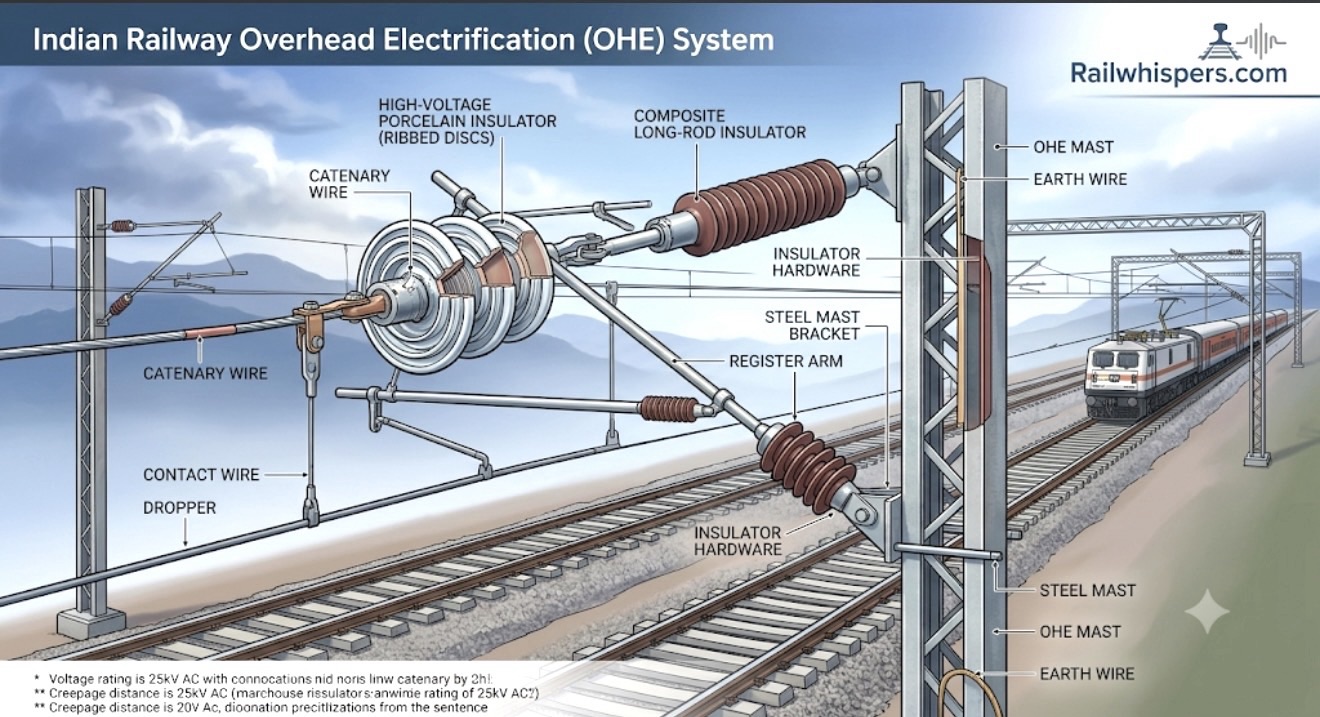
Indian Railways is aggressively pursuing mission-mode electrification across the nation. The backbone of this ambitious expansion is the Overhead Electrification (#OHE) system, where the insulator serves as an indispensable electrical component. Its primary function is to electrically isolate high-voltage electrical conductors from supporting structures, ensuring current remains confined to the contact wires and the entire network operates safely.
#Ep248: इंसुलेटर: दो कंपनियों के कार्टेलाइजेशन में शामिल #RDSO, #RailwayBoard? #IndianRailways
For decades, porcelain technology has been extensively used for this critical application. Today, however, this vital component has become a major bottleneck for contractors and a serious impediment to railway progress. Serious allegations are emerging regarding steep, unchecked price hikes driven by a lack of competitive procurement and excessive market concentration.
Market Shrinks from Four Manufacturers to Two
According to industry sources and field contractors, there were previously around four major RDSO-approved manufacturers operating in the railway OHE porcelain insulator segment. These included Modern Insulator (Rajasthan), IEC Insulators (Mandideep, Bhopal), Sarvana Global, and Aditya Birla Insulators. Over time, Sarvana Global and Aditya Birla either exited the segment or ceased production. Consequently, market reliance shifted almost entirely to just two active suppliers: Modern Insulator and IEC Insulators. When the supplier base for a critical technical component shrinks to this extent, natural market competition evaporates, handing suppliers unilateral power to dictate pricing and terms.
Prices Surge Over Threefold While Contractors Face Tender Rigidities
Contractors allege that porcelain insulator rates have been repeatedly revised upwards over the past two to three years. For several items, current rates have surged by 3 to 3.5 times compared to the prices prevailing at the time tenders were floated. Under railway contract structures, porcelain is not categorized as a volatile commodity, meaning standard tender agreements offer no effective price variation clause to absorb genuine market escalation.
Contractors who submit bids based on prevailing market rates subsequently face steep increases from suppliers. This leaves execution firms with an unsustainable choice: absorb severe financial losses to complete projects or slow down progress. Tied-up bank guarantees, depleted working capital, and fixed manpower and machinery costs have combined to trigger an existential crisis for railway contractors.
Questions Over the Sidelining of Alternative Composite Technologies
A striking policy contradiction is that official RDSO documentation explicitly provides technical specifications for both porcelain and silicone composite insulators. When modern silicone and glass insulators are already deployed across extra-high-voltage transmission lines nationwide, the hesitation to adopt them widely within Indian Railways raises serious questions.
RDSO’s own guidelines acknowledge the operational advantages of composite insulators, particularly in high-pollution zones and areas prone to stone-pelting. Despite these advantages, ground-level procurement has not shifted toward a technology-neutral approach. The failure to institute transparent, time-bound approval channels to onboard qualified alternative suppliers remains an unresolved issue.
Suspicions of Cartelization and Collusion: Calls for an Independent Inquiry
The consolidation of supply into two dominant vendors, combined with synchronized, steep rate hikes and a total lack of alternative procurement options, raises strong concerns regarding anti-competitive conduct and potential cartelization. Whether these sharp price increases correspond to verifiable rises in raw material, energy, and logistics inputs—or whether they reflect opportunistic pricing power—requires rigorous scrutiny.
Despite numerous formal representations submitted by contractors to Zonal Railways, RDSO, and the Railway Board, no decisive relief has materialized. This lack of intervention has fueled concerns over possible administrative collusion. Given the gravity of these claims, the issue warrants an external investigation by bodies such as the Competition Commission of India (CCI) and central vigilance agencies rather than reliance on internal departmental reviews.
Essential Steps Toward Restoring Transparency
Uncovering the operational reality requires auditing historical RDSO vendor directories, approval files, renewal logs, and cancellation records. An independent forensic cost audit is needed to examine purchase orders, contractor quotations, price revision rationales, and input-to-selling-price margins over the past 5 to 10 years. Concurrently, authorities must investigate the specific circumstances surrounding the market exit of legacy suppliers and address bureaucratic delays in certifying new market entrants.
As an immediate corrective measure, Indian Railways should transition to a strictly technology-neutral procurement framework that enables qualified composite insulator manufacturers to compete openly. In addition, appropriate contractual mechanisms must be explored to protect active contracts from extraordinary price escalation. Railway electrification is a critical national infrastructure program financed by taxpayer capital. The momentum of national infrastructure must not be compromised by artificial supply bottlenecks or anti-competitive market concentration.