

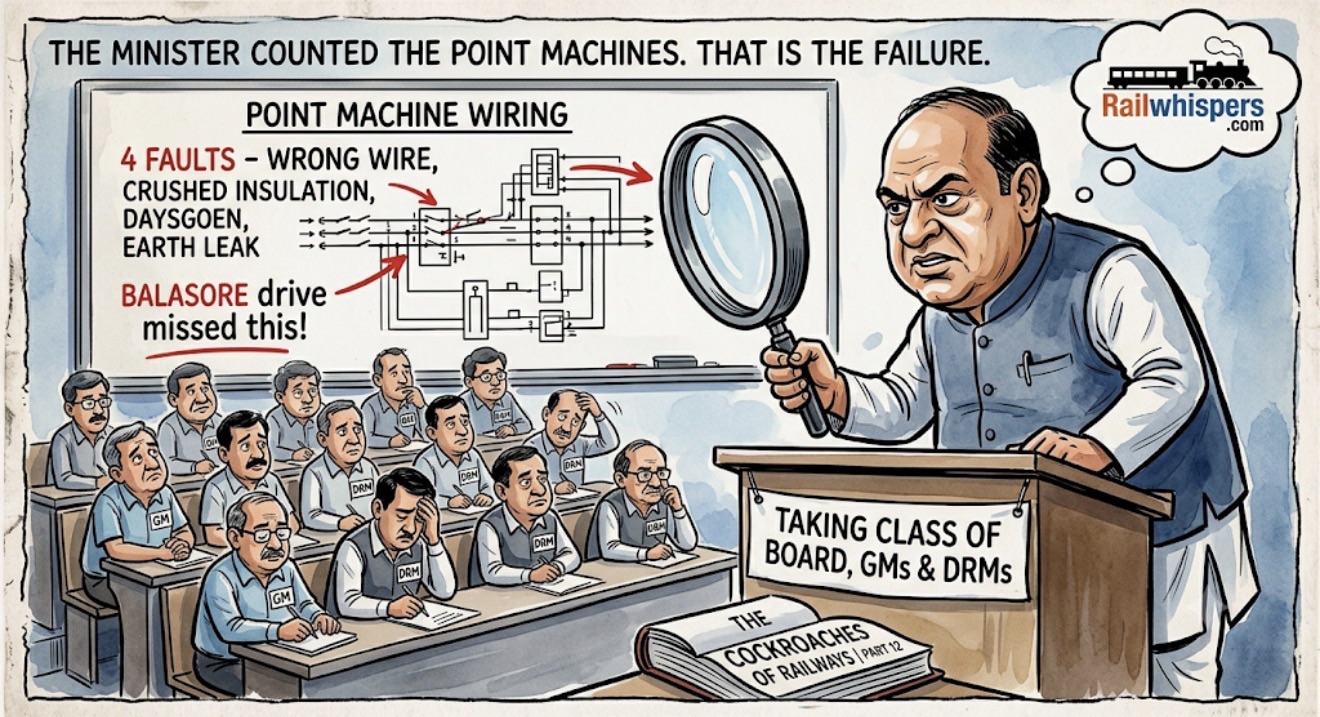
The Cockroaches of Railways | Part 12: The Minister Counted the Point Machines. That Is the Failure
Editorial Note: This part rests on the press briefing and on the whistle blower who shared the Bondamunda incident with us. We are grateful that the Minister took our feedback seriously. Any clarification or counter will be printed in full.
On 3 September 2026 the Minister for Railways sat with every General Manager and every Divisional Railway Manager in the country and asked how a train could take the wrong line at Bondamunda, three years after Balasore and a nationwide safety drive. His own railway had already written the answer down. Here it is. Then the harder question, which is why a Minister has to ask it at all.
First, credit where it is due
Start with what the railway did right, because there is some of it.
Eight days after the Bondamunda incident #RDSO sent every zonal railway a test to check the wiring inside a point machine, and eleven days after it sent a note on how point machines must be wired, tested and kept for the rest of their lives. #SouthEasternRailway checked 4,775 of its 7,250 point machines within days. It found 34 wired wrong and set them right.
That is fast. Faster than after Balasore.
Now read what those checks found, because it changes the Minister’s question.
What a point is, and what went wrong
A point is the moving rail that sends a train left or right. Before a signal can turn green the interlocking must know which way every point on the route is set, and a small circuit inside the point machine, called detection, is the only thing that sends that answer back to the signal. If the answer is wrong, the signal is a lie.
At Bondamunda on 21 August 2026, the signal cleared. The interlocking read point 104A as set for the straight line. The point was set for the other line. The train went where the point sent it.
South Eastern Railway’s own report to the Board explains how. One wire inside the machine had been joined to the wrong terminal when the machine was installed, a second wire had its insulation crushed under a screw, one core of a cable had gone bad, and a leak to earth on a shared 24 volt supply pushed current into the detection circuit from the wrong side.
Four faults. Together they told the interlocking a point had moved when it had not. The machine reported “set” in 375 milliseconds. A real point takes 3 to 4 seconds to move. The point never moved at all.
None of this is high science. A wire on the wrong terminal. A wire under a screw. A power supply shared by a point and a signal. An alarm that was ringing and that nobody read. It is the first year of a signal engineer’s trade.
The date that answers the Minister
The interlocking at Bondamunda Link C was commissioned on 2 May 2023.
Balasore was 2 June 2023.
So the wrong wire was already inside the machine when 296 people died at Bahanaga Bazar, and it was 31 days old, and the nationwide drive that followed Balasore, the very drive the Minister asked about on 3 September, ran over a station that was one month old and found nothing.
Three officers inspected the station in 2026, an Assistant Signal Engineer in March, a Senior Section Engineer in April and another in July, and none of the three found anything wrong with point 104A. Nothing.
Then a train took the wrong line, and RDSO wrote down what to look for, and one railway found 34 wrong points in ten days.
That is the answer. #TheDriveCheckedTheList. The wrong wire at Bondamunda was not on the list. A drive finds only what it is told to find.
The railway said so itself
Do not take this publication’s word for it. Take the railway’s.
South Eastern Railway’s report says the check that would have caught this, a wire count and a bell test of the outdoor circuit, was “not in practice at present”. It did one for the first time at Jaleswar on 30 and 31 August 2026, ten days after the incident.
It says point machines arrive from the maker only partly wired. The safety wiring, called cross protection, is completed in the field. By whom? The report’s own words: the wireman, “who is last rung in our hierarchy”.
It says different wiremen across the railway follow different practices, because the terminals inside the machine are numbered 1, 2, 3, 4 and nothing more.
And RDSO, in its letter of 29 August 2026, says point circuits differ from one railway to the next. It has asked each railway to write its own test.
Read that again. Three years after Balasore, the railway does not have one wiring standard for the machine that decides which way a train goes.
One rule, read sixteen ways
This is not the first time.
On 17 June 2024 the Kanchenjunga Express was hit from behind by a goods train near Rangapani, and ten people died. The automatic signals had failed. The Commissioner of Railway Safety found that the paper authority given to drivers to pass failed signals did not say what speed to run at, and that drivers read the same rule in different ways. Some ran at 15 km per hour and stopped at each signal. Most did not. The Commissioner called it an accident waiting to happen.
Bondamunda is the same disease in a different organ. One rule for wiring a point, followed differently by every wireman. One rule for passing a dead signal, followed differently by every driver.
This is what happens when a railway takes pride in its manuals and spends little on the hands. The manual is the same everywhere. The training is not.
So ask the Minister three plain questions about the training schools in every division, where the wireman and the driver are meant to learn the trade. How many are open and staffed? Who teaches there? When did the instructor last wire a point machine himself?
Publish the report
One more thing the Minister could do tonight.
The inquiry into Balasore, the worst accident in a generation, has never been published. Nor has any inquiry into Bondamunda. In their place the railway issues a few pages of condensed instructions, which strip out the story, the context and the chance to learn from it.
Compare Britain. On 9 May 2026 a passenger train hit two hand trolleys left on the line at Queens Park in London. Nobody was hurt. Four months later the Rail Accident Investigation Branch published a seven page digest of exactly what happened, minute by minute, which form was missing from the safety pack, which lamp was not fitted, and five earlier cases like it. Any track worker in the country can read it. A trolley collision gets that. In India, 296 dead at Balasore gets a circular.
A supervisor who reads how the last wire went wrong does not need a Minister to tell him to check the next one.
Now turn the question round
The Minister asked how this could happen. Here is the question this publication would put to him instead.
Why does a Minister have to ask?
A railway is meant to run like a clock, and it is meant to be as disciplined as the armed forces, where a Defence Minister does not count rifles and does not ask a battalion commander whether the rifles were cleaned last night. The system counts them. The system cleans them. The system reports up in a form that needs no Minister.
When a Minister sits with every Divisional Railway Manager in the country and takes a position on the wiring of point machines, he is not showing control, he is showing that the layers below him cannot be trusted to know their own machines. That is not a fault of the Minister. It is a fault of the system he inherited, and it was built over years.
The point machine did not fail on 21 August 2026. It failed on 2 May 2023, at commissioning, and the system had three years and three inspections and one national drive to notice.
Ask who was in a position to prevent this. Not who is to blame.
What the Minister should now demand
One ask. It is small and it is checkable.
Publish the Balasore inquiry, publish South Eastern Railway’s report to the Board, publish the inquiry into Bondamunda, and then order every zonal railway to publish by a fixed date two numbers that any reader can add up for himself. Point machines checked. Point machines found wired wrong.
One railway found 34 in 4,775. There are sixteen zonal railways. Nobody has printed the national number. Until it is printed, no drive can be judged, and no Minister can know whether the next Bondamunda is already wired and waiting.
The railway’s own report ends with a line worth repeating. RDSO’s improved circuit, it says, “could have not avoided” this incident.
So what would have?
A wireman who was not the last rung. An engineer who tested the machine instead of the bill. A system that did not need the Minister to count.
Count the wrong points. Then count the years it took to look.
In this series
Part 13 reads the railway’s report on who wires the interlocking, and asks who signed the commissioning certificate at Bondamunda.
Further reads on this site
Aug 25, 2026: “Balasore, Again | Part II: Curse of Secrecy—The Demonstration Nobody Was Allowed to Read”
Aug 24, 2026: “Balasore, Again | Part I: The Letter Sixty Days Before”
Aug 23, 2026: “The Cockroaches of Railways | Part 10: Minister Must Urgently Review Conduct, Character & Competence Across Key Railway Bodies”
Jun 9, 2023: “It seems that the Government and especially Ministry of Railways have learned nothing from Balasore!”
References outside this site
Rail Accident Investigation Branch, Safety digest 06/2026, “Collision between a passenger train and rail handling trolleys at Queens Park, 9 May 2026”
Business Standard, 17 July 2024, “‘Accident in waiting’: Report blasts Railways for Kanchenjunga collision”