

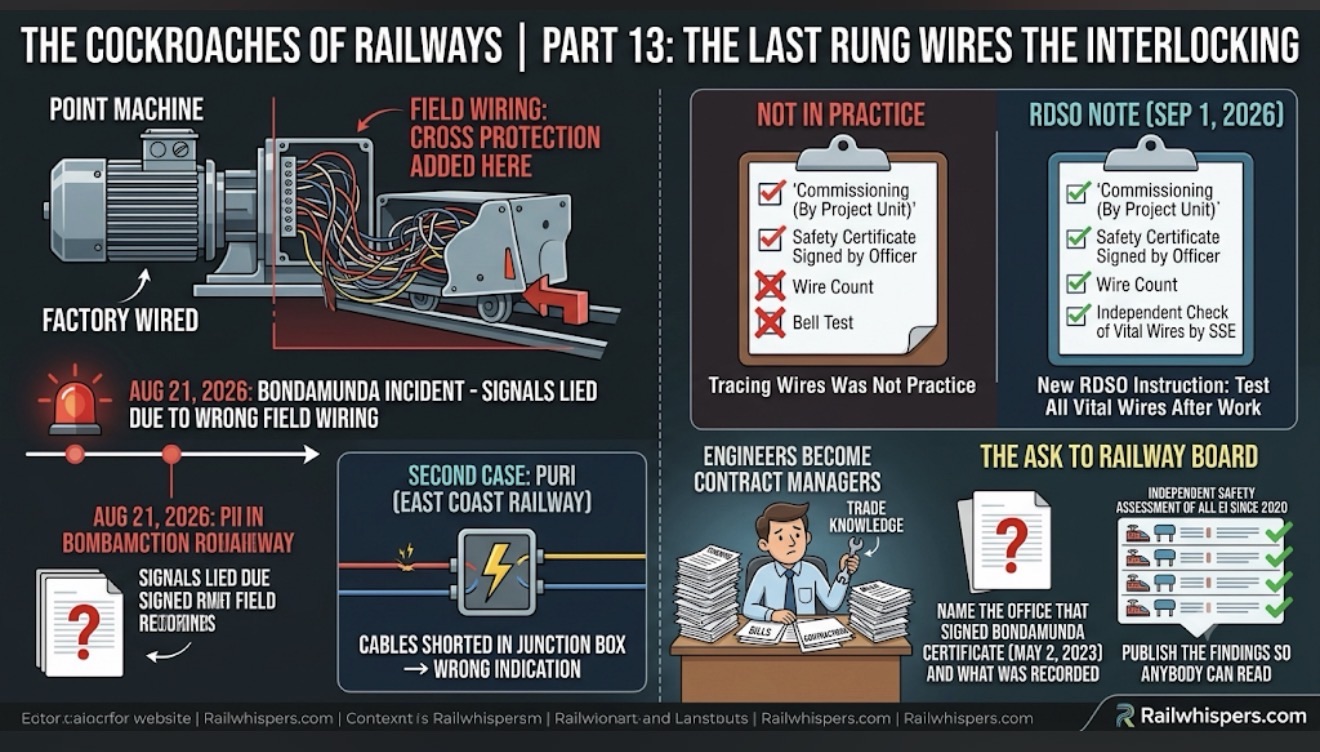
The Cockroaches of Railways | Part 13: The Last Rung Wires the Interlocking
Editorial Note: This part rests on the zonal railway’s own report to the Railway Board and on RDSO’s instructions of 29 August and 1 September 2026. A second case, at Puri, comes from a source inside the railway and is printed only as a second case. We urge the Minister for Railways and the Chairman, Railway Board, to get the matter examined, and any counter will be printed in full.
The Minister asked why the mistakes at Bondamunda were so basic. The railway’s own report to the Board answers him. The wiring that keeps a signal honest is finished in the field by the lowest grade on the railway, on a machine that arrives half wired, with no test after and no second pair of eyes. Above that wireman stands an engineer. He manages a contract.
What was done well, and quickly
Give the railway its due first.
South Eastern Railway put a report before the Board that hides nothing, that names the faults, the dates, the inspections and the gaps in its own practice, and that proposes fixes for every one of them. Most railways would have sent a summary. This one sent the wiring diagram.
RDSO followed with a test procedure in eight days and a maintenance note in eleven.
Now read what the report says about who does the work.
Half a machine
A point machine is the motor and gear that moves a point, the rail that sends a train left or right. Inside it sits a small circuit called detection. Detection tells the interlocking, and through it the signal, which way the point is set. A second circuit, called cross protection, guards detection against a stray current that could make it lie.
South Eastern Railway’s report says point machines “come with partial wiring without cross protection”.
So the safety wiring is not done in the factory. It is done in the field, at installation, by hand.
By whom? “The wireman in field during commissioning who is last rung in our hierarchy”, says the railway.
Those are the railway’s words, not ours. The circuit that decides whether a green signal is telling the truth is finished by the most junior man on the site, and the report says this to the Board as a plain fact of life, in the same tone it uses for the price of cable.
No test after
Fine, you might say. Junior men do skilled work everywhere. The check is what matters.
There was no check.
The report says a wire count and a bell test of the outdoor circuit, the simple test that proves each wire goes where the drawing says, was “not in practice at present”. The railway did its first one at Jaleswar on 30 and 31 August 2026, ten days after a train took the wrong line.
It says the terminals inside the machine are marked only 1, 2, 3, 4, so “different wiremen are following different practices”. It asks the makers to design a plug so that nobody in the field has to wire the machine at all.
RDSO’s note of 1 September 2026 now says that after any wiring work the whole circuit must be tested before the point returns to service, and that a Senior Section Engineer, at least, must independently check every vital wire. Good. Read the date. Three years and three months after Balasore, the railway has written down that vital wiring needs a second pair of eyes.
No one standard
There is a third admission, and it is RDSO’s own.
Its letter of 29 August 2026 says point circuits “are varying from Railway to Railway”. So it has asked every zonal railway to write its own test, based on its own circuits. South Eastern Railway, in turn, asks RDSO to issue one standard circuit for every layout “instead of leaving it to Zonal Railways”.
Each is pointing at the other. Between them sits a point machine wired sixteen different ways across the country, by sixteen sets of wiremen, with sixteen sets of habits.
And the makers are adding to the pile. Serving engineers tell this publication that a locomotive crew now needs two separate courses for the two makes of brake system in service, that every maker of traction equipment issues its own wiring diagram, and that in coaches the fire and smoke detection panels and the brake systems differ by maker, so a fitter who knows one does not know the other. If sixteen railways cannot hold one wiring practice for one point machine, what happens as the number of makers rises and each brings its own drawing?
The manual cannot save you then. Only trained hands can.
Then it happened again
Bondamunda was not one case.
A source inside the railway tells this publication that a second point failed the same way at Puri, on East Coast Railway, in the same weeks. There the cause was different and the result was the same. The way cables are taken into the point machine in the eastern railways let two wires short where they leave the junction box. Detection closed. The point stood the other way.
Puri was not discussed at the Minister’s review of 3 September 2026. We print it as a second case, reported to us, and ask the Board to confirm or deny it.
Two railways. Two different ways of getting the wiring wrong. One failure mode, which is a signal that lies.
Who signed?
Now the question.
The interlocking at Bondamunda Link C was commissioned on 2 May 2023 by the Project Unit. Someone tested it. Someone signed the safety certificate that said the wiring matched the drawing. The wrong wire sat inside from that day until 21 August 2026.
The wireman did not sign that certificate. An officer did.
That officer was in a position to prevent this, and so was the Assistant Signal Engineer who inspected in March 2026, and the Senior Section Engineer who inspected in April, and the one who inspected in July, and not one of them opened the machine and traced the wire, because tracing wires was “not in practice”.
Ask why not. The answer is in the report too. The engineer above the wireman spends his day on tenders, bills, measurement books and contractors, because the railway has turned its engineers into contract managers, and the trade has left the hands and gone to the file. When the trade leaves the hands, the man who signs the certificate no longer knows what he is signing for.
That is not a Bondamunda problem. It is the reason the wrong wire could sit in a one month old station while a national drive walked past it.
The ask
Two things, both to the Member (Infrastructure) and the Director General, Safety.
Name the office that signed the commissioning certificate for Bondamunda Link C on 2 May 2023. Not the person. The post, the department and the unit. Tell the public whether that certificate recorded a wire count and a bell test, and if it did not, what it did record.
Then put every electronic interlocking commissioned since 2020 through an independent safety assessment, by an assessor who does not report to the railway that built it, and publish the list of stations, dates and findings so that anybody can read it. South Eastern Railway itself asks, in its report, for third party audit of installations. Grant it. Then extend it.
A wireman finished the circuit. An engineer signed for it. A drive walked past it. A Minister found out three years later.
Who else was in a position to prevent this?
In this series
Part 12 asked why a Minister has to count point machines. Part 14 counts the blocks every fix in this report will need, and asks who refuses them.
Further reads on this site, newest first
Sep 4, 2026: The Cockroaches of Railways | Part 12: The Minister Counted the Point Machines. That Is the Failure
Sep 1, 2026: Approved by RDSO | Part III: The Chair Was Filled. The Job Was Not
Aug 29, 2026: An Open Letter to the Prime Minister: Focus on First Party not the Fourth—that’s where the problem lies
Aug 24, 2026: Balasore, Again | Part I: The Letter Sixty Days Before
Aug 21, 2026: The Cockroaches of Rail Bhawan | Part 8: Quietly Built to Fail, and Against the Prime Minister’s Advice