

The Cockroaches of Railways | Part 14: Five Thousand Six Hundred Blocks
Editorial Note: This part rests on the zonal railway’s own report to the Railway Board, on the Board’s own letters of 2023, and on accounts from serving officers and supervisors. We urge the Minister for Railways and the Chairman, Railway Board, to get the matter examined. Any counter will be printed in full.
Every fix in South Eastern Railway’s report to the Board needs the same thing. The line handed over for 45 minutes. The report never once names the department that hands it over. This part does. It reads across to “The Tyranny of Traffic”, because the block that is never given is where Bondamunda and Balasore both begin.
The one word missing from the slides
Part 13 read South Eastern Railway’s report for who does the wiring. Read it again for who gives the time.
South Eastern Railway’s report on Bondamunda runs to more than 30 slides. It is honest and it is detailed. Read it for the word “operating”, or “traffic”, or block”.
#Operating does not appear. #Traffic does not appear. #Block appears once, and it means a terminal block, which is a strip of screws inside the machine.
Yet every action on its list needs one, because a block is the time when the operating department hands a line, or a point, to the engineers and stops running trains over it, and nothing on a point machine can be tested with trains going over it. Nothing.
So count what the report asks for, in blocks.
Five thousand six hundred shifts
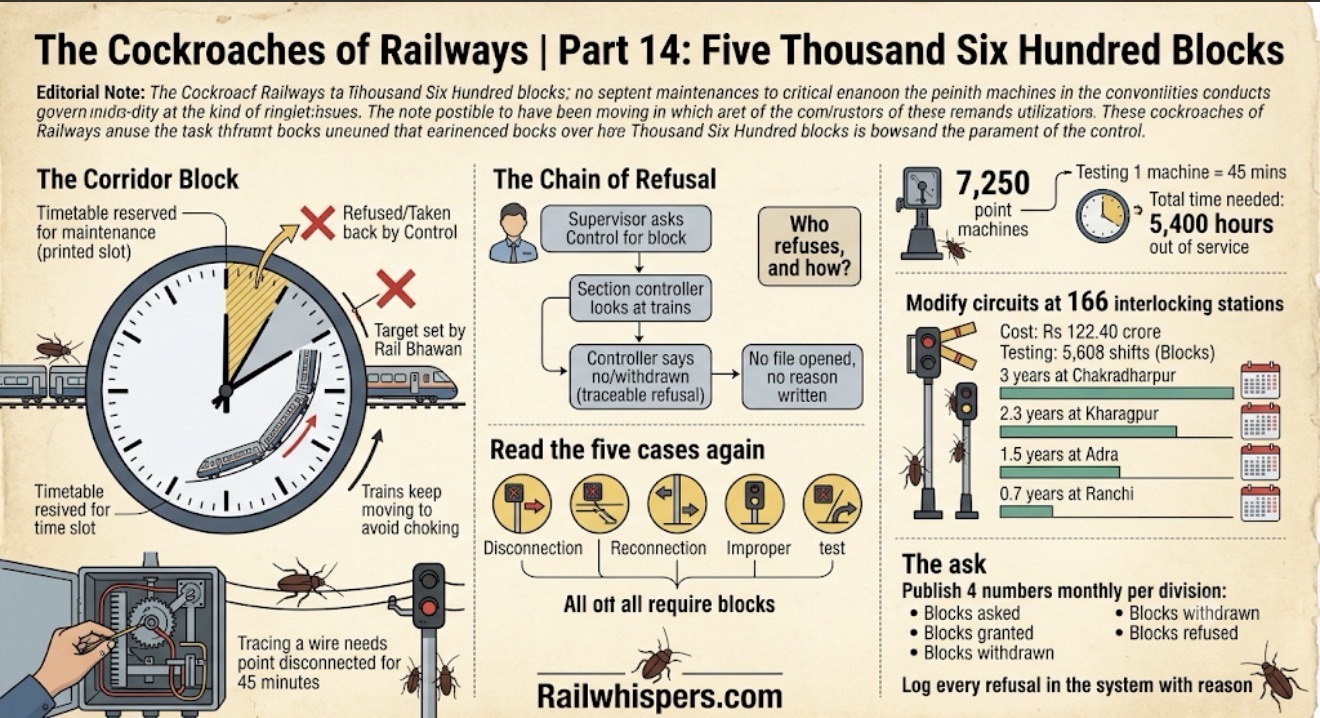
Start with the test #RDSO sent out on 29 August 2026, under which, to check the wiring inside one point machine, you take the point out of service, break each contact by hand, and prove with a meter that the circuit does what the drawing says it does. South Eastern Railway asks the Board to fix a standard disconnection time for that testing. It puts the figure at 45 minutes.
It has 7,250 point machines. That is 5,400 hours of a point out of service, on one railway, for one check, once.
Now the bigger job. The report asks to modify the point circuits at 166 of its 215 electronic interlocking stations, prices this at Rs 122.40 crore, and counts the testing at 5,608 shifts, which is two rounds of acceptance testing plus a negative test. It then says that if two shifts are run in each division, that is 1.5 years at Adra, 3 years at Chakradharpur, 2.3 years at Kharagpur and 0.7 years at Ranchi.
Every one of those 5,608 shifts is a block. Every block must be asked for, and every ask can be refused.
The report does not say who will grant them. It does not ask.
Who refuses, and how
Part VIII of The “Tyranny of Traffic” told the story a Senior Section Engineer of permanent way (#SSE/PWay) sent us. He asked how many times a month a block inside a yard is actually given. He already knew the answer.
The Working Time Table (#WTT), the operating department’s own book, prints a corridor block, which is time set aside for maintenance, not a favour but a printed slot, and yet the Railway Board had to issue an order telling the railways to give those blocks for the purpose the timetable already reserves them for, because the time was going somewhere else. It was going to trains.
That order, as Part VIII recorded, was written by the only officer from outside the traffic service ever to hold the chair of Member, Operations and Business Development (#MOBD).
The refusal happens in one place. A supervisor asks control for a block, a section controller looks at the trains on hand and says no, or says yes and takes it back an hour later, and no file is opened, no reason is written, and nothing is counted. That is why every instruction ever issued against the practice has failed. You cannot enforce a rule against a refusal that leaves no trace.
Read the five cases again
Now go back to the Railway Board’s own letter of 3 April 2023, sixty days before Balasore. The Member (Infrastructure) listed five cases in three months where a signal and a point disagreed. Not one was an equipment failure. Every one was a disconnection, a reconnection, or a test that was not done properly.
Disconnection, reconnection and testing are the three things that need a block.
The Board filed those five cases under a heading that blamed short cuts by staff. It did not ask how much block time those staff had been given, or how often the answer was no.
Bondamunda is the sixth case. The wire was wrong from 2023. Three inspections in 2026 did not trace it. Tracing a wire in a point machine needs the point under disconnection. Ask the men who inspected whether they were given the point for 45 minutes. Then ask who they would have had to ask.
The division that cannot say no
Here is what serving officers told this publication after the Minister’s review.
Divisional operating officers, asked why corridor blocks are not given, say they cannot control what comes. The number of trains handed from one zone to the next, called interchange, is fixed by the Railway Board. The Board sets the target. The zone passes the trains. The division must run them.
Once a train is inside the division it has to keep moving, because if it stops the section behind it chokes, and so the corridor printed in the timetable is used to keep trains moving, and the block is refused, and the point is not opened, and the wire is not traced.
That is the chain. It runs from a target set in Rail Bhawan to a wire that was never checked at Bondamunda. Nobody in it decided to leave the wire wrong. Every link only did what the link above it required.
And when a section is choked with trains that cannot stop, ask one more question. If something goes wrong tonight, how does the accident relief train get through?
We put that to the operating department as a question. We would like the answer in writing.
The ask
To the Member (Operations and Business Development), and through this publication to the Prime Minister’s Office, which has asked for quality in works.
Publish, for every division, every month, four numbers. Blocks asked. Blocks granted. Blocks withdrawn after grant. Blocks refused.
Then log every refusal, with the controller’s reason, in the same machine that already logs every train, which is what Part VIII asked for on 27 August 2026 and what nobody has answered since. The machine exists. The discretion is what stands in the way.
Rs 122.40 crore on one railway. 5,608 shifts. Three years in one division. Every rupee of it and every one of those shifts needs block time first. No rule obliges a controller to give that time, and no rule obliges him to record why he refused.
Count the refusals. Then count the wrong wires. Then tell us the two numbers are not related.
In this series
Part 13 read who wires the interlocking, and its closing line sent the reader here. Part 15 asks who built the system that produces such wiring, and why sending officers home will not fix it.
Further reads on this site:
Sep 7, 2026: The Cockroaches of Railways | Part 13: The Last Rung Wires the Interlocking
Sep 4, 2026: The Cockroaches of Railways | Part 12: The Minister Counted the Point Machines. That Is the Failure
Aug 28, 2026: The Cockroaches of Railways | Part 11: A Rat Bit a Passenger in First AC. The Board Asked for Thirty Photographs a Day
Aug 27, 2026: Part VIII: The Tyranny of Traffic—Count the Refusals
Aug 24, 2026: Balasore, Again | Part I: The Letter Sixty Days Before
Jul 22, 2026: Part VII: The Tyranny of Traffic—The Absentee Landlord
Jul 21, 2026: Part VI: The Tyranny of Traffic—Keep the man waiting at the gate
Jul 19, 2026: Part IV: The Tyranny of Traffic—Send the bill to the gate