

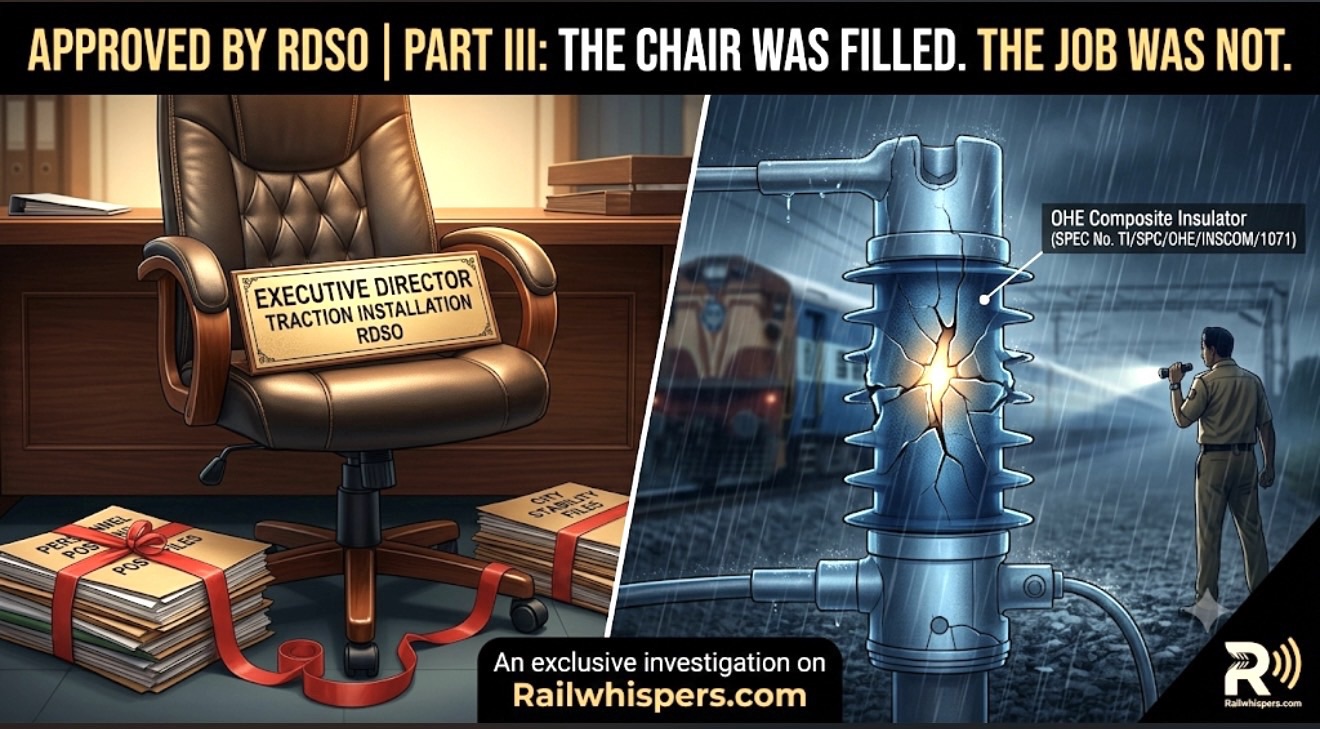
Approved by RDSO | Part III: The Chair Was Filled. The Job Was Not
Part I (30 August 2026, “Crisis Looms Over Railway Electrification: Two-Supplier Dominance in OHE Insulators, Soaring Prices, and Stalled Projects”) asked for technology neutral procurement of overhead equipment insulators. Part II (1 September 2026, “Approved by RDSO | Part II: The Insulator That Does Not Tell You It Has Failed”) answered that the objection to composite is detection and not insulation, and it ended at a chair. This part asks who has been posted to that chair, and prices the answer with a case the Indian Railways lost in the Supreme Court on 8 May 2026.
Editor’s Note: This article is based on whistle blower’s inputs. RDSO and the Railway Board are invited to reply, and any reply will be printed in full.
Part II asked RDSO for three things. The approval, rejection and pendency record of the insulator panel for ten years. An answer on whether toughened glass or coated porcelain has ever been evaluated for overhead equipment. And an account of what was done about the sudden throttling of supply and the spike in cost.
None of the three requires new machinery, and all three require the same thing of one officer, which is to take a view and to sign it.
So the question is who is sitting in that chair.
One chair, and one succession
The Executive Director, Traction Installation, at RDSO owns the specifications against which every railway electrification contract in the country is executed. That is the whole of the job. A contractor bids against those documents, a vendor is approved against them, and a General Manager who wants a relaxation has to be refused against them.
Until recently the chair was held by an officer who had served in railway electrification.
#Ep248: इंसुलेटर: दो कंपनियों के कार्टेलाइजेशन में शामिल RDSO, Railway Board?
He was replaced by an officer whose service is one division and one city: branch officer in that division, then Additional Divisional Railway Manager in the same place, and then Chief Project Manager there for an extended period.
Concede the obvious thing first.
Project experience is real experience, an officer who has strung overhead equipment across a section knows things about it that no specification writer ever learns from a drawing, and construction service is not a lesser service.
But the qualification for that particular chair is not having built overhead equipment.
It is being able to hold a specification decision against a vendor who wants it loosened, against a contractor who wants it waived, and against a zonal railway that wants it read differently this time. And then to have the decision survive after the officer who took it has been transferred.
That is a different capability, acquired over a different career, and it takes about as long to build as the one it replaced.
Ask what the posting was for
This series does not ask who is to blame. It asks who was in a position to prevent something.
So ask what the posting was for.
If a chair is filled because an officer needed to remain in a particular city, then the department has met one requirement that it could see, and accepted a cost that it could not.
The cost is neither abstract nor in the future, because every railway electrification contractor in India works to the documents that chair owns, and the insulator question set out in Part II is sitting on that desk right now. Officers in the field say what they are afraid of: a hurried permission for polymer insulation, granted as relief for a price problem, taking the reliability of the traction distribution network down several notches. Part II sets out why that fear is technically reasonable.
One officer’s convenience is visible. It has a date, a name and a file.
The livelihoods on the other side of that trade have none of those things, which is precisely why the trade is pleading helplessly.
A case won in 2015 and lost in 2026
Anybody who answers that a posting is an internal personnel matter should be handed the following.
On 6 May 2014 the Ministry of Power issued a letter declaring the Indian Railways a deemed distribution licensee. In November 2015 the Central Electricity Regulatory Commission held that the Railways is one. The railway won.
Eight state distribution companies and commissions then appealed to the Appellate Tribunal for Electricity, and five of the eight had already held independently that the Railways is not a deemed licensee. The Tribunal found that the Ministry letter was an administrative direction, that it was not mandatory, and that it therefore decided nothing.
On 8 May 2026 the Supreme Court agreed. The Indian Railways is a consumer.
Read how it was lost, because the pattern is the argument.
The claim rested on a letter, and when the Tribunal removed the letter there was nothing standing behind it. Section 173 of the Electricity Act, under which the Railways Act prevails wherever the two are inconsistent, was the foundation and was never pressed. Sesa Sterlite, decided in 2014, had already set a functionality test: an entity that consumes its own power and supplies no consumers is a consumer. It was three years old when the Tribunal proceedings began and it went unanswered. And the Board’s own two failed attempts to have the Electricity Act amended, in 2014 and again in 2018, both rejected by Parliament’s Standing Committee, were read by the court as the Railways conceding that it was not a licensee.
The file sat in New Delhi throughout. REMCL and the Energy Management Directorate held it. The hearings were in Delhi, the briefs were written in Delhi, and the officers were in Delhi, for ten years.
The money, and both figures are estimates by industry observers rather than any court or Board figure: between Rs 15,000 crore and Rs 20,000 crore of liability that had been avoided, and an additional outgo of upwards of Rs 2,000 crore every year from now.
The second cost is not money at all. The Railways Act stands weaker against state regulatory frameworks today than it did on 7 May 2026, and no budget line records that.
This publication has already named the reason for the defeat, and the reason was not the law.
15 May 2026: “How Indian Railways Switched Off Its Own Power—When Incompetence Represents—The Current Goes Out, Part-1”
That account names the Railway Board, REMCL and the Energy Management Directorate. It names the Delhi posting culture as the reason the work was not done.
This publication goes one step beyond that account, on its own knowledge.
The chairs at #REMCL, at the Railway Board and at #RDSO were filled by the personal convenience of the individual officer, and not by the expertise the role demanded or the competence the file required.
That is a charge, and it is made in the knowledge that no paper the Ministry publishes will prove it. The Establishment Officer’s records would settle it in an afternoon.
Ten years. One file. A succession of officers, each of whom held it for a while and moved on within the same city.
Nobody flashed a red signal, no Commissioner of Railway Safety held an inquiry, there was no accident anywhere to count, and no rule was broken by anyone. A capability decayed inside one directorate, quietly, and the bill arrived in a courtroom twelve years later.
Slow decay does not trip a protection relay
Now notice what makes this pattern survive.
It is the same property that Part II identified in a composite insulator, and it is worth putting the two side by side, because they are the same fault in two materials.
A porcelain insulator that has failed leaves a flash mark, and a man walking the section finds it.
A directorate that has lost its expertise leaves a spreadsheet, filled in on time, with every column complete.
There is no patrol for the second one. Reliability action plans are submitted, reviews are held, and the returns go up on the appointed day. Nothing in that process is capable of detecting that the people filling it can no longer take the decisions the posts exist to take.
Four more places where the same question is open
The insulator is one instance and the electricity case is another. Officers in service put four more on the table, and this publication has documented none of them and is therefore asking rather than asserting.
The Nitrogen Injection Fire Protection System, switchgear, protection relays, and supervisory control and data acquisition.
In each, the same question applies without modification. Who in RDSO can read the vendor’s design and say no to it?
One line deserves separating out, because it is now written into procurement documents across the Indian Railways.
A specification can require cybersecurity in a single sentence. Testing for it requires somebody who can read a protocol trace and knows what should not be in it. With 100% railway network controlled by SCADA, the need to assess trustworthiness of supplier is most acute and critical today.
So which RDSO directorate holds that capability, how many officers in it hold it, and what were they doing before they were posted there?
The government has already settled this argument, in its own favour
There is a contradiction here that the Railway Board should be asked to reconcile, and it is the strongest fact in this part because it is dated, public and not in dispute.
Recruitment of engineers into the Indian Railway Management Service resumed through the Engineering Services Examination from the 2025 examination year. The Department of Personnel and Training approved recruitment to the technical stream through the Engineering Services Examination, and to the non technical stream through the Civil Services Examination. About 225 vacancies across civil, mechanical, electrical, signal and telecommunication and stores were added to the 2025 notification.
The Government reopened engineering recruitment because it concluded that technical work needs engineers, recruited as engineers, and tested as engineers.
Then ask the question that follows from its own decision.
If an engineering qualification matters enough to change a national recruitment system, at what point on the way up does it stop mattering?
What to ask for
Four things, none of which needs a committee, and three of which can be answered from the Establishment Officer’s room.
Publish the qualification the Board requires for each directorate chair at RDSO, and the record of the last three incumbents of each against it.
Publish the minimum tenure prescribed for those chairs, and the tenure actually served in the last five years.
Interview before posting to RDSO, to the Board’s technical directorates, and to senior vigilance positions. This publication has asked for that before.
And one audit that costs nothing at all. For each of the last ten years, list the RDSO directorate chairs in which the incumbent had no prior service in the subject of the directorate.
That last list is either empty, in which case the charge in this part collapses and the Board should say so, or it is not.
A specification is a decision that somebody has to be able to defend.
Ask what the chair was filled for. Then publish the answer.
Part I of this series: 30 August 2026: “Crisis Looms Over Railway Electrification: Two-Supplier Dominance in OHE Insulators, Soaring Prices, and Stalled Projects”
Part II: 1 September 2026: “Approved by RDSO | Part II: The Insulator That Does Not Tell You It Has Failed”