

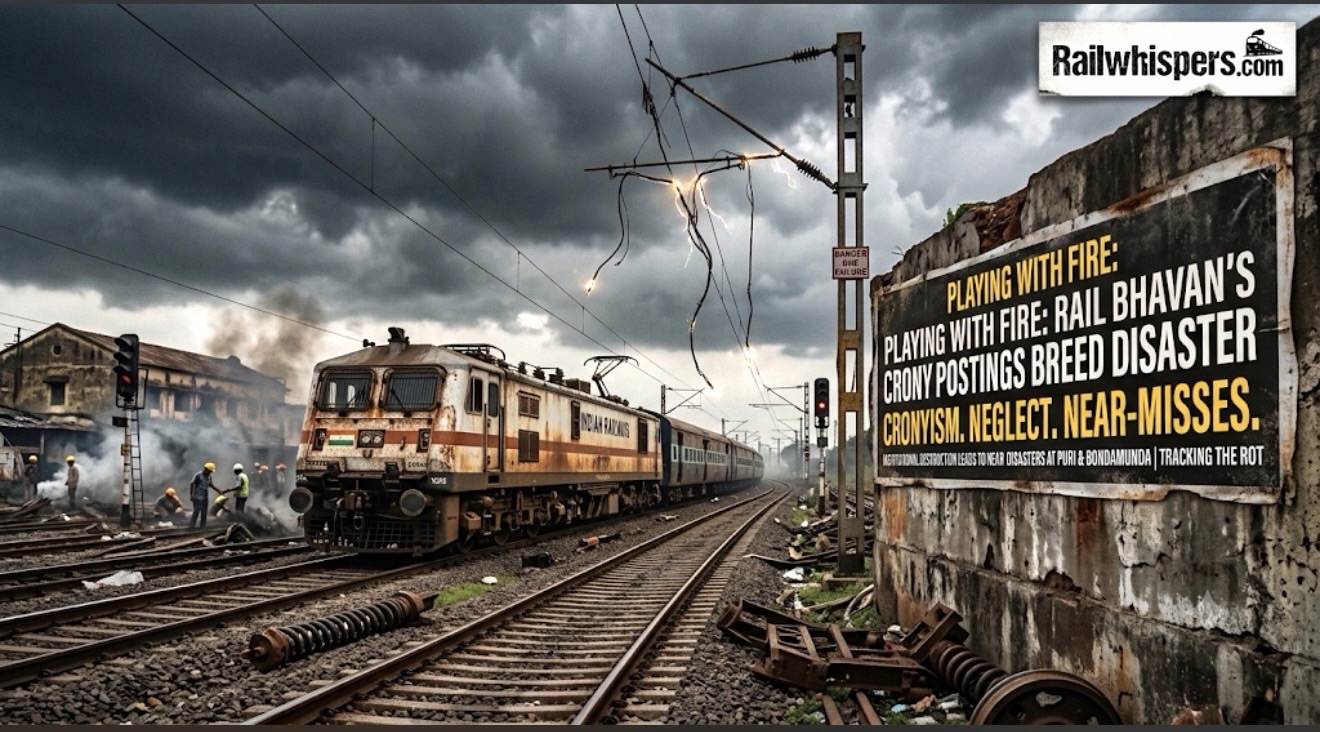
Playing with Fire: How Rail Bhavan’s Crony Postings Breed Disaster
Recent alarming incidents at Puri and Bondamunda carried the chilling potential of another Balasore-scale catastrophe. The fact that a major disaster did not materialize was not due to superior maintenance or robust safety compliance—it was pure, unadulterated luck.
These are not isolated mechanical glitches or scattered operational hiccups. They are the direct, toxic fallout of an administrative rot at the very top: a posting and transfer regime that exists to serve officer convenience and proximity to power, rather than the core technical needs of Indian Railways.
A Litany of Near-Misses, Not Minor Complaints
Consider the catastrophic nature of the failures recorded across these jurisdictions:
- Overhead Equipment (OHE) melted and collapsed onto running tracks and train rakes.
- Train parting incidents occurred in both passenger and freight services.
- Severe brake binding led to jammed wheels in coaches and wagons, triggering fires in brake pads.
- Repeated primary spring failures, Fire and Smoke Detection System (FSDS) issues, and recurring wheel defects.
Every single one of these defects carries the mathematical certainty of a high-speed derailment or fire. This is not a laundry list of routine complaints; it is a catalog of narrow escapes. The margins have worn so thin that safety is now running on borrowed time.
The Breakdown of Rail Bhavan: Two Decades of Inaction
When the Railway Minister is forced to bypass the Railway Board and address General Managers (GMs) and Divisional Railway Managers (DRMs) directly—as witnessed in the high-level meeting on September 3—it is an open admission that the apex body has failed. A Board that must be circumvented has already surrendered its institutional relevance.
The core agenda of that ministerial review reportedly centered around signal interlocking-induced failures at Bondamunda and Puri. The irony is tragic: the Railway Board’s explicit instructions on this very subject date back to 2006, stemming from RDSO recommendations following thorough investigations into serious rail accidents in June 2005.
Two decades have elapsed. For the past decade, budgetary support, capital expenditure, and technological resources have been available in abundance. Yet, twenty years later, the administration is struggling with the exact same fundamental interlocking safeguards. If two decades and record capital outlays cannot execute basic safety guidelines issued in 2006, the failure is institutional, not financial.
The Delhi Orbit: Confusing Proximity with Competence
The rot begins with a culture that equates physical presence in the corridors of New Delhi with professional competence.
A serious audit must ask every Executive Director (ED) and Principal Executive Director: how many consecutive years have they spent within the comfort of Rail Bhavan and the National Capital Region? Proximity to power does not bestow expertise in rolling stock, carriage and wagon maintenance, OHE dynamics, or metallurgy. It merely reflects a mastery of survival in the capital’s corridors.
A deeply entrenched pattern has taken hold: officers maneuver to spend the closing years of their service in Delhi, while DRMs are drawn straight from Rail Bhavan desks only to be pulled right back the moment their tenures end. In bodies like the Railway Board, RDSO, and Production Units—where deep, cutting-edge domain expertise and technical rigor are non-negotiable—mere bureaucratic familiarity with procedural rulebooks is passed off as competence. Subject-matter knowledge has been pushed to the background.
Furthermore, questions must be asked when key policy and posting decisions are steered by apex authorities on the verge of superannuation—such as an outgoing Member (Traction & Rolling Stock) directing postings on the eve of retirement. What accountability remains when those deciding field postings leave office within weeks?
Crippling RDSO and Strangling Domestic Innovation
This compromised system does not merely undermine track-level safety; it suffocates domestic manufacturing and self-reliance.
Key chairs at the Research Designs and Standards Organisation (#RDSO) and the Railway Board are frequently handed out as personal accommodation rather than merit-based assignments.
When unqualified or unmotivated officers occupy technical gatekeeping roles at RDSO, the price is paid by MSMEs and domestic technology firms:
- Critical safety and equipment approvals stall indefinitely.
- Technical specifications drift without engineering justification.
- Proven indigenous products wait years for clearance while favored officers struggle to learn basic domain fundamentals on the job.
The Burden of Choice
These postings are not created in a vacuum by an abstract cadre system. The authority to appoint and retain rests squarely at the highest executive level: the Minister and the Chairman, Railway Board. With that exclusive authority comes undivided responsibility.
The political and bureaucratic leadership must confront an uncomfortable question: are these postings meant to serve the Indian nation and protect its passengers, or is the entire rail apparatus running merely to accommodate a select few?
Every posting file for sensitive technical and administrative chairs must mandate two explicit, auditable notes:
- The objective competence of the officer for the specific assignment.
- The written rationale establishing why this specific officer was chosen over qualified peers.
If postings continue to be governed by personal loyalty, bureaucratic patronage, and capital-city comfort rather than proven subject mastery, the Minister’s emergency virtual conferences will remain an exercise in futility. If this rot is not arrested, the Railway leadership in 2036 and 2046 will find itself convening the exact same review meetings—lamenting the very same avoidable failures, while praying that luck does not finally run out.