

The Defaulter’s Reward — Part-4
The Law Is Available. The Silence Is a Choice
Recap so far: Across three factories the same Howrah firm cheated on steel grade and missed deliveries. It was shielded by silence between factories, by a switched inspection, by the transfer of the official who caught it, and by a portal that still calls it approved. And it kept winning orders.
Read: “The Defaulter’s Reward — Part-1”
Read: “The Defaulter’s Reward — Part-2”
Read: “The Defaulter’s Reward — Part-3”
#Ep221: लोको शेल सप्लाई: पुरस्कृत की जा रही है डिफाल्टर फर्म! #PLW #BLW #CLW #PMO #indianrailways
Everything in the first three parts is, in the railway’s own language, administrative. Notes, orders, transfers, portal entries. But under all of it lies a plain fact. A firm took payment for one grade of steel and supplied a cheaper one, again and again, in a written government contract. That is not an administrative matter. That is the kind of act the criminal law is written for.
To see how the law treats it, put two cases side by side.
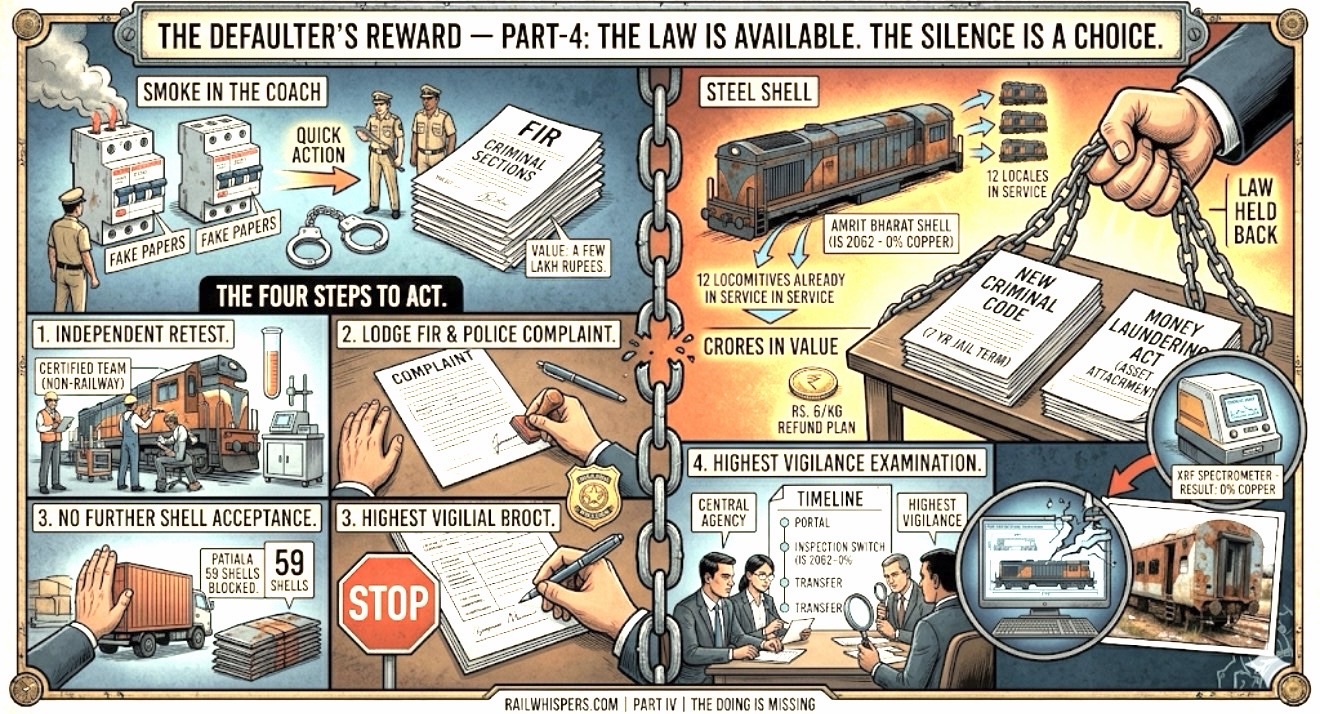
In March 2026, smoke filled a coach on Central Railway. The cause was a faulty protective device that did not trip when it should have. The devices had been supplied by a Kolkata firm with fake test papers. The whole tender was worth only a few lakh rupees. The response was quick. A formal complaint. An FIR. Criminal sections applied. The law moved within weeks. (See: 19 May 2026, “A Rs. 6 Per Kg Exit Clause for a Fraud Worth Crores — Part II“).
Now the second case, the one running through this series. A firm substituted cheap steel for safety grade steel in locomotive shells, across four orders, confirmed by the railway’s own testing, with twelve locomotives already in service and hundreds more shells in the pipeline. The value runs into crores. The response was a plan to recover six rupees a kilogram and close the file. No complaint. No FIR. (See: 11 May 2026, “A Rs. 6 Per Kg Exit Clause for a Fraud Worth Crores“).
Same railway. Same kind of fraud, a firm taking money for one thing and supplying another. One case worth a few lakh draws the police in weeks. The other, worth crores, draws a request for a small refund. The law did not run out for the bigger case. It was held back.
The law that fits this is not in doubt. Under the new criminal code, cheating by deceiving someone into handing over property carries a jail term of up to seven years. Where the same trick is repeated across many factories and many orders, the law on criminal conspiracy also applies. And because cheating of this kind is a listed offence under the money laundering law, the firm’s gains from years of passing off cheap steel can be treated as proceeds of crime and attached. These are not new or untested ideas. They are the ordinary tools the state uses against ordinary fraud. (See: 11 May 2026 and 19 May 2026, the two “Rs. 6 Per Kg” reports cited above.)
The railway’s own senior leadership has said as much. In May 2026, in a recorded safety meeting, the leadership directed that police complaints must be lodged against firms caught supplying spurious goods. That direction was given with the small circuit breaker case in mind. It fits the steel shell case far better, because in the shell case the cheating is proved by the railway’s own machine, not merely suspected. To act on the direction for the small case and ignore it for the large one is to make the direction meaningless. (See: 19 May 2026, “A Rs. 6 Per Kg Exit Clause for a Fraud Worth Crores — Part II“).
It is fair to ask why a passenger should care about steel grades and purchase orders. The answer is in the metal. The copper in CCU grade steel is there to slow down rust. A shell built from plain steel will rust faster, and the weakness will not show on day one. It shows years later, deep in the frame, where no one is looking. What that looks like in the end is not hard to picture. In June 2026, at Ludhiana, an old coach broke into two pieces as its train began to move. It was saved from disaster only because it was still at the platform. The railway’s own letter blamed heavy rust in the load bearing floor and frame, and admitted the fixed checks of those very parts had not been done. (See: 8 June 2026, “A Coach Broke in Two—The Real Crack Is in Rail Bhavan“).
That is the future these shells are being built toward. Not a sudden, dramatic failure, but a slow weakening that arrives, one day, under a moving train. When it does, the response will follow the now familiar pattern: shock, a drive, an inquiry, a circular asking others to be careful. Shock is not a safety system. A circular is not an FIR. (See: 16 June 2026, “Surprise Is Not a Safety System“).
So the close of this series is not a demand for anger. It is a short list of plain steps that the railway can take, and that the public can check on.
First, all twelve locomotives already in service should be retested for steel grade by an outside, accredited agency, not by the same inspection chain that passed the shells in the first place.
Second, a police complaint should be lodged, as the railway’s own leadership has said must be done in such cases.
Third, no further shells should be accepted from this firm at any factory, including the fresh fifty-nine shell order at Patiala, until the retesting and the inquiry are complete.
Fourth, the pattern across the three factories, the orders, the inspection switch, the transfer and the portal entry, should be examined by the railway’s highest vigilance authority together with the central investigating agency, not by the units that took the decisions.
None of this is hard. The evidence already exists. The law already exists. The instruction to act already exists, in the railway’s own words. What is missing is the doing. The railway’s continued silence on this is not a neutral, careful pause. A choice not to act is still a choice. And choices have authors.