

The Defaulter’s Reward — Part-3
How the System Protects the Vendor !
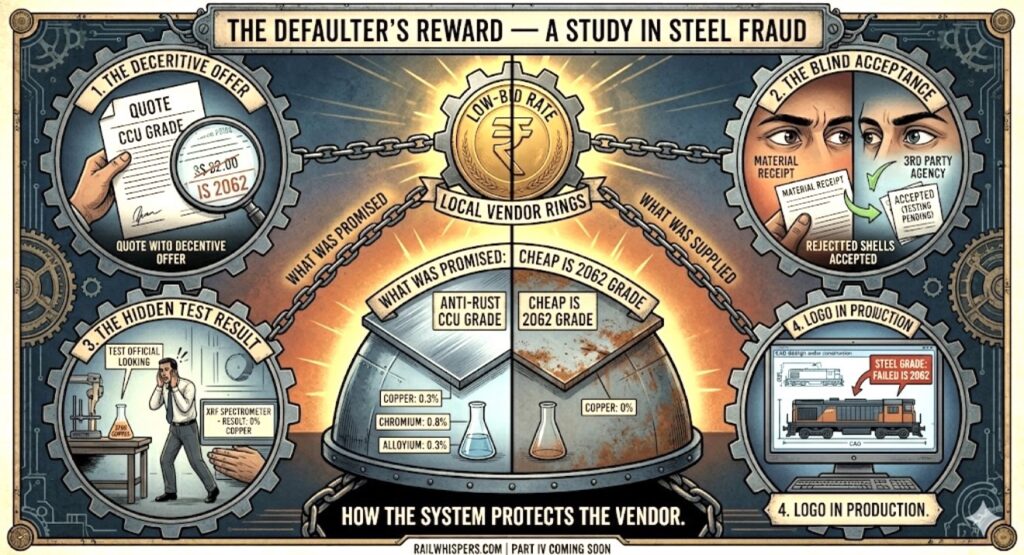
Recap so far: A Howrah firm supplied Amrit Bharat loco shells in cheap IS 2062 steel instead of the required CCU grade, and the railway’s own tests found zero copper. #BLW, Banaras kept 12 such locomotives in service. #PLW, Patiala then handed the same firm a fresh order for 59 shells, days before cancelling an earlier 15 shells order the firm had already failed to supply.
Also Read: “The Defaulter’s Reward — Part-1”
Also Read: “The Defaulter’s Reward — Part-2”
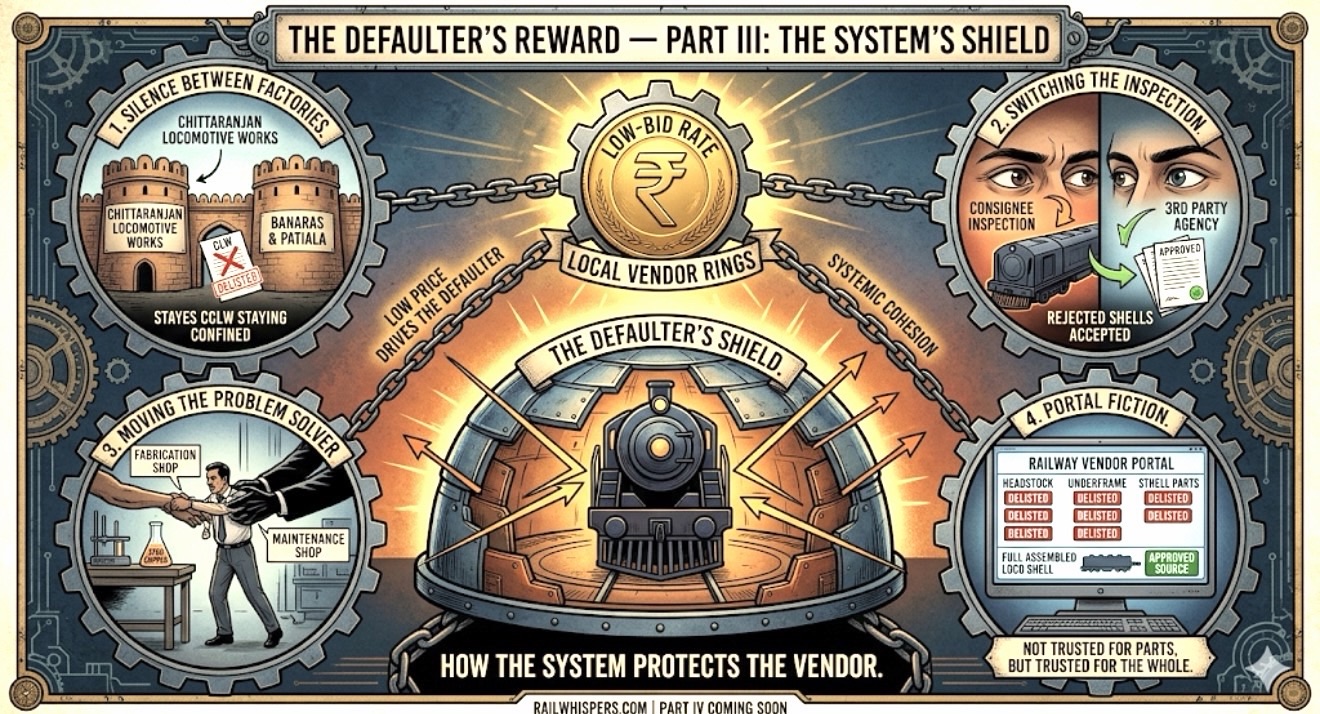
A firm that cheats once and is caught should fall out of the system. This firm was caught more than once, at more than one factory, and stayed in. That does not happen by accident. It happens because the system has parts that, working together, keep the firm in place. There are four such parts. Each looks small on its own. Put together, they form a shield.
- The first part is silence between factories. Chittaranjan Locomotive Works (#CLW) ran a surprise check on the firm and found material that failed the specification. It then struck the firm off its approved list for seven of the eight main parts of a loco shell. But it kept this finding inside its own walls. It did not tell BLW. It did not tell PLW. So when those two factories went on buying from the same firm, they did so blind. The firm knew its own record. The factory that caught it knew. The factories still placing orders did not. A warning that stays inside one office protects no one outside it. (See: 19 May 2026, “A Rs. 6 Per Kg Exit Clause for a Fraud Worth Crores — Part II“).
- The second part is switching the inspection. At BLW, the railway’s own consignee inspection had rejected shells. The papers for that rejection exist. After the rejection, the type of inspection was changed. Consignee inspection was taken out. A third party inspection agency was put in. The same rejected shells then came back into the system with fresh certificates from the new agency, and were accepted. Third party inspection is a normal tool when used honestly. Used this way, it is a method to pass material that the railway’s own staff had already turned down. And it leaves a paper trail that points away from the people who ordered the switch. If a shell fails later, the new certificate will be waved about, the outside agency will be blamed, and the official who changed the rule on already rejected material will say he followed the process. (See: 19 May 2026, “A Rs. 6 Per Kg Exit Clause for a Fraud Worth Crores — Part II“).
- The third part is moving the person who found the problem. The official who led the factory inspection, the one whose team produced the test result showing zero copper, was shifted out of the fabrication shop into another shop. No reason needs to be stated out loud. Every other inspecting officer in the organisation can read the message. Do your job too well, and you may be moved. That is how an organisation teaches its honest staff to look away. (See: 11 May 2026, “A Rs. 6 Per Kg Exit Clause for a Fraud Worth Crores“).
- The fourth part is the portal fiction. The railway’s vendor portal removed the firm from the approved source list for seven of the eight main shell parts. These seven parts carry over 90% of the shell’s weight, and every one of them takes load. Yet the same portal still shows the firm as an approved source for the full assembled shell. So the firm cannot be trusted to make the headstock, the bolster, the underframe, the centre sill, the side walls or the driver cab, but it is trusted to make the whole loco body that is built from those very parts. On paper this passes. In engineering it makes no sense. The portal is treated as the truth, and the portal says approved. (See: 5 June 2026, “Editorial: The Steel That Was Never There“).
Behind these four parts sits the money. The firm wins these orders by quoting low. In open online bidding, rates can be driven down below the level at which honest supply is possible. A rate that is too low to make a CCU grade shell is not a sign of a sharp, efficient firm. It is a sign that the firm never meant to use CCU grade at all. The low price is the first clue, not the prize. (See: 11 May 2026, “A Rs. 6 Per Kg Exit Clause for a Fraud Worth Crores“).
The railway has been warned about exactly this kind of leakage in its own finances. A recent review of railway spending pointed to two opposite faults in tendering. Work is split into small pieces to dodge higher scrutiny, and high value contracts are taken at rates forty to fifty percent below the estimate, which then leads to delay, poor work and costly revised bills. The same review noted that officers who sit too long in procurement and vigilance posts, without rotation, let local vendor rings take root and weaken the checks that are meant to stop them. (See: 25 May 2026, “An Analysis of Structural Imbalances and Fiscal Strain in Indian Railways’ Financial Performance“).
Put the four parts and the money together and the picture is plain. The firm is not slipping through a gap in the rules. It is being carried through, step by step, by choices that people made. Silence was chosen. The inspection switch was chosen. The transfer was chosen. The portal entry was left as it was, by choice.
A shield this neat is not built by one careless clerk. It needs the law to even look at it. Whether the law is being allowed to look is the subject of Part-4. Contd.