

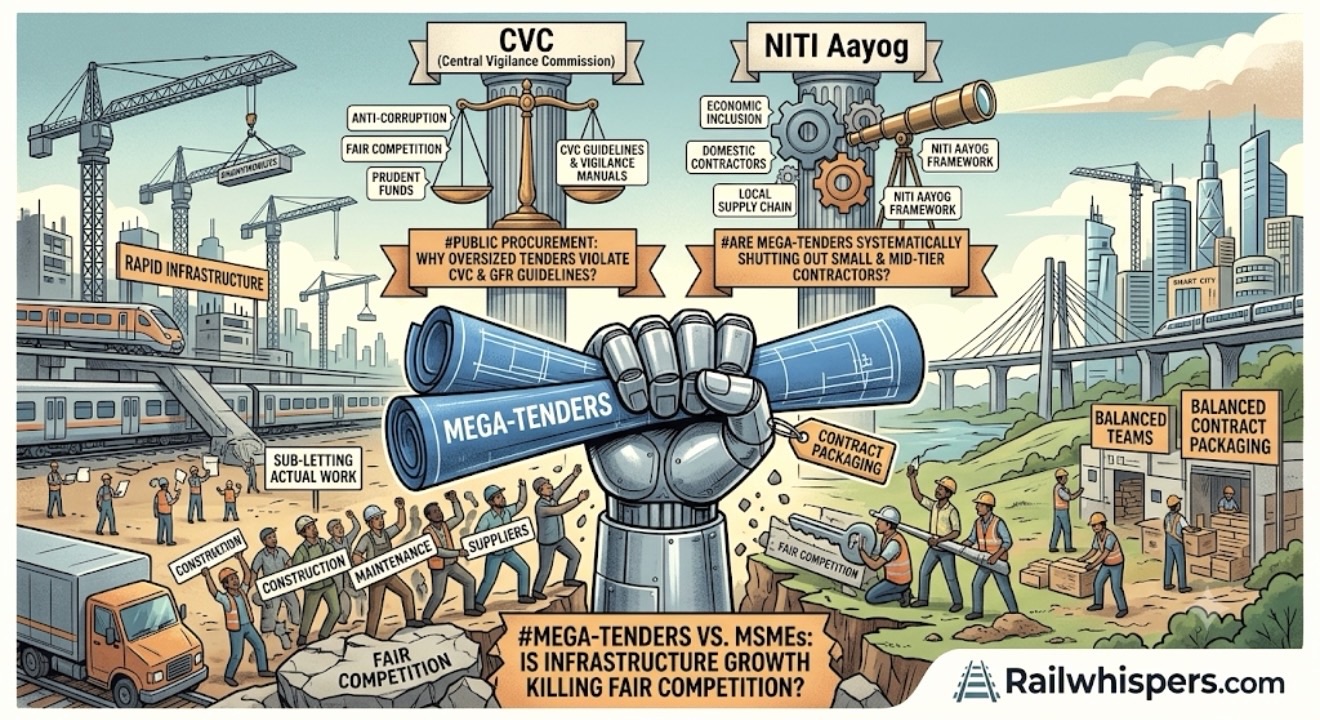
Mega-Tenders vs. MSMEs: Is Infrastructure Growth Killing Fair Competition?
Public Procurement: Why Oversized Tenders Violate CVC and GFR Guidelines?
Mega-Tenders in Public Procurement: The Threat to MSMEs
Are Mega-Tenders Systematically Shutting Out Small and Mid-Tier Contractors?
Contract packaging in public procurement has always been at the center of policy decisions and debates. Amid the rapid infrastructure development in India, massive mega-tenders are continuously being issued in major projects across Indian Railways, the National Highways Authority of India (NHAI), and the Smart Cities Mission. This trend has raised serious questions in the market regarding whether current policies are systematically excluding Micro, Small, and Medium Enterprises (MSMEs) and mid-tier contractors from fair competition.
Clear guidelines from the Central Vigilance Commission (#CVC) and #NITIAayog are available on this matter. The CVC primarily focuses on anti-corruption, fair competition, and the prudent use of public funds. Through its various circulars and vigilance manuals, the Commission has clarified that work should not be artificially bundled or enlarged without a solid technical or administrative justification. When a tender’s scope is made so large that only two or three major corporations in the market meet the eligibility criteria, it fosters monopolistic practices. According to the Commission, pre-qualification requirements—such as annual financial turnover, bank guarantees, and past experience—should be proportionate to the actual scale of work rather than overly restrictive to benefit specific bidders.
On the other hand, NITI Aayog emphasizes balancing infrastructure growth with economic inclusion. Its procurement framework aims to ensure that domestic and local contractors are not pushed out of the national supply chain. While larger contract packages may streamline administrative management, eliminating market competition ultimately inflates total project costs in the long run. Furthermore, it is frequently observed that prime contractors winning mega-tenders end up sub-letting the actual work to smaller local contractors, operating merely as middlemen collecting profit margins.
Under the General Financial Rules (#GFR-2017) and CVC principles, whenever a procuring entity consolidates work into a large package, it must explicitly record the technical necessity, cost-benefit ratio, and market assessment on file. Both the CVC and NITI Aayog share the conclusion that transparency, fair competition, and accountability are paramount in public procurement. While massive contracts may be necessary for highly complex, high-tech projects, optimal and balanced contract packaging should be adopted for standard civil and maintenance works to provide local enterprises a level playing field in national development.