

The Defaulter’s Reward — Part-1
The Same Firm, Three Factories, One Pattern
This is the first of four parts. Together they follow one firm and one question: why did three railway factories keep buying #loco-shells from a particular supplier that had failed them on quality and on delivery?
#IndianRailways builds the #locomotives for its flagship Amrit Bharat Express at Banaras Locomotive Works (#BLW) in Varanasi. The body shell of each locomotive is the frame on which everything else sits. It carries load, heat, and shock every day the train runs. It must last for decades. For that reason the railway does not allow ordinary steel in this shell.
The rule is written down. The shell must be made from #CCU grade steel. This grade has #copper in it, and the copper makes the #steel resist rust. The drawing that fixes this requirement is BLW/DES/MISC/784. It leaves no room for a cheaper substitute.
A #Howrah based firm found a way around the rule. It used IS 2062 grade steel instead. This is plain structural steel. To the eye it looks the same as CCU grade. The difference is the copper, which the eye cannot see. The difference in price is about six rupees a kilogram as fixed by the former PCAO/PLW. On a shell that weighs many tonnes, that small gap adds up to real money.
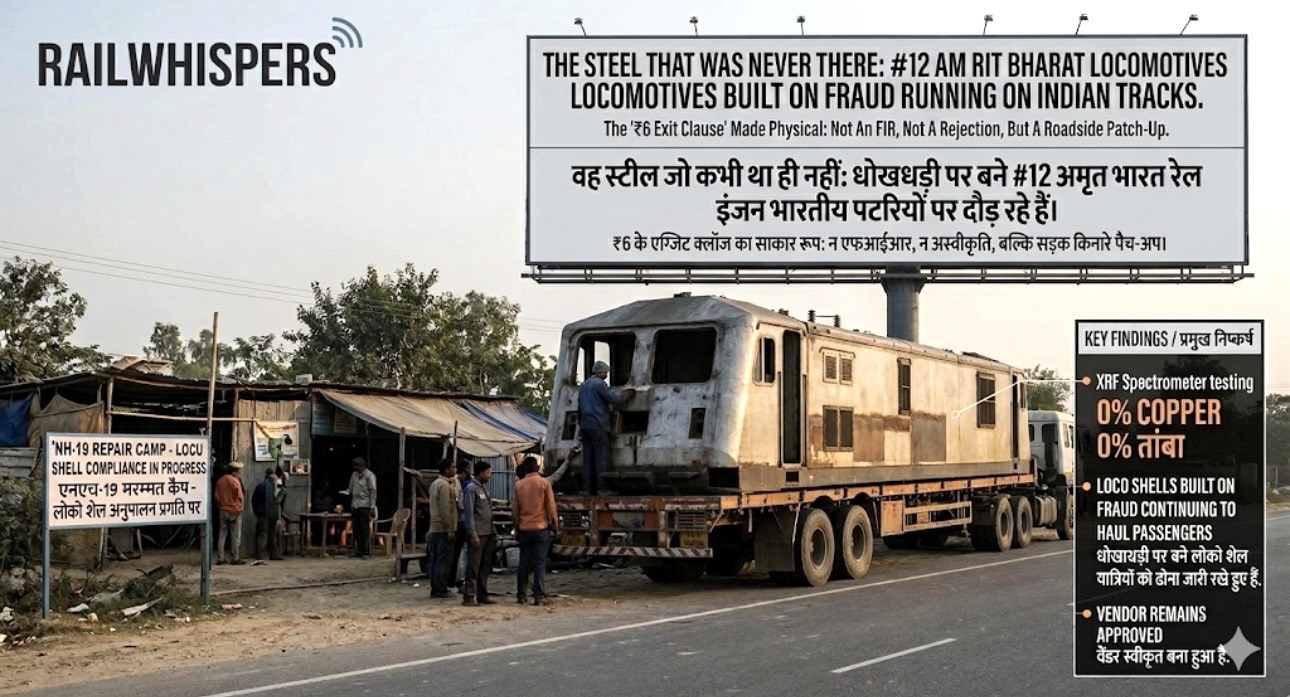
This was not a guess. The railway’s own vigilance team took a handheld XRF machine to the firm’s factory and tested the steel. An XRF machine reads the metal and tells you what is inside it. The reading was the same on every plate and section they checked. Zero copper. Not one sample passed the CCU test. The firm had billed for CCU grade and supplied IS 2062. (See: 11 May 2026, “A Rs.6 Per Kg Exit Clause for a Fraud Worth Crores“).
The swap was not a one time slip. It ran across four purchase orders, from November 2024 to April 2026. By the time the testing was done, twelve locomotives built on these shells had already left the factory. They now work out of sheds at Tughlakabad, Siliguri, New Cooch Behar, and Samastipur. Each shell costs about eighty lakh rupees. Around seven hundred shells are in the supply line, and almost all of them come from this one firm. (See: 5 June 2026, “Editorial: The Steel That Was Never There”).
When this came to light, the response inside the railway was not to reject the firm. It was to recover the price difference of six rupees a kilogram and close the file. In plain words, the plan was to charge the firm the small saving it had made, and let the matter end there. A deliberate swap of #Safety grade steel was being treated as a billing error. (See: 19 May 2026, “A Rs. 6 Per Kg Exit Clause for a Fraud Worth Crores — Part II“).
BLW was not the only factory dealing with this firm. Chittaranjan Locomotive Works (#CLW) ran its own surprise check on the same supplier. It found the same problem: “material that did not meet the specification.” It then removed the firm from the approved list for seven of the eight main parts that make up a loco shell. These seven parts carry more than 90% of the shell’s weight. Every one of them takes load.
Here the record turns strange. The firm was struck off for the headstock, the bolster, the underframe, the centre sill, the side walls, and the driver cab. Yet it stayed approved on the railway’s vendor portal for the full assembled shell. If a firm cannot be trusted to make the spine and the frame of a locomotive, it is hard to see how it can be trusted to make the whole locomotive. On paper, though, it still could. And it still received orders.
There is one more fact that matters. Chittaranjan found the problem and acted on it inside its own walls. It did not pass the warning to BLW, Banaras. It did not pass it to PLW, Patiala. So when other factories placed fresh orders on the same firm, they did so without knowing what had already been found. The firm knew. The factory that caught it knew. The factories still buying did not.
This brings the story to Patiala Locomotive Works (#PLW), and to a short run of dates that forms the heart of this series. PLW Patiala did not just buy from a firm with a hidden record. It placed a fresh and larger order on the firm at a moment when the firm had already failed to deliver an earlier one. And the people taking that decision knew about the failure when they took it.
That sequence, and what it tells us, is the subject of Part-2..