

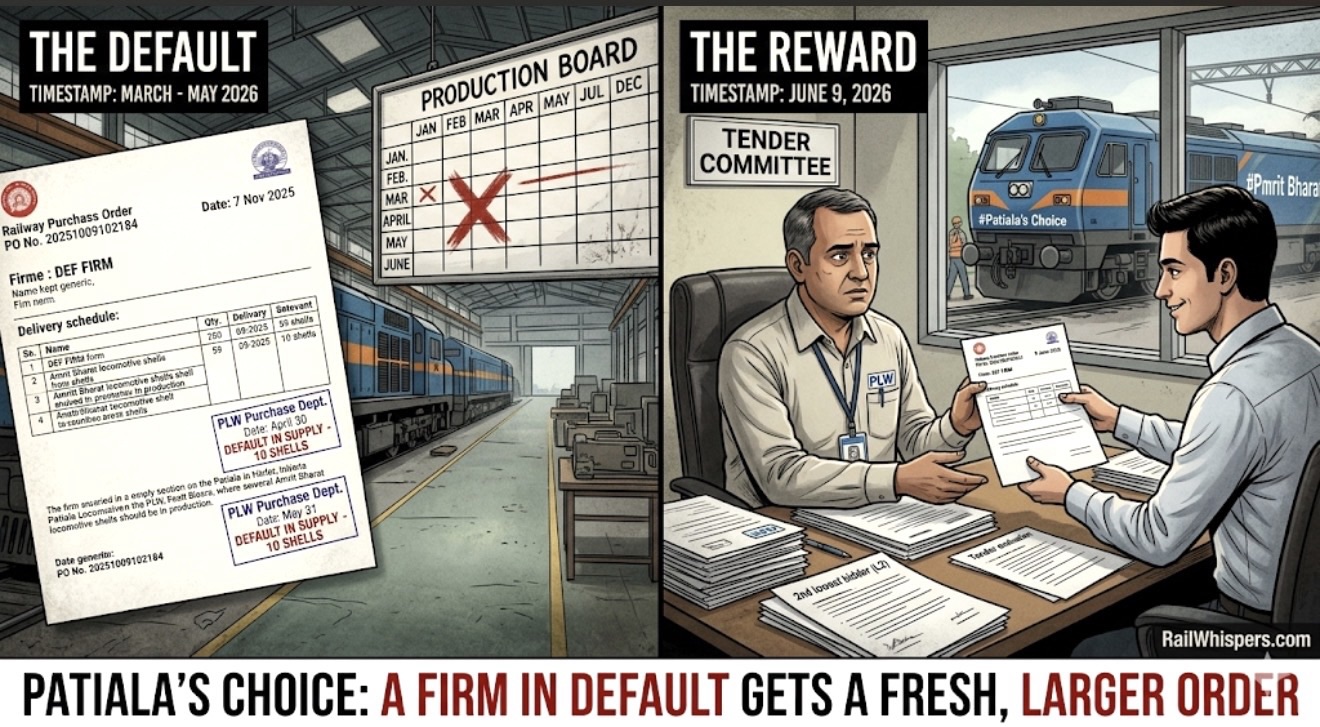
The Defaulter’s Reward — Part-2
Patiala’s Choice: Rewarding a Firm in Default
Recap of “Part-1”: A Howrah firm supplied Amrit Bharat loco shells in cheap IS 2062 steel instead of the required anti-rust CCU grade; the railway’s own XRF tests found zero copper, yet 12 such locomotives already run in service. The factory that caught the problem did not warn the other factories buying from the same firm.
Part-1 showed what the firm did. Part-2 shows what one buyer did next, with its eyes open.
Patiala Locomotive Works (#PLW) is one of the railway’s production units. Like #BLW, Banaras and #CLW, Chittaranjan, it places orders on outside firms for loco shells and parts. The story here does not turn on test reports or copper content. It turns on dates, and on what was known on each date. The dates come from Patiala’s own purchase papers.
Start with the first order. On 7 November 2025, Patiala placed purchase order no. 20251009102184 on the firm for 15 sets of loco shells. The delivery was set to run month by month, starting February 2026. The firm was to supply in small batches, five shells a month.
The firm did not keep to this. For the months of March, April and May 2026, it was due to supply 15 shells in all, five each month. It supplied none of them. By the end of May, the order was running well behind, and the shortfall was hurting Patiala’s own monthly output of locomotives.
Now hold that picture in mind, because the next step is the heart of this article.
While the firm was failing to deliver, Patiala floated a fresh tender for more shells. This tender, no. 20261025, was opened on 4 May 2026. By that day, two of the monthly batches under the old order, March and April, had already fallen due and had not been supplied. That is 10 shells short, on the record, before the new tender was even opened.
The tender ran its course. On 9 June 2026, Patiala placed a fresh purchase order, no. 20261025100852, on the same firm. This new order was for 59 shells. The firm was not even the lowest bidder. It stood second, the L2 firm. Yet it was handed 59 shells, which came to about 37% of the total tender quantity. A firm that had just failed to deliver under a live order was rewarded with a larger new one.
The tender committee that took this decision was aware of the failure. By its own knowledge, the firm had missed the supply schedule of two lots — 10 shells — under the running order. This was not hidden information that surfaced later. It sat in front of the people making the award. They placed the order anyway.
Then comes the last date, and it is the one that gives the whole sequence away.
On 15 June 2026, just six days after the new 59 shell order, Patiala issued a cancellation advice. The advice, no. 002213, cancelled lots one to three of the old order, 15 shells in all. These were the very batches the firm had failed to supply across March, April and May.
Read the order of events slowly, because the order is the point. The firm fails to deliver 15 shells. The buyer knows this. The buyer then gives the same firm a fresh order for 59 shells. Only after that fresh order is safely placed does the buyer cancel the 15 shells the firm had already failed to supply. The reward came first. The penalty, such as it was, came second, and the penalty was only to cancel an order the firm had already chosen not to honour.
A cancellation of undelivered shells is not a punishment. The firm had not made those 15 shells. Cancelling them took nothing away from the firm that the firm had not already withheld on its own. The real decision, the one with money and trust behind it, was the new order for 59 shells. And that decision went the firm’s way.
This is where the second order links back to the wider story told in this series. Railway rules allow a strange thing. When a firm is downgraded or delisted after it has already won an order, it is still allowed to keep supplying under that order, and the railway is still allowed to accept those supplies. Worse, those accepted supplies later become proof of a working record, which the firm can use to win its way back onto the approved list, sometimes under a fresh name. In plain terms, a firm can be punished and rewarded at the same time, and can turn the reward into a clean certificate for the future. (See: 5 June 2026, “Editorial: The Steel That Was Never There“).
Patiala’s sequence fits this pattern exactly. A firm that had failed on delivery, and that had failed on steel grade at sister factories, was kept inside the supply line rather than pushed out of it. Each fresh order it receives is one more line in a record it can later show as proof that it is a reliable, approved source.
So the question for #Patiala is simple and hard at once. On the day the larger order was placed, the firm had already failed to deliver under a smaller one, and the people deciding knew it. What reason of quality, of price, or of public interest can explain handing more work to a firm that had just let the buyer down?
That question does not stand alone. The same firm enjoys a wider shield across the system, built from siloed findings, switched inspections, and a portal that calls a delisted firm approved. How that shield is built is the subject of Part-3. Contd.