

An Analysis of Structural Imbalances and Fiscal Strain in Indian Railways’ Financial Performance
The financial performance of Indian Railways for the opening month of the 2026–27 fiscal year signals an alarming divergence between sluggish revenue inflows and rapidly escalating operational expenditures. A critical review of the data issued by the Railway Board reveals that traffic earnings recorded a marginal, near-static growth of just 1.8% in April 2026.
This minor expansion is severely outpaced by an 11.6% surge in Ordinary Working Expenses (OWE) alongside a 9.1% spike in pension liabilities. Such disproportionate expenditure growth in comparison to stagnant receipts fundamentally threatens the core fiscal mandate of Indian Railways, which requires the network to meet its recurring revenue expenditure directly from its internal resource generation.
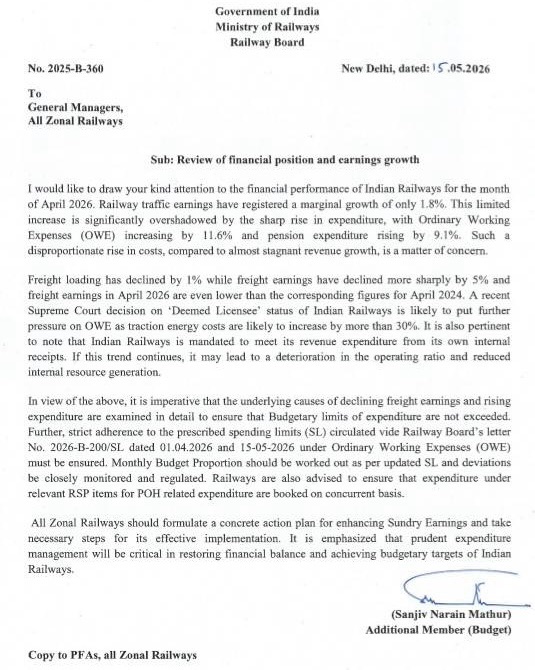
The primary catalyst behind this fiscal strain is a sharp, structural downturn in the freight sector, historically the bedrock of railway profitability. Freight loading volumes fell by 1%, yet freight earnings plummeted by a far more severe 5% compared to the previous year, dropping even below the baseline performance recorded in April 2024. This widening gap between physical volume and actual revenue points to severe tariff erosion, an unfavorable shift in the commodity mix, or competitive pressures that undermine the organization’s pricing power.
Compounding this structural revenue deficit is an impending external shock to the operational cost base: a recent Supreme Court judgment concerning the “Deemed Licensee” status of Indian Railways is projected to drive traction energy costs upward by more than 30%. Because energy is a massive component of OWE, this legal outcome threatens to accelerate the deterioration of the network’s financial stability.
To arrest this slide toward an unsustainable operating ratio and depleted internal capital generation, the administration must pivot toward aggressive expenditure control and revenue diversification. Structural stabilization requires strict enforcement of the newly updated Spending Limits (SL) mandated under the Railway Board’s directives. Zonal railways must systematically calculate their Monthly Budget Proportions and enforce daily fiscal discipline to prevent overruns in ordinary working expenses, while concurrently ensuring that Periodic Overhauling (POH) costs are booked promptly on a concurrent basis against relevant Rolling Stock Programme (RSP) items.
However, long-term fiscal resilience cannot rely solely on austerity. Because core freight revenues are under severe stress, the survival of the network’s financial balance depends heavily on the immediate execution of aggressive zonal action plans to scale up Sundry Earnings through non-fare avenues, commercial land utilization, and secondary revenue streams.
Systemic Drainage: A Critical Assessment of Operational Overruns and Capital Inefficiencies in Indian Railways
The sharp divergence between stagnant revenue and escalating Ordinary Working Expenses (OWE) points toward deeper, systemic vulnerabilities within administrative, procurement, and asset-management frameworks. Rather than being driven purely by external economic shifts, the current fiscal strain is heavily compounded by sub-optimal capital allocation, procedural non-compliance, and leakages across zonal operations. Restoring financial equilibrium requires an unvarnished examination of the structural factors driving these cost overruns.
A visible contributor to escalating project costs is the diversion of funds toward high-end, non-essential aesthetic upgrades. The widespread installation of premium materials like granite and marble on platform surfaces and station walls represents a departure from standard, cost-effective, and durable engineering practices. These choices not only inflate initial procurement budgets but also create long-term maintenance liabilities, draining resources that would be more prudently directed toward core safety infrastructure, track renewals, and operational bottleneck removal.
The integrity of the procurement system is being undermined by distinct anomalies at both ends of the tendering spectrum.
Splitting of Works and Single Tenders: Artificially breaking down comprehensive projects into smaller, fragmented pieces avoids higher-level financial scrutiny and enables the award of works through restrictive single-tender mechanisms. This practice bypasses competitive market forces and frequently results in inflated costs for low-priority or redundant works.
Unviable Under-Bidding: Conversely, the acceptance of high-value contracts at aggressively low rates—falling 40% to 50% below the estimated cost—creates a severe operational hazard. These unviable bids inevitably lead to project delays, compromised execution quality, disputes, and subsequent “revised estimates” that ultimately cost far more than the original valuation, disrupting predictable budgetary planning.
Large-scale capital infusions—about ₹20 lakh crore—are increasingly being directed into high-profile initiatives without rigorous, data-driven feasibility studies. Major capital commitments for projects like station redevelopments, and massive kavach & Video Surveillance Systems (VSS) etc. are frequently sanctioned without robust cost-benefit analyses, resulting in asset creation that does not yield a proportional return in traffic or operational efficiency.
Advanced mechanical assets, including heavy track machines, are regularly procured at high capital costs while existing fleets remain underutilized, poorly maintained, or sidelined due to inadequate block allocations and scheduling. This practice of purchasing new hardware before optimising current inventory reflects an inefficient cycle of asset accumulation over asset management.
A lack of stringent internal controls has allowed routine operational costs to inflate unchecked. Unregulated, frequent administrative inspections and their associated logistical expenses generate a continuous drain on zonal revenue budgets without delivering measurable improvements in safety or performance. Furthermore, the misdirection of both departmental labor and contracted private labor away from their primary operational or maintenance duties severely impacts workforce productivity, forcing dependence on additional outsourced contracts to fulfill core tasks.
At the root of these fiscal leaks is an administrative breakdown in accountability, driven heavily by systemic negligence and a failure to enforce basic anti-collusion safeguards. The widespread stagnation of personnel—where key officers, supervisors, and inspectors remain in sensitive procurement, vigilance, and administrative positions indefinitely without strict rotation—fosters institutional inertia. This lack of rotation compromises objective oversight, facilitates localized vendor cartels, and weakens internal resistance against corrupt practices, directly leading to the inflation of project costs and the dilution of expenditure control.
To arrest this fiscal decline and restore structural integrity to Indian Railways’ finances, the Ministry of Railways and the Railway Board must transition from reactive austerity to systemic, structural reform. Here is an actionable framework for the Railway Minister and the administration to regain control over expenditures and curb operational leakages:
The Ministry of Railways and the top railway administration must urgently transition from reactive austerity to deep structural reforms to arrest the financial decline and restore long-term fiscal discipline across the network. The foundational step in breaking localized interest groups and vendor cartels involves the immediate and uncompromising enforcement of the mandatory officer and staff rotation policy.
The Railway Board must deploy a centralised, automated tracking dashboard to identify and automatically transfer senior officers at the JAG, SAG, and HAG levels, alongside influential supervisors and inspectors, who have overstayed their prescribed tenures in sensitive procurement, vigilance, commercial, and engineering roles. Eliminating these prolonged tenures will instantly weaken institutional inertia and disrupt the cozy relationships that frequently lead to inflated project costs.
Concurrently, the administration must overhaul its procurement frameworks to eliminate the financial leakages caused by both arbitrary contract splitting and predatory under-bidding. The practice of breaking large, cohesive projects into smaller, low-value components simply to bypass higher financial scrutiny and award lucrative single tenders must be strictly prohibited through aggregated, transparent tendering processes.
Furthermore, to address the hazard of contractors bidding forty to fifty percent below the estimated project cost, the ministry must mandate steep, upfront performance bank guarantees. This measure ensures that independent price discovery is maintained and prevents contractors from later compromising on quality or demanding revised estimates that inflate the final cost well beyond the original budget.
Financial discipline must also be injected into asset management and project sanctions by shifting the focus from reckless capital expenditure to optimisation. The Railway Minister should institute an immediate freeze on the procurement of high-value machinery, such as advanced track machines, until zonal railways provide certified utilization logs proving that their existing fleets are operating at full capacity.
Similarly, prestige projects like mega station redevelopments, rolling stock, Kavach and massive video surveillance installations must not receive budgetary sanctions without rigorous, independent cost-benefit analyses. The administration must also ban the use of premium, non-essential materials like marble and granite for platform surfaces, replacing them with standardised, durable, and cost-effective industrial alternatives.
Finally, the daily operational drain on zonal budgets must be plugged by curbing administrative waste and labour misuse. The Railway Board needs to enforce strict expenditure ceilings on official inspections and reduce the size of administrative entourages to minimise unnecessary logistical overheads. Alongside this, surprise biometric and payroll audits must be executed across all divisions to ensure that departmental staff and contracted private laborers are deployed exclusively for their designated operational duties rather than personal or unauthorized tasks. By combining these manpower controls with the mandatory, concurrent booking of periodic overhauling expenses against the rolling stock programme, the ministry can establish real-time financial accountability and successfully restore balance to the operating ratio.