

Editorial: The Steel That Was Never There
12 locomotives built on fraud are running on Indian tracks. The repairs are happening on a highway in Varanasi. Nobody has been arrested
The left hand of Indian Railways did not merely not know what the right hand was doing—it chose not to ask!
If a supplier cannot be trusted to provide the spine, the chassis, the shoulders, and the driving cab of a loco, in what sense is it approved to supply the locomotive?
The rule is not a loophole being exploited by clever vendors. It is a policy choice that systematically blunts every penal instrument the railway possesses!
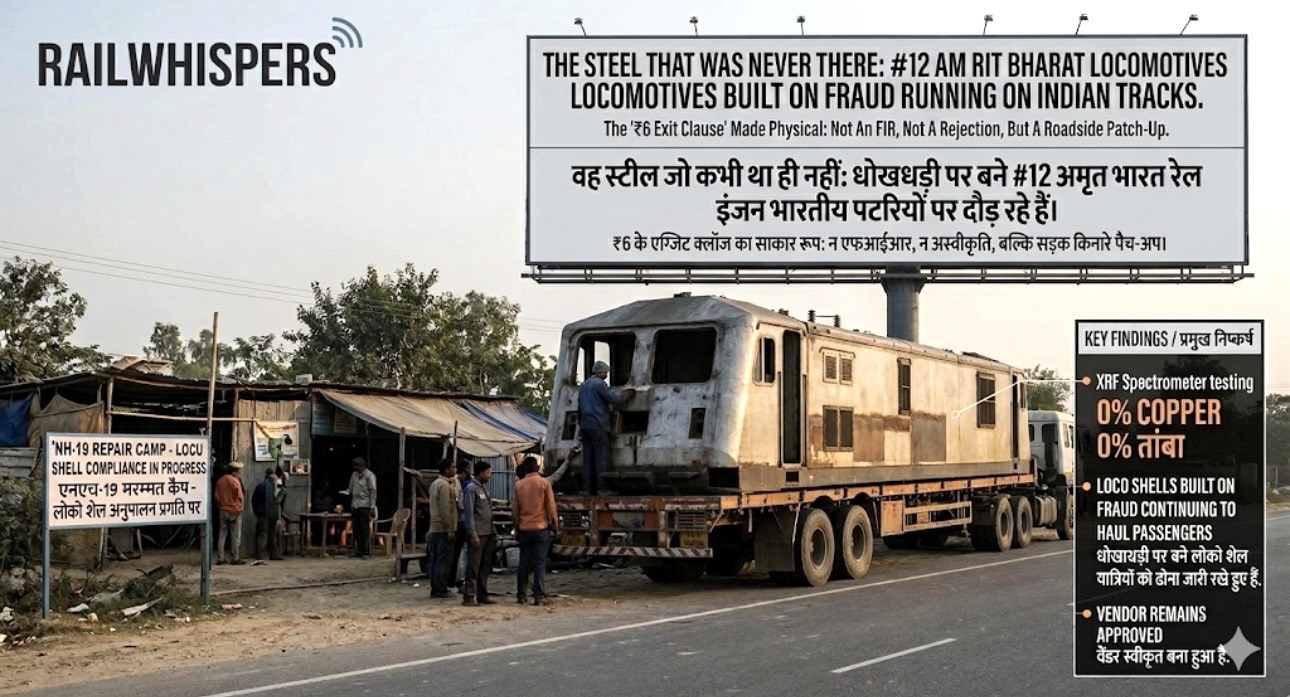
There are trucks parked on NH-19 near Naubatpur on the western edge of Varanasi—the Prime Minister’s own city and constituency—that have been sitting there for the better part of a fortnight. They carry locomotive body shells meant for the Amrit Bharat Express. Security guards man an aluminium gate. Journalists who went to ask questions were turned away. The district administration has said nothing. The railway administration has said nothing.
What is reportedly happening inside that camp is this: “the shells are being repaired. Patched. Brought into compliance—after the fact, on a national highway, in a makeshift enclosure—because the Howrah-based factory that fabricated them is full, and sending the trailers back to Kolkata is apparently inconvenient.”
That detail is not incidental. It is the story.
The #fraud itself is documented with unusual precision. Amrit Bharat locomotive shells are procured under #BLW-specification BLW/DES/MISC/784, which mandates #CCU grade steel—a copper-bearing, anti-corrosion variety essential to a locomotive’s structural integrity over decades of traction, vibration, and thermal stress. Ordinary IS 2062 structural steel looks identical, but it costs approximately six rupees less per kilogram.
Across four successive purchase orders spanning November 2024 to April 2026, a Howrah-based supplier submitted shells fabricated from IS 2062 while billing at rates consistent with CCU grade. This was not uncovered by an audit or a tip-off. BLW’s own vigilance team conducted XRF spectrometer testing at the supplier’s factory and found zero copper content across every structural plate and section tested. Not one sample met specification. The 12 locomotives built from these shells are already in operational service at sheds in Tughlakabad, Siliguri Junction, New Cooch Behar, and Samastipur. Each shell costs approximately ₹80 lakh. There are roughly 700 shells in the current procurement pipeline, overwhelmingly from this single supplier.
The institutional response? Internally, a proposal to recover the cost differential—six rupees per kilogram—as the standard set by the former PCAO/PLW under the guidance of CRB—and close the matter. Externally, the Naubatpur repair camp. But this is not a matter of repair; this is a matter of fabrication. How can they be fabricated at roadside Naubatpur?
This is the “₹6 exit clause” made physical: “not an FIR, not a rejection, but a roadside patch-up that puts the shells back into the acceptance queue while 12 locomotives built on fraudulent material continue to haul passengers.”
Now to the #loophole that makes all of this possible, and the second loophole that ensures it will happen again.
Indian Railways’ #UVAM vendor portal has deleted this #Howrah firm from the “approved source list” for seven of the eight major structural sub-assemblies that constitute a locomotive shell—“the headstock, the bolster, the central underframe, the centre sill, the side walls, and the driver cabs.” These seven components account for over ninety percent of the shell’s structural weight. Every one of them is load-bearing. Every one of them is now struck off.
And yet, the firm remains listed as an “approved Part-I source for Loco Shell Assembly” as a whole—the complete assembled article. It remains eligible for bulk orders. It is receiving them.
Ask yourself what this means in engineering terms. If a supplier cannot be trusted to provide the spine, the chassis, the shoulders, and the driving cab of a locomotive, in what sense is it approved to supply the locomotive? The answer—on paper—is that it is. The UVAM portal says so. And in Indian Railways, the portal is the #procurement-universe. The Chittaranjan Locomotive Works (#CLW) conducted a surprise inspection, found material non-conformance, and removed the vendor from those seven categories—but did not communicate its findings to BLW or PLW. BLW placed fresh orders. The #vendor continued to supply. The left hand of Indian Railways did not merely not know what the right hand was doing—it chose not to ask.
There is a second structural flaw here that has nothing to do with #steel-grades. Under current Railway procurement rules, when a vendor is downgraded or delisted after having already received a purchase order, it is permitted to continue making supplies under that order—and the railway is permitted to accept those supplies. Here is why that matters: “accepted supplies, made after downgrading, become the documented basis for faster re-enlistment. Alternatively, the vendor changes its name, cites the completed supply record, and re-enters the approved list through the front door.” Multiple vendors have successfully neutralized penal action through exactly this route.
The logical incoherence of this rule should be self-evident. “If a vendor has been found wanting on quality, process, and raw materials—found wanting severely enough to be delisted or downgraded—on what basis does the railway continue to accept fresh fabrications from the same factory, operated by the same management, using the same processes, during the period of punishment?” The acceptance of those supplies does not validate them. It extends the fraud and then launders it into a reinstatement credential.
This requires the immediate attention of the Railway Minister and the Railway Board’s Stores directorate. “The rule is not a loophole being exploited by clever vendors. It is a policy choice that systematically blunts every penal instrument the railway possesses.”
On 8 May 2026, the Chairman of the Railway Board told General Managers on camera that police complaints must be lodged against vendors caught supplying spurious items. “In March 2026, a Kolkata firm that supplied counterfeit circuit breakers worth a few lakh rupees received an FIR within weeks. For this fraud—spectrometrically verified, running into hundreds of crores, involving the structural shells of the PM’s flagship train—no complaint has been filed.” The inspector whose team produced the XRF findings was transferred from the Loco Fabrication Shop. The rejected shells were re-certified through a substituted inspection agency and absorbed into service.
After #Railwhispers first published this investigation, the editor received threatening phone calls from someone claiming influence in the Uttar Pradesh government, asking the reporting to stop. The editor offered to tag Chief Minister Yogi Adityanath publicly and note that a person from his administration was protecting a vendor and his liaisoner (dalal) operating in the PM’s constituency. The calls stopped. An apology came. The investigation did not stop.
Varanasi is Narendra Modi’s constituency. BLW is Varanasi’s most significant industrial institution. The Amrit Bharat Express is this government’s most loudly marketed symbol of manufacturing revival. The shells of its locomotives were fabricated from the wrong steel, the repair is happening on a highway outside the factory gates, the vendor remains a Part-I approved source eligible for further orders despite being disqualified from 90% of what it is supplying, and a rule exists that will allow it to use these very supplies as a stepping stone back to full enlistment.
The Railway Board’s silence on all of this is not a neutral administrative posture.
It is a decision. And decisions have authors.
The facts in this column are drawn from XRF spectrometer test reports, formal rejection notices, internal vigilance correspondence, UVAM portal records, and ground reporting in Varanasi, as reported by Railwhispers.com (May 11 and May 19, 2026). Contributed by a senior retired railway officer.
May 11, 2026: “A ₹6 Per Kg Exit Clause for a Fraud Worth Crores”
May 19, 2026: “A ₹6 Per Kg Exit Clause for a Fraud Worth Crores—Part-II—One Law for Thousands, None for Crores”
Institutional Failure: A Deeper Ethical Breakdown
The details of this investigation expose a profound breakdown in institutional ethics, systemic accountability, and public safety safeguards within the Railway administration. This crisis is defined by five core ethical violations:
- Compromising Public Safety for Administrative Convenience: By accepting sub-standard, non-copper-bearing steel (IS\ 2062 instead of CCU grade) for passenger-hauling locomotives, the administration is prioritizing operational speed over long-term structural integrity. This introduces hidden physical risks—such as accelerated corrosion and structural fatigue under dynamic load—that will only manifest years down the line, shifting the ultimate burden of safety onto the traveling public.
- The “Laundering” of Corporate Misconduct: The current procurement policy allows a delisted vendor’s active contracts to continue, creating a perverse ethical cycle. Allowing a punished vendor to build a track record of “successful delivery” using the very processes that got them penalized effectively uses public administration rules to launder corporate fraud into a clean credential.
- Asymmetric Enforcement of Rules: The contrast between the rapid filing of an FIR for low-value counterfeit circuit breakers and the total absence of criminal action for a multi-crore locomotive shell fraud shows a dangerous double standard. It signals that penal consequences within the administration are scaled by political or financial influence rather than the severity of the offense.
- Institutional Retaliation vs. Whistleblower Protection: Punishing the vigilance inspector who uncovered the material non-conformance via an XRF spectrometer by transferring them out of the shop represents a classic, unethical defense mechanism. It penalizes integrity while signaling to other officers that documenting structural corruption is career-limiting.
- Deliberate Compartmentalization (Willful Blindness): The fact that CLW vigilance uncovered the fraud and delisted the vendor for individual sub-assemblies, but did not formally block the vendor at the aggregate level across sister production units (BLW/PLW), shows how bureaucratic silos are maintained intentionally to allow corrupt procurement pipelines to remain open under a veneer of plausible deniability. Contd..