

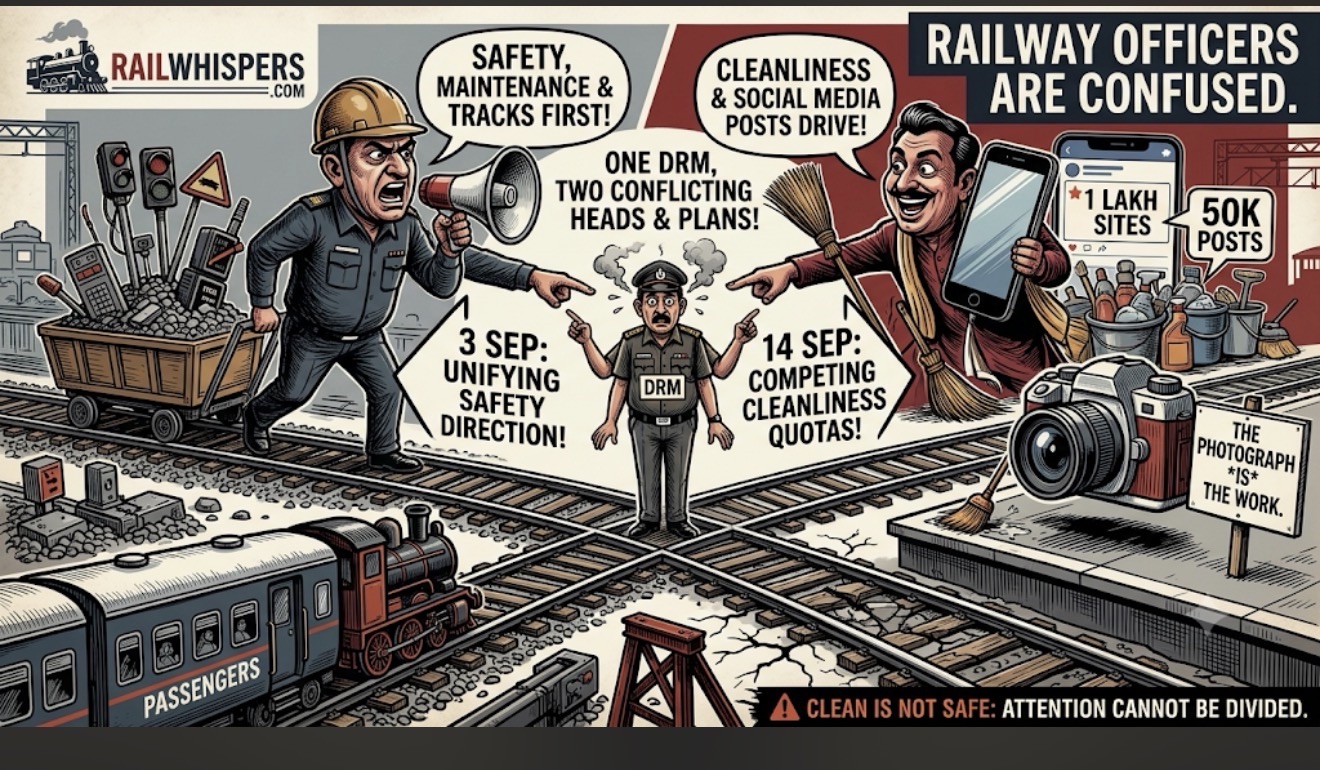
Railway Officers Are Confused
Editorial Note: The accounts of the meetings of 3 September and 14 September 2026 come from serving officers. Where a citation appears in brackets, the claim is tied to a published article or to an original order. Any rebuttal from the Railway Board will be printed in full.
Railway officers are confused. (6 September 2026, “Back to Basics | Part 1: Seventeen Days—Seven Events—Three Reached a Portal”)
On 3 September the Minister took a class of Divisional Railway Managers and General Managers. Two Balasore class events had happened in fifteen days, at Puri and at Bandamunda. (7 September 2026, “The Cockroaches of Railways | Part 13: The Last Rung Wires the Interlocking”) (4 September 2026, “The Cockroaches of Railways | Part 12: The Minister Counted the Point Machines. That Is the Failure”) Removal from service was spoken of, at General Manager and Divisional Railway Manager level.
Yesterday, on 14 September, the Chairman Railway Board took a video conference of Divisional Railway Managers and General Managers on behalf of the EnHM Directorate. The priority of both officers has now been made CTU and the social media campaign on cleanliness. (22 August 2026, “The Cockroaches of Railways | Part 9–Lesson: Swachchhata is Antidote to the Cockroaches”) Last year 85,000 sites were cleaned, this time more than one lakh are to be done. Last year there were 35,000 social media posts, this year there are to be more than 50,000. (28 August 2026, “The Cockroaches of Railways | Part 11: A Rat Bit a Passenger in First AC. The Board Asked for Thirty Photographs a Day!”. It prints letter No. 2025/EnHM/26/02/System Improvement of 25 August 2026, which asks every zone for 25 to 30 photographs a day) The responsibility is the Divisional Railway Manager’s.
The Cabinet Secretary and the Prime Minister were named. Forty per cent of the outcome of these Central Government drives comes from the Ministry of Railways alone.
So what will the top leadership of the railway now be put on? It has been said before that ENHM is nothing but empire building. (9 August 2026, “The Cockroaches of Rail Bhawan | Part 4: Feeding the Cockroaches”) (17 August 2026, “The Cockroaches of Rail Bhawan | Part 6: Read the Passenger List”) (27 July 2025, “The रायता !”) (5 July 2024, “EnHM: Mechanical Engineers have to do cleaning, so why become engineers?”) Its work has to be looked after by commercial, operating, civil engineering, medical and mechanical. (26.09.2018 and 12.10.2018, Office Orders 105 of 2018 and 111 of 2018, No. 2018/O&M/7/10) (03.03.2026, Railway Board letter 2015/EnHM/06/02, the 2025 revision applies at Board level only and field responsibilities are unchanged) (17.10.2025, Office Order 72 of 2025, No. 2025/O&M/7/20, coach cleaning, coach watering, toilet policy and hydrogen trainsets to the EnHM Branch)
So when a Divisional Railway Manager or a General Manager directs operating, civil and mechanical, will the frontline safety of the railway not be affected? (27 August 2026, “Part VIII: The Tyranny of Traffic—Count the Refusals”)
Four rules this breaks
The rest of this piece is this publication’s reasoning. It does not rest on any order. It rests on management doctrine that every officer of the Indian Railways was taught, and that the Railway Board itself teaches at its own academies.
One. One head and one plan
Henri Fayol set down fourteen principles of administration in 1916. This publication has read a Railway Board order against those principles once already, clause by clause. (7 September 2026, “Maximum Government at Rail Bhawan | Part 2: Read the Letter with a 1916 Textbook”) That piece took five of the fourteen. This one needs a sixth.
Unity of direction. Fayol stated it as one head and one plan for every group of activities with the same object.
Read the fortnight against that sentence. On 3 September one head gave the Divisional Railway Manager a plan on signalling, track, rolling stock and suppliers. On 14 September a second head gave the same officer a different plan on cleaning and photographs. Eleven days apart. Same officer. Two plans, two objectives, and no paper anywhere that says which one yields when the two collide.
That is not a busy month. That is a breach of the oldest rule in the book, and it was committed at the top of the organisation, not at the bottom.
Two. Eliminate numerical quotas and exhortations
W. Edwards Deming rebuilt Japanese manufacturing on fourteen points. The number is a coincidence and the two lists are different. Fayol wrote fourteen principles in 1916 and Deming wrote fourteen points seventy years later.
Point ten asks the manager to eliminate slogans, exhortations and targets aimed at the workforce. Point eleven asks the manager to eliminate numerical quotas.
Deming’s reason was not that targets are unkind. His reason was that a quota set above the capability of the system does not raise output. It transfers the shortfall to the man at the bottom, who then meets the number in the only way left to him, which is to produce the appearance of the work.
One lakh sites. Fifty thousand posts. Twenty five to thirty photographs a day from every zone. These are numerical quotas set on men whose day is already full.
Ask the honest question. When a Senior Section Engineer has a quota of photographs and a testing schedule on the same day, which one gets audited by Wednesday?
Three. A measure that becomes a target stops being a measure
Goodhart’s law, in the form in which it is usually quoted, says that when a measure becomes a target it ceases to be a good measure.
The photograph began as evidence of cleaning. It has become the thing that is counted, reported and reviewed at the highest level. This publication showed the mechanism in the Board’s own letter, where paragraph 3 says the objective should not merely be the sharing of photographs and paragraph 4 orders twenty five to thirty of them daily.
So the metric is now the work. A clean platform with no photograph does not exist. A photographed corner of a dirty platform does. Nobody decided this. It is what a target does to a measure, every time, in every organisation.
Four. Attention is the scarce resource, not effort
Herbert Simon, who won the Nobel Prize in Economics, made the point in 1971 that a wealth of information creates a poverty of attention.
The railway does not lack staff hours. It lacks the attention of the man who decides what gets looked at this month. There is exactly one General Manager in a zone and one Divisional Railway Manager in a division. Their attention is the scarcest asset the railway owns, and it is not divisible.
Peter Drucker put the cost of getting this wrong in one sentence. There is nothing so useless, he wrote, as doing efficiently that which should not be done at all.
A hundred thousand sites cleaned to schedule, in the month the monsoon damage waits, is that sentence in operation.
What a wrongly wired point costs
Modi ji, will all the officers and soldiers of your army take their attention off the gun and get down to cleaning inside their cantonment? Give some direction towards balance. Remember, one Balasore will not leave its shadow for decades. (24 August 2026, “Balasore, Again | Part I: The Letter Sixty Days Before”) The damage done to the track in the monsoon has not yet been made good in full, and one month of a drive will take one month away from asset maintenance. It is meaningless to say that everything can be done at the same time. You do not talk on the phone while driving, nor do you encourage anybody to do it.
Railway safety is a very large stone in the foundation of a developed India. Do not forget it. A railway leadership busy with a broom and with social media may take the lives of the poor. Just now, on North Western Railway, a passenger waiting on a platform for his train was killed when an angle fell on his head. This station is said to be quite clean, and the Minister of Railways himself gave the former General Manager here a certificate from several platforms that he was the best General Manager.
Clean is not the same as safe. A platform can shine and the iron above it can still come down.
Further reads on this site, newest first
- September 7, 2026, Maximum Government at Rail Bhawan | Part 2: Read the Letter with a 1916 Textbook (1916 की किताब लेकर पत्र पढ़िए)
- September 7, 2026, The Cockroaches of Railways | Part 13: The Last Rung Wires the Interlocking (आखिरी पायदान ही इंटरलॉकिंग की वायरिंग करता है)
- September 6, 2026, Back to Basics | Part 1: Seventeen Days—Seven Events—Three Reached a Portal (सत्रह दिन, सात घटनाएँ, तीन पोर्टल तक पहुँचीं)
- September 4, 2026, The Cockroaches of Railways | Part 12: The Minister Counted the Point Machines. That Is the Failure (मंत्री ने प्वाइंट मशीनें गिनीं, विफलता यही है)
- August 28, 2026, The Cockroaches of Railways | Part 11: A Rat Bit a Passenger in First AC. The Board Asked for Thirty Photographs a Day (फर्स्ट एसी में चूहे ने यात्री को काटा, बोर्ड ने रोज तीस फ़ोटो माँगे)
- August 27, 2026, Part VIII: The Tyranny of Traffic—Count the Refusals (इनकार गिनिए)
- August 24, 2026, Balasore, Again | Part I: The Letter Sixty Days Before (साठ दिन पहले लिखा गया पत्र)
- August 22, 2026, The Cockroaches of Railways | Part 9–Lesson: Swachchhata is Antidote to the Cockroaches (स्वच्छता ही इलाज है)
- August 17, 2026, The Cockroaches of Rail Bhawan | Part 6: Read the Passenger List (यात्री सूची पढ़िए)
- August 9, 2026, The Cockroaches of Rail Bhawan | Part 4: Feeding the Cockroaches (कॉकरोच को खुराक)
- July 27, 2025, The रायता !
- July 5, 2024, EnHM: Mechanical Engineers have to do cleaning, so why become engineers? (यांत्रिक इंजीनियर को सफ़ाई करनी है, तो इंजीनियर क्यों बनें?)
Orders and letters, newest first
- 03.03.2026, Railway Board letter 2015/EnHM/06/02, signed by the Director EnHM. The 2025 revision applies at Board level only and “does not supersede or alter the existing field-level responsibilities of all departments including Traffic Commercial department”.
- 17.10.2025, Office Order 72 of 2025, No. 2025/O&M/7/20. Cleanliness of coaches in service, coach watering and coaching toilet policy move from the Mechanical Engineering (Coaching) Branch to the EnHM Branch. Clause 2 gives the same branch hydrogen trainsets.
- 12.10.2018, Office Order 111 of 2018, No. 2018/O&M/7/10. It substitutes the footnote to item 1.
- 26.09.2018, Office Order 105 of 2018, on the same number. The revised duty list of EnHM.
Management sources named in the text
- Henri Fayol, Administration Industrielle et Générale, 1916, English translation by Constance Storrs, 1949. The fourteen principles. This publication used five of them on 7 September 2026, in Maximum Government at Rail Bhawan Part 2.
- W. Edwards Deming, Out of the Crisis, 1986. The fourteen points. Points 10 and 11.
- Goodhart’s law, 1975, in the form given by Marilyn Strathern in 1997.
- Herbert A. Simon, 1971, on attention and information.
- Peter F. Drucker, on efficiency against effectiveness.