

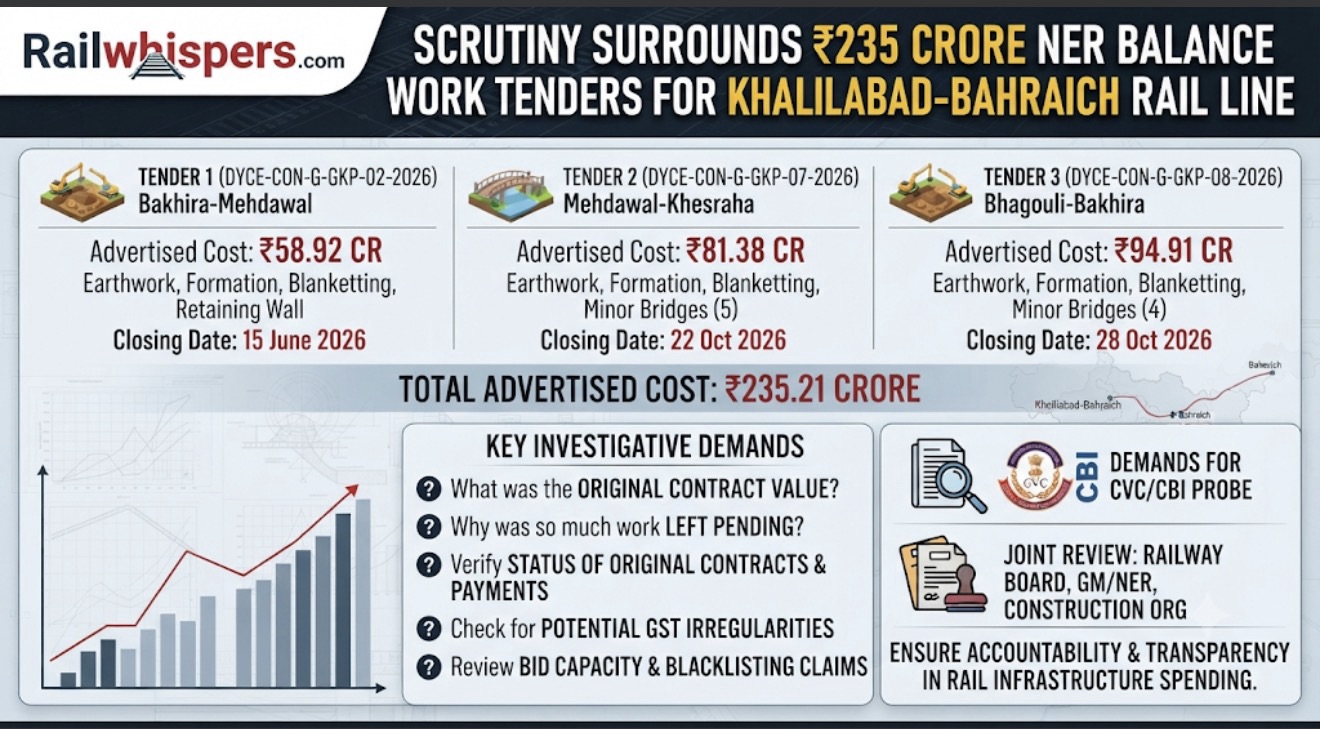
The ₹235 Crore NER Balance Work Tender Controversy
Public money belongs to the public—its protection and accountability must be ensured
Over ₹235 Crore ‘Balance Work’ Tenders in North Eastern Railway Under Scrutiny; Demand Grows for Probe into Original Contracts, GST Compliance, and Bid Capacity
Continuing from the previous issue—
The biggest question is: if contracts for these sections of the Khalilabad–Bahraich new rail line project had already been awarded earlier, what led to the necessity of ‘balance work’ tenders exceeding ₹235 crore now? Were there technical changes, land or design constraints, contractor failures, or deficiencies in contract management behind this? A fair investigation into all these possibilities is imperative.
Ensuring transparency and accountability in railway projects built with public funds is the primary responsibility of the railway administration.
An independent audit of all related records—ranging from the original contracts to the new balance works—must be conducted. Potential financial irregularities should be verified based on documents, and if violations of rules or losses to the exchequer are established at any level, strict action must be taken against the responsible individuals and companies in accordance with the law.
Investigation into the movable and immovable properties of responsible railway officials and their family members must also be made mandatory!
In the context of the three balance work tenders worth over ₹235 crore for the Khalilabad–Bahraich new rail line project, it is essential to determine which officials made the decisions, who granted approvals, who has approved, and under whose guidance and supervision the works were evaluated and payments were processed from the original contracts down to the new tenders.
We urge the CVC and the CBI to examine not only the roles of the officials concerned but also their known income, declared assets, actual properties, and known sources of income within the scope of the investigation. Wherever documentary evidence or indications of transactions are found, the movable and immovable properties as well as financial transactions held in the names of spouses, children, parents, siblings, brothers-in-law (Sala), sisters-in-law (sali), brothers-in-law (jija), and all other related persons should also be probed as per the law.
The objective of the investigation should not be to harass any innocent relatives, but to ascertain whether funds acquired through the misuse of public office were concealed via relatives, benami properties, companies, or other mediums. No individual should be held guilty solely on the basis of familial relation; action must be founded on concrete evidence.
The probe should also review original contract costs, termination approvals, calculation of balance works, chainage-wise level books, measurement books (MBs), GST-related records, bid capacity, and payments. If any financial irregularities occurred in these works, accountability must be fixed for the decision-making officials.
Experts suggest that the railway administration clarify the roles of the officers concerned and that competent investigative agencies conduct an impartial probe into disproportionate assets and potential benami transactions. Public money belongs to the public—its protection and accountability must be ensured.
Demand to Halt Payments Until Reconciliation of Slips for Earthwork, Blanketing, Ballast, Stone Chips, and Sand
In the Khalilabad–Bahraich new broad-gauge rail line project, the most critical issue pertains to the actual supply of construction materials and their payments. Has the actual quantity of earth, blanketing material, ballast, stone chips, and sand that reached the site and was utilized in the work truly matched the quantities shown on paper?
It is demanded that payments to the contractors for the respective works be reviewed, and disputed or suspicious items be withheld until the documentary reconciliation of material supply and quantities is completed. This should include cross-checking every truck’s supply slip, mining challan, royalty receipt, weighbridge (dharmkanta) slip, vehicle number, weight ticket, site receipt record, and measurement book (MB).
It must also be verified whether the quantity for which payment has been claimed aligns with actual supply, approved sources, applicable technical standards, and the work quantities recorded at the site. It should be checked whether the slip of the same truck was reused, whether minerals were extracted without paying royalties, or whether a discrepancy exists between the material shown on paper and the actual construction volume.
The accountability of the CAO/C/NER who has given approval and the concerned Chief Engineer must also be fixed. The records of actions taken by the officials under their supervision regarding the verification of material quality, quantity, source, royalty, measurement books, and payments should be inspected. If negligence, erroneous certification, or rule violations are established at any level, strict action against the responsible officials and contractors must be ensured.
Rather than unnecessarily halting payments for all undisputed and certified works until the investigation is concluded, disputed items and suspicious payouts should be withheld as per the rules. This will protect public funds while safeguarding the rights of contractors entitled to legitimate payments.
It is urged that the Railway Board, the General Manager of North Eastern Railway, the Vigilance Department, and, if necessary, the CVC conduct an independent audit of the material records of all contractors associated with this project.
A Direct Question: Can every single truck slip, royalty, mining record, weighbridge record, and site measurement of the earth, blanketing, ballast, stone chips, and sand shown as supplied be cross-checked and reconciled?